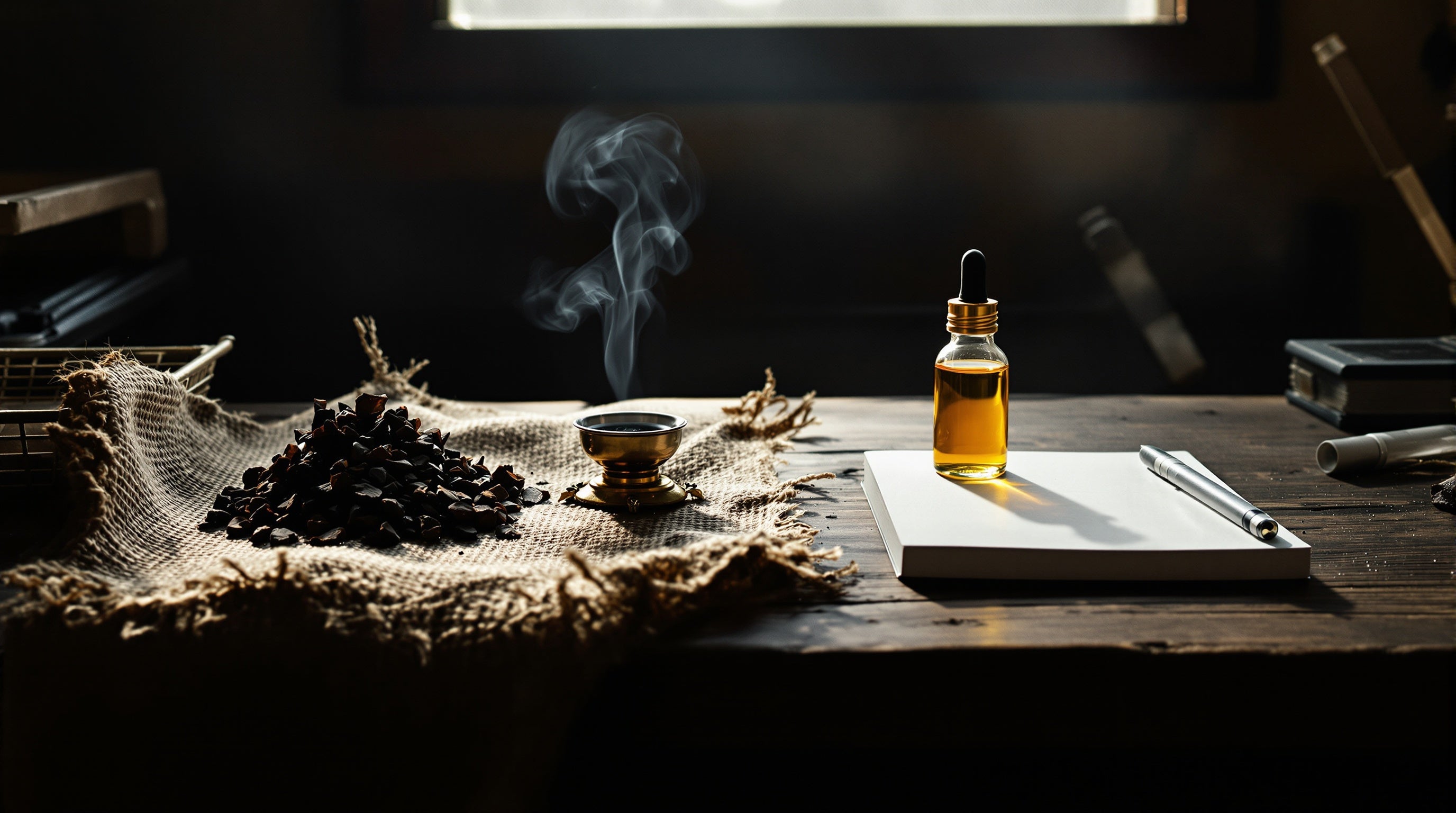
Real Oud vs Synthetic Oud: How to Tell the Difference
The word "oud" sits on more bottles every year, yet very few of them contain the material itself. Understanding real vs synthetic oud is the single most useful thing a fragrance lover can carry into a boutique, because the gap between genuine distilled agarwood and a clever synthetic oud accord is enormous in cost, in character, and in the way each one moves on the skin. This guide explains what real oud actually is, why it commands some of the highest prices in perfumery, how to tell it from a stylised oud, and why both have a place. Throughout, we point only to oud fragrances we stock as decants, so you can test the theory on your own wrist.
What real oud actually is
Real oud, also written oudh and known across the trade as agarwood, is not a wood you can simply cut and distil. A healthy Aquilaria tree is odourless. The fragrant resin appears only when the heartwood is wounded and then colonised by specific fungi (Phialophora parasitica and Fusarium species among them), at which point the tree floods the injured tissue with a dark, protective resin. That resin-saturated heartwood is agarwood. In the wild, only a small fraction of Aquilaria trees, by most estimates around seven to ten percent, ever develop it naturally, and the finest resin can take decades to mature.
To turn that wood into perfume, distillers soak and often ferment the chipped heartwood, then run it through steam or hydro-distillation to capture the oud oil (dehn al oud). Yields are tiny. Figures cited across the industry put average extraction at roughly 0.1 to 0.6 percent, so it can take many kilograms of resinous wood to produce a few millilitres of oil. The trees are protected too: all Aquilaria species sit on CITES Appendix II, and the best old-growth sources have been heavily depleted by illegal logging.
Put those facts together and the price makes sense. High-grade oud oil is one of the most expensive natural materials on earth, with the rarest kyara and kinam-grade distillations quoted at figures that can approach a thousand US dollars per gram. A genuine oud composition is therefore never cheap, and a twenty dollar "oud" almost by definition is not built on the real thing.
How real oud smells: movement, not a single note
The signature of authentic oud is movement. Trace compounds such as indole and p-cresol give many distillations a deep animalic or barnyard edge on first contact, a raw, almost feral note that can read as challenging for the first half hour. Give it time. As the volatile top molecules burn off, real oud unfolds into smoke, leather, resin, balsam, and a warm sweetness that sits close to the skin for hours. It is layered, it shifts, and no two distillations from different regions smell quite alike.
You can experience this clearly in the work of Ensar Oud, the artisan agarwood house whose founder hand-distils his own single-origin oud and musk oils and is widely regarded as one of the most exacting oud producers in the world. Our Ensar Oud decants are about as close to pure, oil-based agarwood perfumery as the market offers.
Ensar Oud - Oud Sultani: Kannan Koh is the clearest demonstration of what real agarwood does. Ensar Oud lists each full bottle as carrying 7.75 grams of oud, including 1.5 grams of the rare Kannan Koh grade alongside seven other aged ouds. On skin it asserts itself with resinous force, a dark barnyard warmth edged by raw agarwood smoke and the rooty, medicinal pull of spikenard. This is the archaic, animalic register that synthetics cannot reach.

Ensar Oud - Kyara de Kalbar shows the other face of real oud: refinement rather than ferocity. Three Bornean ouds anchor it, with kyara, the rarest grade, at the centre, resinous and cool, threaded through wild fig, orris, and a bruised-fruit opening of black grape and persimmon. Each oud reads distinct, settling into a meditative drydown that sits cool against the skin. Kyara is among the costliest raw materials in all of perfumery, which is precisely why a decant is the sensible way to meet it.

Other artisans work this way too. Lost Tribe - Prince of Persia is built, Lost Tribe says, on a full gram of rare Black Thai Kinam Oud 2011, one of the most prized aromatics in perfumery; its kinam reads earthy, medicinal, and deeply animalic beneath two rose ottos. And Bortnikoff - Oud Maximus comes from Dmitry Bortnikoff, an artisan distiller whose compositions run high in natural content and who uses genuine Indian oud and deer musk; its vast rose heart sits over real oud, birch tar, and civet for a long, animalic drydown. These are real-oud-forward fragrances in the truest sense.

What synthetic oud is, and why it exists
Most mainstream and commercial "oud" fragrances do not contain meaningful amounts of distilled agarwood. Instead they use a synthetic oud accord. There is no single molecule called oud; an accord is a recipe, often five to fifteen aromachemicals calibrated to evoke the direction of real agarwood. Familiar building blocks include woody-leathery captives and ambery-woody molecules such as Iso E Super, sometimes extended with natural cypriol oil (nagarmotha), which shares a few chemical markers with the real thing.
The reasons synthetics dominate are practical, and worth respecting rather than dismissing. Cost is the obvious one: where wild oud oil can run from many thousands to tens of thousands of dollars per kilogram, synthetic accords sit in the low hundreds. Sustainability matters too, given the CITES-protected, over-logged status of wild Aquilaria. So does consistency, because a lab accord smells identical batch after batch while a natural distillation never does. Compliance plays a part as well, since a controlled synthetic blend is easier to keep within fragrance safety and labelling standards. A good synthetic oud is clean, woody, smoky, and reliably wearable. What it tends to lack is the depth and hour-by-hour evolution of the genuine article, often staying comparatively linear from first spray to drydown.
None of this makes synthetic oud "fake" in a pejorative sense; it makes it a different tool, and some of the most loved oud-style fragrances in the world lean on accords and wear beautifully. Louis Vuitton - Ombre Nomade is the great modern example, a dense, smoky, raspberry-and-rose oud best understood as a polished Western interpretation of the genre rather than a pure agarwood distillation, and it is none the worse for it.

Creed - Royal Oud sits at the cleaner, more restrained end of the same idea. Here the oud emerges not as dense smoke but as a lean, polished woodiness, rounded by sandalwood and musk into a dry, skin-close signature. It is elegant and easy to wear in company, the stylised oud done with real craft, and reading it next to Oud Sultani is the fastest education in the difference between an oud accord and oud oil.
How to tell real oud from synthetic oud
You do not need a laboratory. A few habits take you most of the way.
- Watch the first hour. Real oud changes markedly as it opens, often starting rough or barnyard-like and resolving into smoky, resinous, sometimes sweet woods, whereas a synthetic accord usually holds a steadier, cleaner shape throughout.
- Read for three-dimensional movement. Genuine oil feels layered and a little unpredictable, while many accords feel smooth, linear, and uniform from first spray to drydown.
- Check format and price. Real oud tends to live in oil-based attars and small flacons priced to reflect a raw material that runs into the hundreds of dollars per gram, not in a cheap eau de parfum.
- Notice the animalic opening. That faint funk on first contact is often a sign of the real thing, since it comes from natural trace compounds the lab versions tend to scrub away.
Experience real oud, affordably
The catch with real oud has always been the cost of entry. A full bottle of genuine, artisan-distilled agarwood is a serious commitment, both financially and on the skin, and animalic, evolving compositions are exactly what you want to live with before you buy. That is what decants are for. A 2 ml, 5 ml, or 10 ml decant lets you wear true oud across several occasions, learn how your skin reads its barnyard-to-sweet arc, and compare it against a stylised oud accord, all for a fraction of a full flask. Browse our complete oud perfume decants and our Ensar Oud decants to put the difference between real and synthetic oud on your own wrist, shipped worldwide by DHL.
Frequently asked questions
Is Ombre Nomade real oud?
Not in the distilled sense. Louis Vuitton Ombre Nomade is best understood as a polished Western oud built largely on a synthetic oud accord rather than pure agarwood oil. It smells rich, smoky, and raspberry-sweet, but it is an interpretation of the genre rather than dehn al oud, and it wears beautifully on its own terms.
Why does real oud smell like barnyard?
That raw, animalic funk on the opening comes from natural trace compounds such as indole and p-cresol formed as the wounded Aquilaria heartwood resinates. It is a hallmark of genuine distilled agarwood, and it usually softens within the first half hour into smoke, leather, and resin. Synthetic accords tend to scrub this edge away.
How much does real oud oil cost per gram?
It varies enormously by grade and origin, but fine artisan oud oil commonly runs from tens to hundreds of dollars per gram, with the rarest kyara and kinam-grade distillations quoted near a thousand. That is why a genuine oud composition is never cheap, and why a decant is the sensible way to explore it.


Leave a comment
This site is protected by hCaptcha and the hCaptcha Privacy Policy and Terms of Service apply.