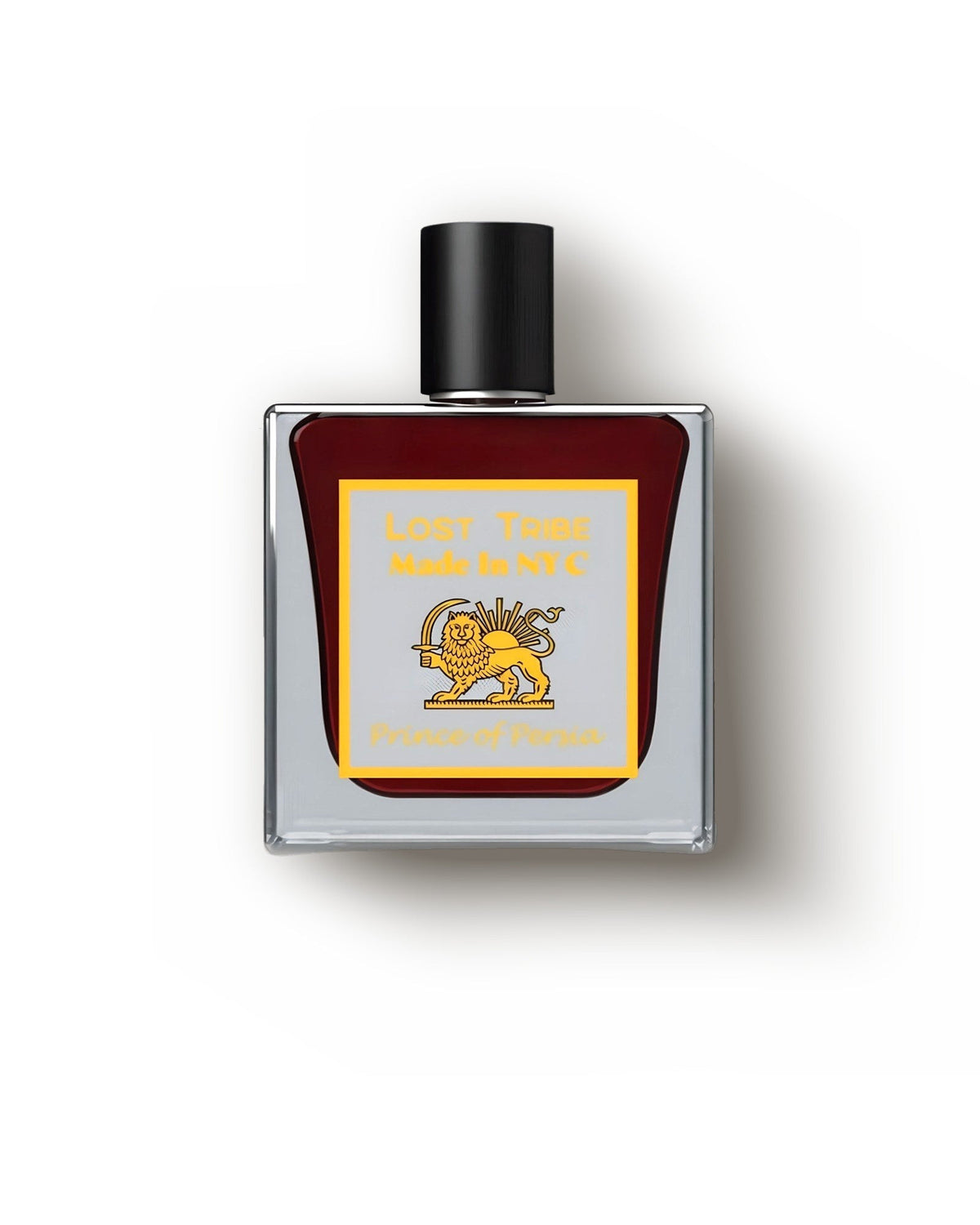
Lost Tribe
Prince of Persia
The Story
Prince of Persia is a tribute to Persian majesty rendered through spice, rose, and oud. At its center sits Black Thai Kinam Oud 2011, one of the rarest aromatics in perfumery, dosed at a full gram per bottle. Two rose ottos define the opening: one rich and wine-like, the other soft and luminous, their contrast giving the composition unusual depth.


Fresh Spicy
Cool bite of cracked pepper
Pink pepper, cardamom and ginger, spice that prickles rather than warms. It fizzes near the top of a fragrance, dry and faceted, closer to crushed peppercorns and a split cardamom pod than to anything simmering in a kitchen. Bright, never comforting.


Woody
Dry grain of cut timber
The smell of cedar shavings, sandalwood, and dry vetiver roots, a sanded, resinous warmth with a faint pencil-box rasp. It feels grounded and composed, the quiet backbone that makes a scent read as serious and lasting.


Floral
A whole garden, never one flower
Not one flower but the impression of many, usually rose, jasmine and orange blossom leaning on each other until no single one is recognizable. Sweet, dewy, faintly powdery, with nectar underneath. It is what people mean when a perfume smells like flowers and they cannot say which.


Rose
Velvet petals, honey and thorn
Dewy and fruity on top, then a jammy, honeyed heart with a green peppery bite underneath. Here the rose is largely the real flower, rose otto or absolute, rather than an accord built from aroma-chemicals.


Citrus
First bright zest of morning
The juicy, rind-snapping brightness of lemon, bergamot, and orange peel, tart and effervescent with a clean bitter edge. It opens a scent with instant lift and sparkle, fresh and energizing, evaporating quickly like sunlight on water.


Powdery
Soft hush of dressed skin
A velvety, slightly dry softness of iris root, violet, and fine talc, like face powder or clean linen warmed by skin. It feels intimate, refined, and nostalgic, blurring a fragrance into a gentle, cushioned haze.


White Pepper
Dry, sneeze-bright heat that snaps awake
What it is
One vine, four peppercorns. Picked green and sun-dried, the berries wrinkle black; left to ripen and soaked until the hull slips off, they come out white. Both are distilled to a thin, terpene-bright oil.
How it smells
Dry, prickly, warm, with the woody sparkle of a mill cranked over a plate. Under the bite sit resin and a clove-like green. Black reads sharper and crackling; white runs more fermented, almost barnyard.
In perfumery
A top-to-heart spice that lifts without sweetening, electrifying woods, vetiver, rose and citrus. The burn never makes it into the bottle: piperine is too heavy to distil, so what you get is the crackle without the sting.
Good to know
Pepper once worked as money. Rents were settled in it, dowries counted out in it, and the hunt for a direct route to the source pushed European ships around the world.


Rose Otto
Dewy sweetness over a green, peppery bite
What it is
Most perfumery rose is one of two: damascena from Bulgaria and Turkey, centifolia from Grasse. Whole blossoms are picked by hand from before sunrise until about ten thirty, then distilled into otto or solvent-extracted into absolute.
How it smells
Fresh, honeyed, green at the edges, with something dewy still on it. Spice and fruit sit underneath, and in the absolute a jammy darkness. Otto opens crisp and bright; absolute is warmer, smokier, closer to skin.
In perfumery
Rose behaves less like one note than a whole palette. It carries a perfume alone or vanishes into a chypre, turns dark against oud and patchouli, goes powdery beside violet, and holds a floral heart together.
Good to know
The two extractions are not the same bargain. Otto takes three to four thousand kilograms of blossoms to yield one kilogram of oil. Absolute, pulled out with solvent, gets there on roughly a seventh of the flowers.


White Rose
The cooler, greener cousin of the damask
What it is
Bulgaria grows two oil roses. Everyone knows the pink damask; the white alba is the other one, an ancient hybrid picked in the same short late-spring window and worked as both otto and absolute.
How it smells
Coolest of the distilled roses: white petals, crushed green stem, a honeyed black-tea edge, a flick of clove bud. Where damask turns jammy, this stays dewy and silvery. A rose smelled before the heat gets to it.
In perfumery
Reach for alba when the rose has to be cold and see-through: white pepper and frankincense beside it, not oud and amber. Among several rose origins its green tea lift rides on top, damask holding the heart.
Good to know
Alba takes roughly twice the blossoms per kilo of oil that damask does, a quiet tell about how a house buys. If Taif or damask reads too rich and wine-like, this is the rose that does not.


Bergamot
Sparkling citrus light with a bitter edge
What it is
Nobody eats bergamot. It is sour, seedy and disappointing, and almost the whole world's supply grows on one strip of Calabrian coast, farmed purely for the oil pressed cold from its green rind.
How it smells
Zest and green light in the first second, then something rounder than lemon: a floral, tea-like smoothness sitting on a faintly bitter warmth. It burns off fast. What stays behind is a quiet, slightly spiced hum.
In perfumery
It defines eau de cologne, and sits on top of nearly every fougère alongside lavender and oakmoss. Perfumers want the first bright second it gives, and the oil is also what makes Earl Grey smell like Earl Grey.
Good to know
The thing that makes it sparkle can also burn. Bergamot carries bergapten, which leaves skin hypersensitive to sunlight, so perfumers either keep the dose low or reach for a grade with the molecule stripped out.


Nutmeg
Warm baking spice with a hidden narcotic edge
What it is
Two spices come out of one fruit. Split the apricot-like flesh and there is a hard brown seed, nutmeg, wrapped in a scarlet lace of mace. The seed is ground for the kitchen or steam-distilled for perfumery.
How it smells
Warm and dry rather than sweet, with a cool camphor lift on top that stops it feeling like dessert. Underneath, soft wood and a faint balsamic resin. Cozy at first, then oddly sharp, almost pine.
In perfumery
It works high in a fragrance, giving warmth and an ambery glow without the sugar a gourmand note brings. Vanilla, tobacco, lavender and woods take it well. The warm-spice signature of a barbershop fougere is mostly this.
Good to know
Nutmeg holds myristicin, mildly psychoactive and toxic in quantity. In the 1600s the world's entire supply grew on one small cluster of islands, the Banda, and Europe went to war over them.


Bulgarian Rose
The fresh dawn breath of the Rose Valley
What it is
Damask roses around Kazanlak, in the valley Bulgaria named after them. Three to four tonnes of blossoms go into the still for a single kilo of rose otto. Solvent extraction gives a deep red absolute.
How it smells
Dewy and lemon-bright on top, then honey, then a velvet spice underneath. It is the clearer of the two great damask roses. Give it time and a clove warmth surfaces, with something waxy and close to black tea.
In perfumery
Transparency is what perfumers want from it: it holds its shape next to patchouli, oud, sandalwood or something fruity like lychee, and most of the great rose fragrances lean on it.
Good to know
The harvest is three or four weeks, mid-May into June, and that is the whole year. Pickers are out before sunrise because the day's heat drives the oil off. Left somewhere cool, the otto crystallises in the bottle.


Blue Lotus
The sacred water lily of pharaohs and dreams
What it is
Egypt made this flower sacred, though the absolute sold today comes mostly from Thailand and India. The lily roots in mud; its star-shaped blossoms are washed with solvent, then alcohol, into a thick dark extract.
How it smells
Cool and watery to begin with, like a pond at dawn, with a honeyed sweetness and a lychee-soft fruitiness underneath. Then it warms: earthy, faintly spicy, powdery, drying down resinous rather than bright. More meditative than pretty.
In perfumery
A heart note that bridges water and warmth. Perfumers reach for it when a floral needs to feel ancient rather than fresh, mostly in niche work and in amber-incense accords on Egyptian themes.
Good to know
Tomb walls are full of it, a symbol of the sun and rebirth, and the Egyptians are thought to have steeped it in wine for a mild psychoactive lift. The symbolism was earned: it opens through the morning and closes at dusk.


Orris Root
Cool powdery violet wrung from patient roots
What it is
The iris flower gives nothing. Everything is in the rhizome, which comes out of the ground with next to no scent, then waits three to five years before grinding and distillation turn it into a waxy butter.
How it smells
Cool, dry and powdery, a violet sweetness with something rooty behind it, carrot and suede. It reads silvery and almost edible, iris over warm rice powder, and it never raises its voice. Think makeup rather than bouquet.
In perfumery
Perfumers use it from heart to base for the irones, the molecules that read as violet and suede at once. It sits well with rose, violet, leather and musk, and it is the powder in most iris-forward masculines.
Good to know
Hundreds of kilos of root come down to barely one kilo of butter, and the years of waiting cannot be hurried, which puts orris among the most expensive naturals a perfumer can reach for.


Cedar
Dry sharpened pencils and sun-warmed timber
What it is
Most perfumery cedar is not cedar. It is juniper, from the Virginia and Texas trees, steam-distilled from chips and sawmill shavings. True Atlas cedar exists and is used, but it is the smaller source.
How it smells
Freshly sharpened pencils, then the inside of a cedar-lined closet. Atlas leans warm, smoky and balsamic; Virginia reads sharper and cleaner. Either way it settles into soft sawdust warmth and stays there for hours.
In perfumery
A workhorse. It gives woody compositions their backbone and holds lighter materials in place, sitting comfortably beside vetiver, rose, citrus and amber. Its plummy-woody core runs through most modern unisex woods.
Good to know
Egyptian embalmers poured cedar oil into the body rather than burning it, and cedar timber lined the tombs and coffins they meant to outlast them. The true cedars and the junipers share a name through smell, not lineage.


Jade Wood
Dry cypress with a warm-milk softness
What it is
There is no jade wood tree. The name belongs to the trade, and the oil behind it is steam distilled from white cypress pine, a conifer scattered across the dry Australian interior.
How it smells
Dry wood with an unexpected softness over it, lactonic, nearer warm milk than fresh sap. Balsamic underneath, barely sweet. Blue cypress is its closest relative on the shelf, with sandalwood and massoia bark somewhere behind.
In perfumery
From the base it works as a fixative, holding a composition together without announcing itself. Incense and smoke accords suit it, so does a place beside agarwood. It often stands in for blue cypress at lower cost.
Good to know
Australians know this tree as timber, not perfume. Its heartwood shrugs off termites, an effect traced to sesquiterpenes in the wood, and it gets milled into flooring and fence posts right across the country.


Blue Cypress
Sweet smoky wood that distils to ink blue
What it is
Not a true cypress, and nowhere near Italy. This is an Australian conifer of the monsoon north, and the still takes chipped wood and bark, not foliage. Different genus, different hemisphere.
How it smells
Warm and sweet where you expected cold and green. Sanded wood, honeyed fruit, a curl of smoke, a faint licorice edge underneath. Closer to a balsamic resin than to a clipped green hedge.
In perfumery
Perfumers build it into the base. A needle oil lifts and vanishes; this one barely moves, so it fixes incense and wood accords in place and stretches the drydown. Citrus reads brighter over it.
Good to know
The blue is not in the tree. Its timber is pale gold. The colour is made in the still: wood and bark go in together, and the heat builds a blue the tree never had.


Atlas Cedar
Dry mountain wood, sweet balsam and warm resin
What it is
A true cedar, and a mountain one: it comes from the high Atlas ranges of Morocco and Algeria. The oil is steam-distilled from chips, offcuts and sawdust, largely what the lumber trade has already finished with.
How it smells
Warm and dry with a sweet balsamic core, lifted by something camphorous and faintly smoky over an earthy base. Sweeter and more resinous than the dry pencil-shaving bite of Virginian cedar. It dries down clean and tenacious.
In perfumery
A workhorse in the base, giving structure, dryness and something for the rest to hold onto. It sits under rose, vetiver, patchouli, oakmoss and labdanum, and it holds up chypre and woody oriental builds from underneath.
Good to know
Atlas cedar is endangered in its own range now, and the forests are shrinking. It is the rare case where the responsible material is the leftover one: sawmill waste, not a standing tree.
Black Thai Kinam 2011


Mongolian Musk
Chocolate, dust and a warm animal hum
What it is
Deer musk from the cold end of its range, the forested mountains where Mongolia meets southern Siberia. Perfumers grade it against Tonkin, the Tibetan and Chinese musk named for its old trade route, which every other musk is measured by.
How it smells
Sweeter than expected, almost chocolatey, with earth and resin underneath and a dry sandy warmth close to ambergris. Muddier than the floral prettiness of Tonkin, softer than the feral Siberian grade. It sits on skin, not above it.
In perfumery
A trace holds everything above it in place for hours and gives a blend its brooding, skin-close weight. All-natural houses set it against oud, where its earthy backbone meets the smoke halfway.
Good to know
Almost everything sold as musk today is synthetic and unrelated to any deer, which is why the word tells you so little on a note list. Tonkin stays the benchmark; taiga grades read rougher and more barnyard.


Civet
Animal warmth that makes flowers bloom indecent
What it is
A paste scraped from a pouch under the tail of the African civet, a nocturnal cat-like animal, then tinctured in alcohol. Nearly all perfumery civet today is civetone, made in a lab.
How it smells
Undiluted it is shocking: fecal, indolic, more soiled stable than perfume. At a trace it turns honeyed and leathery, warm as skin, with a low tobacco hum. The shift from repellent to alluring happens entirely through dilution.
In perfumery
Perfumers use it in traces, as base and fixative, to make jasmine and rose smell like they are growing on a living body rather than sitting in a bottle. Animalic chypres and orientals run on it.
Good to know
Animals are still caged and scraped for it in Ethiopia, on a small scale, decades after the lab made that unnecessary. And this is not the palm civet behind kopi luwak coffee: same family, different animal.


Mysore Sandalwood
Creamy heartwood, pulled up roots and all
What it is
Harvesting means uprooting: the oil runs richest in the roots, so in Karnataka the whole tree comes out of the ground. Heartwood only begins forming around ten years, but a heart worth taking is closer to thirty.
How it smells
Cream and warm milk over sawn wood, with a sour-buttery edge that turns almost lactic. Something rosy and balsamic sits underneath. It never sharpens and never smokes, just settles on skin, quiet and close, for hours.
In perfumery
Perfumers use it to hold a blend together: it rounds sharp edges and makes everything above it last longer. Rose, jasmine, violet and oud all soften against it. The great vintage milky-woody orientals are built on it.
Good to know
India cut its own supply almost to collapse. Standing trees and sales now fall under government licence and auction, and genuine Mysore oil has grown scarce, so most sandalwood you meet is Australian plantation wood or a synthetic sandalwood molecule.
Fragrance Character
The opening throws pepper, bergamot, and spiced rose forward with considerable force, the nutmeg adding a dry, almost smoky warmth. Blue lotus and orris root soften the transition, pulling the rose inward toward the Black Thai Kinam, which reads balsamic, resinous and incense-dark rather than animalic. By the drydown, civet and Mysore sandalwood wrap everything in a close, creamy skin-warmth that barely lifts but does not fade quickly.


Longevity
how long it stays on skin
The hourglass reads wear time: how many hours the fragrance keeps speaking before it fades. A bar that barely leaves the start means a few fleeting hours. One that runs the full length carries from morning into evening. Treat it as typical, not promised. Oily skin holds scent far longer than dry.


Sillage
the size of its scent trail
Sillage is French for a ship's wake, and that is exactly what this measures: how much of the scent reaches the room instead of staying on you. Low is a whisper only close friends catch. Enormous fills the room, then keeps filling it after you leave.


Experimental
Built to provoke, not to please
Some perfumes are made to be liked. These are made to be argued about: inky tar, hot rubber, fruit on the turn, metal and fur where you expected flowers. The coin glows for a scent that provokes and dims for one that plays it safe, which is sometimes the point.


Office
Polished, and never louder than the room
Scent is manners in a shared room. At this range it should reach the person across the desk and stop there: tidy citrus, soft musk, pale woods, all of it reading competent and considerate. A glowing coin means nobody has to mention it. A dim one means it travels.


Evening
After dark, when it deepens
Dinner, drinks, the night that runs long. Low light is where ambers, resins and smoky woods stop being polite, and where a plush floral finally blooms. A glowing coin means it is waiting for exactly this hour. A dim one means it did its best work in daylight.


Romantic
Close enough to be felt
A fragrance can hum against skin instead of announcing itself across a table. That is the register here: creamy florals, vanilla, soft musk, a thread of spice, warm enough to make someone lean in. The coin glows when a scent sets that mood and dims when it is more practical than seductive.


Formal
Quiet authority in a dressed-up room
A wedding, a ceremony, a room where everyone has thought about their shoes. What works here is structure, not volume: smooth woods, disciplined florals, soft leather. A glowing coin means it holds its posture all evening. A dim one means it is too casual for the room.


Casual
Easy comfort for unhurried days
Errands, coffee, a slow Saturday with nowhere to be. Nothing here has to impress anyone, so the fit is soft and easy: fresh citrus, light woods, a little warmth off the skin. A glowing coin says yes to all that. A dim one means the fragrance is asking for a bigger night.


Day to Night
where its mood naturally falls
A bar running from sun to moon, reading the hour the fragrance was made for. The more of it that stays gold, the more the scent belongs to daylight and open air. The further the blue reaches back toward the sun, the deeper and warmer it turns: evening, candlelight, low rooms.


Winter
Warmth that carries through cold air
Cold air mutes a fragrance and slows it down, which is why winter belongs to the dense and the warm: resin, smoke, vanilla, leather, ambered spice. The bar reads how well this one pushes back, glowing against the chill instead of thinning out in it.


Spring
Fresh blooms in mild, rising warmth
Mild, humid air lifts a light composition, so the season belongs to dewy florals, green stems, soft powder and citrus you can see through. Alive rather than heavy. The further the green runs along the bar, the more comfortably this one wears in that weather.


Summer
Bright and airy in real heat
Heat does the projecting for you, which is why the wrong perfume turns unbearable by noon. What survives is cool and breathable: sharp citrus, salt air, aromatic herbs, water. Things that refresh instead of cloy. A short bar here means save it for cooler months.


Fall
Spiced warmth for cooling days
As the air cools, the rich materials stop smothering and start reading clearly: dry woods, warm spice, tobacco, amber, fruit gone golden. It is the season perfume turns contemplative. The bar fills according to how naturally this one settles into crisp, cooling days.
Best Worn
Autumn and winter evenings, formal or unhurried; best suited to those who wear fragrance as a quiet statement of authority rather than an invitation.
Choose options
The Vibe


The Nose
Mathew Schmuelian
Founder and perfumer
Founder and perfumer of Lost Tribe, who moved from collecting artisanal naturals to macerating his own musks in 2022; his first release was Lost Tribe Hope You Like It. He composed Lost Tribe Sultry Sambac, Lost Tribe Smoky Bear and Lost Tribe Prince of Persia.
More by this noseNeon PalmsVanilla Waves V2 Extra MuskLost Lotus
The Maison

Small tribe, real musk, no compromises, poured while stock of the originals lasts.
Lost Tribe makes fragrance that feels lived in and loud, the kind that arrives before you do and lingers after you leave. There is a maximalist streak running through the whole house, from sun drunk tropical fruit to resin thick vanilla to rare oud built on aged Kinam.
- Known for
- Maximalist naturals, aged Kinam

EVERY DECANT
From the original bottle to your door
We buy the original flacon at full retail price, direct from the house.
A medical grade Socorex syringe takes the exact millilitres straight from the flacon.
Packed into the hot foiled box and handed to DHL, every duty already paid. How a decant is made
More from Lost Tribe
You may also like