
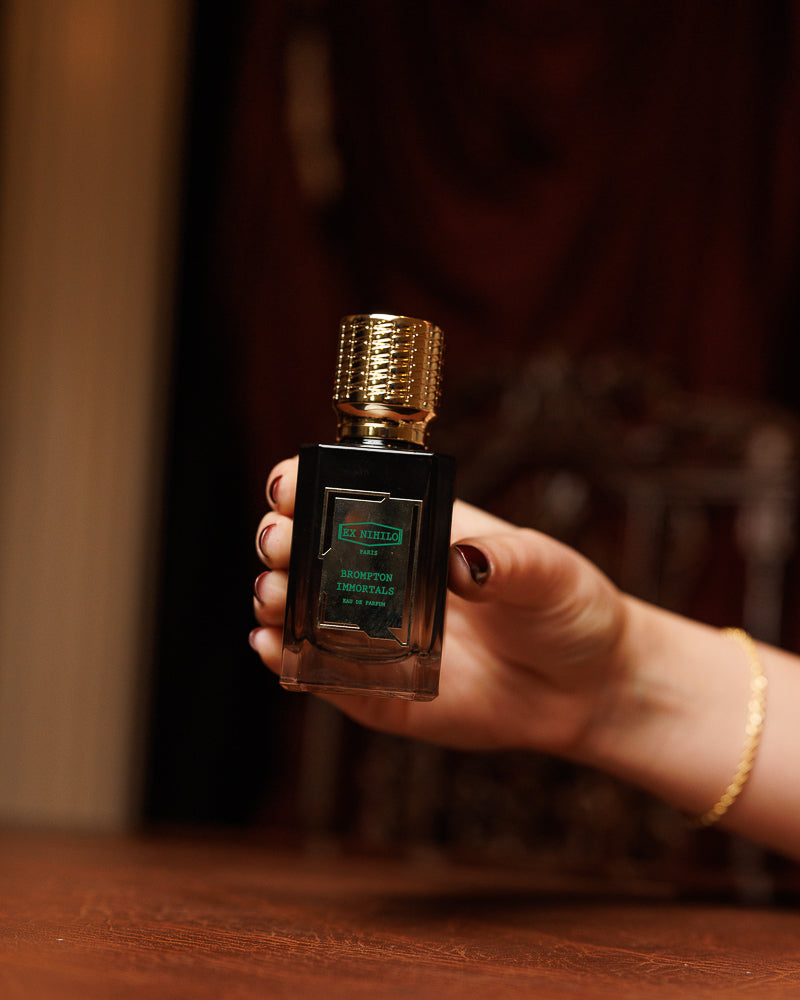
Ex Nihilo - Brompton Immortals
Saffron and pink pepper crack open with a dry, metallic heat before Bulgarian rose and jasmine sambac pull the fragrance inward, anchoring it in something dense, powdered, and deeply floral. Patchouli and olibanum hold the base in place like pressed velvet, while Madagascar vanilla smooths every edge without softening the intention.
The Nose
Composed by Jordi Fernandez for Ex Nihilo, also behind Explicite, Outcast Blue and Gold Immortals.


Warm Spicy
Glowing embers of the spice drawer
The rounded heat of cinnamon, clove, and nutmeg, dry and slightly resinous, like a baking pantry rather than a sharp kitchen. It creates a flushed, enveloping warmth that feels intimate and cool-weather, hugging the skin from within.


Vanilla
Creamy bean steeped in warmth
The soft, custardy sweetness of cured vanilla pods, rich and balsamic with a faint boozy, smoky depth beneath the cream. It feels comforting and skin-warm, a tender glow that smooths and rounds everything it touches.


Woody
Dry grain of cut timber
The smell of cedar shavings, sandalwood, and dry vetiver roots, a sanded, resinous warmth with a faint pencil-box rasp. It feels grounded and composed, the quiet backbone that makes a scent read as serious and lasting.


Patchouli
Damp earth and dark cocoa
A deep, earthy darkness that smells of damp soil, dry wood, and a faint bitter-sweet cocoa, with a cool, almost camphorous edge. It feels grounding and a little mysterious, lending weight and shadow to whatever it touches.


Rose
Velvet petals, honey and thorn
The layered scent of true petals, dewy and fruity up top, with a deeper jammy, honeyed heart and a faint peppery, green bite. It feels timeless and emotional, by turns delicate and commanding depending on how it unfolds.


Amber
Golden resin glowing warm
A soft, resinous glow built from labdanum, benzoin, and vanilla, sweet but dusky, like sun-warmed tree sap with a hint of incense smoke. It radiates a cozy, golden heat that wraps close to the skin and lingers.


Saffron
Crimson threads breathing leather, honey and dry hay
What it is
Saffron is the dried stigma of Crocus sativus, a purple autumn-flowering crocus in the iris family. Each bloom yields just three slender crimson threads, plucked by hand. The dried threads are steeped into a tincture or solvent-extracted into an absolute to capture their aromatic oil for perfumery.
How it smells
Warm and dry at first, with hay, honey and toasted bread, then a metallic, leathery edge driven by the molecule safranal. Beneath runs a bittersweet, faintly medicinal earthiness and a soft rubbery warmth. It opens spicy and golden, drying into suede, tobacco and dusty amber.
In perfumery
Saffron works in the heart, bridging spice and leather and lending a glowing, reddish warmth. It pairs classically with rose, oud, amber and tobacco. Whole leathery accords can be built around it, and it is often wed to rose for a rich, spiced-floral effect.
Good to know
Saffron is the costliest spice on earth, dearer by weight than gold. A single kilogram demands roughly 150,000 hand-picked flowers and many days of stooped labor. Most perfumery saffron is reconstructed from synthetic safranal or saffron bases, since the natural extract is too rare and expensive to use widely.


Pink Pepper
Bright rosy berries with a sparkling spice fizz
What it is
Pink pepper is the dried berry of the Peruvian pepper tree Schinus molle, native to the Andes and a member of the cashew family Anacardiaceae, not a true pepper. The rose-colored berries are steam-distilled or CO2-extracted into an oil dominated by alpha-phellandrene, limonene and pinene.
How it smells
Bright, dry and sparkling, more rosy and fruity than black pepper, with only a soft prickle of spice. Crushed-berry, juniper-like resin and faint citrus facets give a fizzy, airy lift. It flashes peppery on top, then fades quickly into a gentle warm spiciness.
In perfumery
A favoured top-to-heart note that adds effervescent spice and a rosy glow without heat or bite. It brightens florals, freshens woods and ambers, and pairs with rose, bergamot and patchouli. Its sparkle opens many modern scents, notably the tea-and-bergamot top of bright fruity-floral bombs.
Good to know
Despite the name, these berries are botanically unrelated to true pepper, Piper nigrum; the resemblance is purely aromatic. As an Anacardiaceae cousin of cashew and mango, Schinus can trigger reactions in people sensitive to that family, so culinary use of the berries is best in moderation.


Bulgarian Rose
The fresh dawn breath of the Rose Valley
What it is
The flower of Rosa damascena, grown chiefly around Kazanlak in central Bulgaria's Rose Valley. Petals are hand-picked at dawn, then either steam-distilled into rose otto or solvent-extracted into a deep-red absolute. Roughly three to four tonnes of blossoms yield a single kilogram of otto.
How it smells
Bright, dewy and honeyed, with a green lemony lift on top over a spicy, velvety heart. Compared with Turkish rose it reads fresher and clearer. As it settles, a faint clove-like warmth and a waxy, black-tea softness surface beneath the petals.
In perfumery
A heart note prized for transparency and natural radiance, paired with patchouli, oud, sandalwood or fruity notes like lychee. The otto can crystallise in cool weather. It anchors many of the great rose-centered compositions, lending lifelike floral depth.
Good to know
Harvest runs only three to four weeks in May, and pickers work before sunrise because midday heat evaporates the volatile oils. That tiny, weather-dependent window, plus the tonnes of petals needed per kilo, makes rose otto one of perfumery's costliest naturals.


Ylang-Ylang
Sun-warmed tropical bloom, banana-cream and jasmine
What it is
The drooping yellow star-shaped flower of Cananga odorata, a tropical tree native to Southeast Asia and now grown mainly in the Comoros, Madagascar and Mayotte. Hand-picked blossoms are steam-distilled for fifteen to twenty hours, the run siphoned off in stages into grades from Extra to Third.
How it smells
Creamy, heady and warm: jasmine-like florals over a soft banana-custard sweetness, threaded with rubber, clove and narcissus. The Extra fraction is bright, fruity and spicy on top; later grades turn deeper, fattier and more medicinal, drying down to a rounded, slightly waxy floral.
In perfumery
A heart-note workhorse adding tropical richness and lift to floral and oriental compositions, bridging jasmine, rose and tuberose while softening citrus tops. It forms part of the floral bouquet of the great aldehydic classics, drives many a legendary floral, and underpins countless solar tiare blends.
Good to know
The name traces to the Tagalog ilang-ilang, commonly glossed as flower of flowers, reaching European perfumery via Spanish. In Indonesia the blossoms are traditionally scattered over the beds of newlyweds. A single tree fruits for decades, with the most fragrant flowers picked at dawn while still cool.


Jasmine Sambac
The white flower of warm Eastern nights
What it is
Jasmine Sambac is a climbing shrub, Jasminum sambac, in the olive family, cultivated in India, China and the Philippines. Its small white flowers open after dusk and are hand-picked before dawn, when scent peaks. Solvent extraction yields a waxy concrete, washed with alcohol into the absolute.
How it smells
Brighter, greener and more tea-like than grandiflorum jasmine, with less fruity heaviness. It opens crisp and slightly waxy, almost banana-tinged, then deepens into warm indolic sweetness. That indole carries an animalic, narcotic undertone that turns heady up close yet stays clear and luminous.
In perfumery
A heart note prized for lift and body, blending with rose, tuberose, sandalwood and green tea accords. It anchors white-floral bouquets and rounds sharp citrus. Some night-blooming soliflores build almost entirely on Sambac, and it threads through countless tea-floral compositions.
Good to know
Sambac is the Philippine national flower, sampaguita, strung into garlands and used to scent Chinese jasmine tea. Because the blooms are tiny and picked by hand nightly across a long season, the absolute ranks among the costliest florals in a perfumer's palette.


Lily
Cool white trumpets, green stems and golden pollen
What it is
Lily refers to true lilies of the genus Lilium, large trumpet-shaped flowers such as Casablanca and stargazer. The living blooms yield almost no extractable oil, so the lily note is built largely as a perfumer's headspace reconstruction, recreating the flower's scent from synthetic and natural floral materials.
How it smells
Fresh, cool and creamy white-floral with a green, slightly waxy edge and a peppery, spicy lift. A dewy, watery transparency sits over a fuller honeyed heart, with a touch of golden pollen warmth. It falls between the lushness of tuberose and the clean coolness of magnolia.
In perfumery
A heart note giving radiant, dewy volume to white-floral and modern bouquets, blending with rose, freesia, magnolia, green notes and soft musks. The cool lily accord shapes single-flower lily soliflores and lends a powdery floral character to many modern bouquets.
Good to know
Because true lily cannot be steam-distilled economically, the note is an act of reconstruction built from headspace analysis of the live flower. Note that lily of the valley, or muguet, is an unrelated plant and also a reconstruction, so the two lily notes smell quite different.


Madagascar Vanilla
Cured black pods breathing deep boozy sweetness
What it is
The cured seed pods of the orchid Vanilla planifolia, grown on Madagascar's northeast coast, which supplies most of the world's vanilla. Hand-pollinated flowers ripen into green pods that are blanched, sweated, sun-dried and conditioned for months, then extracted as absolute or tincture.
How it smells
Warm, sweet and rounded: creamy custard and dried fruit over a boozy, rum-like depth, with smoky, woody and faintly tobacco facets that cheaper synthetic vanillin lacks. It opens rich and balsamic, then dries to a soft, powdery, almost leathery sweetness.
In perfumery
A base note delivering rounded sweetness, warmth and fixative staying power. It pairs with amber, tonka, sandalwood and spice in oriental and gourmand blends. The natural material lends depth to classic smoky orientals and lavish vanilla soliflores.
Good to know
Outside its native Mexico the orchid lacks its natural bee pollinator, so every flower is pollinated by hand within hours of opening, a technique twelve-year-old enslaved boy Edmond Albius devised on Reunion in 1841. This labor keeps vanilla among the costliest spices.


Patchouli
Damp earth and dark wood after rain
What it is
Patchouli comes from Pogostemon cablin, a leafy bush in the mint family native to tropical Asia and grown mainly in Indonesia, India and Sri Lanka. The harvested leaves are dried and lightly cured or fermented, then steam-distilled or hydrodistilled into a thick, dark essential oil.
How it smells
Deeply earthy and woody, like damp forest floor, wet soil and old cellars, threaded with a winey, slightly sweet darkness. Fresh oil can read sharp, almost camphorous and green; with age it rounds into chocolate, leather and dried-fruit warmth that clings for hours.
In perfumery
A base note and powerful fixative, patchouli anchors a composition and lengthens its wear. It forms the backbone of chypres and orientals, pairing with rose, vetiver, labdanum and vanilla. It defines many gourmand-oriental blends and carries the woody-balsamic heart of plush chypre accords.
Good to know
In the 19th century, real Kashmiri shawls were packed with dried patchouli leaves to repel moths in transit, so Europeans learned to recognise genuine imports by smell. Unlike most essential oils, patchouli improves with age, deepening and mellowing over years much like wine.


Olibanum
Sun-baked resin tears that smell of sacred smoke
What it is
Olibanum is frankincense, the dried gum resin of Boswellia trees, chiefly Boswellia sacra and Boswellia carterii of Oman, Yemen and Somalia. Harvesters score the bark, and the milky sap bleeds out and hardens in the sun into amber tears that are then steam-distilled or solvent-extracted.
How it smells
Bright, dry and resinous, opening with cool lemon-pine and green terpenes over a balsamic warmth. Beneath runs peppery incense, a faint waxy sweetness and a smoky, slightly camphoraceous lift. As it dries it turns soft, ambery and meditative, recalling old stone churches and warm dust.
In perfumery
A versatile heart-to-base material prized in incense and oriental compositions, lending lift, cool radiance and a spiritual signature. It pairs with myrrh, rose, citrus and labdanum, and defines the smoky cathedral-incense and dry woody-incense styles built around it.
Good to know
Frankincense was once valued like gold and traded along Arabian caravan routes, and it appears in the Nativity story. Overtapping, overgrazing and pest damage now stress wild Boswellia stands, with Boswellia sacra listed as Near Threatened, raising real sustainability concerns for the trade.


White Musk
The laundered lab musk in almost everything
What it is
White musk is not a natural material but a marketing name for clean synthetic musks, chiefly the polycyclic Galaxolide and the macrocyclics Habanolide and ethylene brassylate. These lab molecules replaced endangered deer musk and now anchor the base of nearly every mass-market and designer fragrance made.
How it smells
Soft, airy and weightless, reading as fresh cotton, warm clean skin and powdery soap. There is a faint sweetness, sometimes a fruity shimmer from Galaxolide, but none of the animalic, fecal or sweaty depth that defines real musk. It smells laundered rather than alive.
In perfumery
White musk is the great diffuser and fixative, stretching other notes and lending tenacity and a radiant glow. Cheap, stable and uncontroversial, it builds the cozy second-skin drydown of countless modern scents. Older polycyclic musks raise environmental persistence concerns, nudging perfumers toward newer biodegradable macrocyclics.
Good to know
Many people are anosmic to specific musks such as Galaxolide, so a scent can vanish on one wearer and bloom on another. White musk is what most people now picture as musk, a clean abstraction far removed from the dark animalic glandular secretion the word originally named.
Fragrance Character
The opening is sharp and almost abrasive, saffron's mineral bite cut through by the faint crackle of pink pepper. In the heart, rose and jasmine sambac merge into a rich, warm bloom, ylang-ylang adding a waxy, almost narcotic depth. By drydown, patchouli and frankincense take over completely, resinous and close-sitting, the vanilla a quiet hum rather than sweetness.


Longevity
how long it stays on skin
This gauge reads the expected wear time, how many hours the fragrance keeps speaking on skin before it fades. A marker near the low end means a few fleeting hours, while a marker pushed to the far end promises a scent still present from morning into night.


Sillage
the size of its scent trail
This reads how far the fragrance reaches beyond you and the trail it leaves behind. Low sits soft against the skin, an intimate whisper noticed only up close; high climbs through moderate and strong toward enormous, filling a room and lingering in the air after you have left it.


Experimental
For the bold and curious
Unconventional, boundary-pushing scents for someone who wants to provoke a reaction and stand apart. Suited to artistic, challenging compositions: inky tar, rubber, fermented fruit, metallic or animalic facets that defy easy liking. On this wheel a glowing coin means it rewards the adventurous nose, a dim one means it plays things safe.


Office
Polished but never overpowering
Close-quarters professional settings where a scent should be noticed only by those near you. Suited to restrained, clean compositions with modest projection: tidy citrus, soft musk, pale woods that read competent and considerate. On this wheel a glowing coin means it works in shared workspaces, a dim one means it carries too far.


Evening
After dark, turned up
Dinners, drinks, and nights out when a fragrance can deepen and project with confidence. Suited to richer, warmer compositions: ambers, resins, smoky woods, or plush florals that bloom under low light. On this wheel a glowing coin means the scent comes alive after sundown, a dim one means it stays better suited to daytime.


Romantic
Close enough to be felt
Intimate moments and date nights meant to draw someone nearer. Suited to warm, sensual compositions that hum against skin: creamy florals, vanilla, soft musk, a touch of spice or amber that invites closeness. On this wheel a glowing coin means it sets an alluring mood, a dim one means it leans more practical than seductive.


Formal
Refined for the occasion that matters
Weddings, ceremonies, galas, and dressed-up affairs that call for composure and elegance. Suited to polished, structured scents with quiet authority: smooth woods, refined florals, soft leather, nothing loud or playful. On this wheel a glowing coin means it carries the right gravitas, a dim one means it feels too casual for the room.


Casual
Easy comfort for unhurried days
Everyday wear with no agenda: errands, coffee, friends, a slow weekend. Suited to soft, approachable scents that feel clean and natural, like fresh citrus, light woods, or a gentle skin warmth. On this wheel a glowing coin means the fragrance fits these laid-back moments, a dim one means it asks for more.


Day to Night
where its mood naturally falls
This slider reads the hour the fragrance was made for. A marker to the left leans luminous and bright, easy in daylight and open air; slide it right and the character turns deeper and warmer, the kind of presence that belongs to evening and candlelit rooms.


Winter
Warmth that carries through cold air
Cold air mutes and slows a fragrance, so winter rewards the dense and the warm: resins, smoke, vanilla, leather, and ambered spice that radiate heat against the chill. The bar shows how strongly this particular scent holds up and glows in cold weather.


Spring
Fresh blooms in mild, rising warmth
Mild, humid air lifts lighter compositions beautifully, so spring favors dewy florals, green stems, soft powder, and transparent citrus that feel alive rather than heavy. The bar shows how well this particular scent matches that fresh, gently warming season.


Summer
Bright and airy in real heat
Heat amplifies and projects scent hard, so summer calls for cool, crisp, breathable things: sharp citrus, salty marine air, aromatic herbs, and watery freshness that refresh instead of cloy. The bar shows how comfortably this particular scent wears in real warmth.


Fall
Spiced warmth for cooling days
As temperatures drop, richer materials read clearly without smothering, so autumn suits dry woods, warm spice, tobacco, amber, and golden fruit that feel cozy and contemplative. The bar shows how naturally this particular scent settles into crisp, cooling days.
Best Worn
Made for cold nights and formal interiors, the kind of occasion where a coat is shed and the fragrance finally breathes. Suits a wearer who dresses with deliberate weight.
Why the Brompton Immortals Decant
The combination of heavy florals, resin, and saffron is genuinely full-on, and at Ex Nihilo's price point, a decant is the only honest way to know whether that density suits your skin.
Official Notes
Saffron · Pink Pepper · Bulgarian Rose · Ylang-Ylang · Jasmine Sambac · Lily · Madagascar Vanilla · Patchouli · Olibanum · White Musk
Explore more: Ultra-Niche Perfume Decants · All Fragrance Decants
Choose options
The Vibe


Select your decant size

You are selecting a decant size, not the full bottle