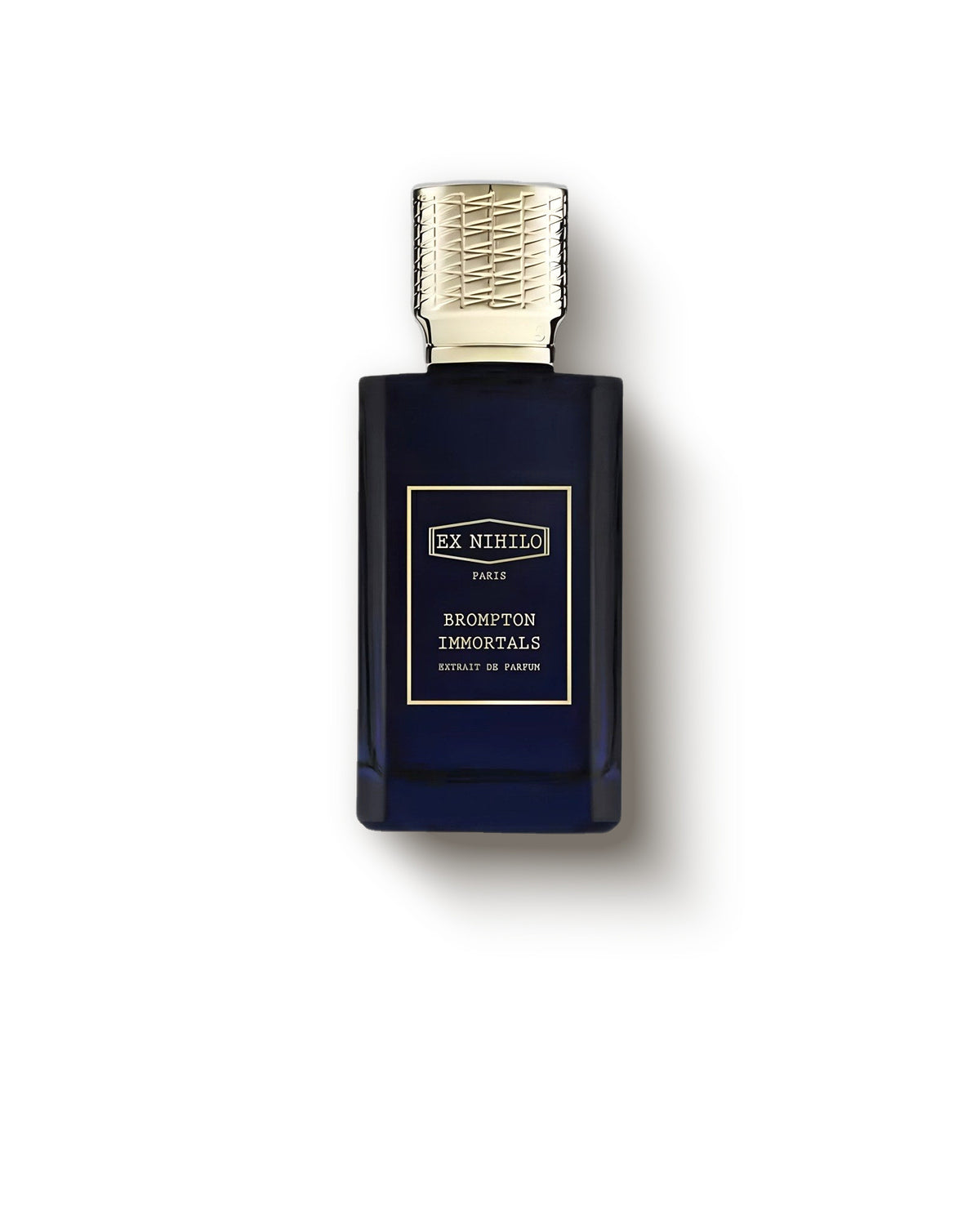
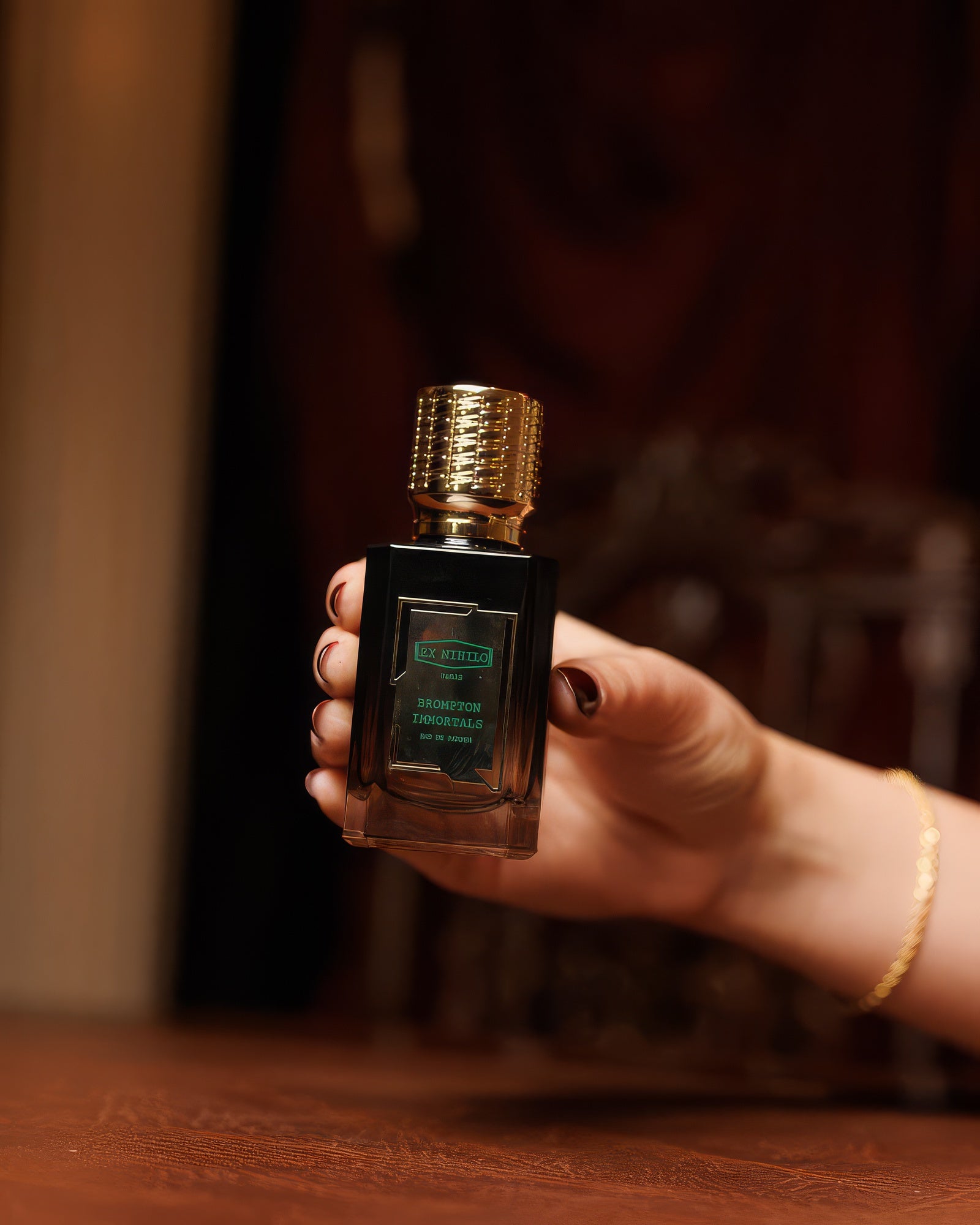
Ex Nihilo
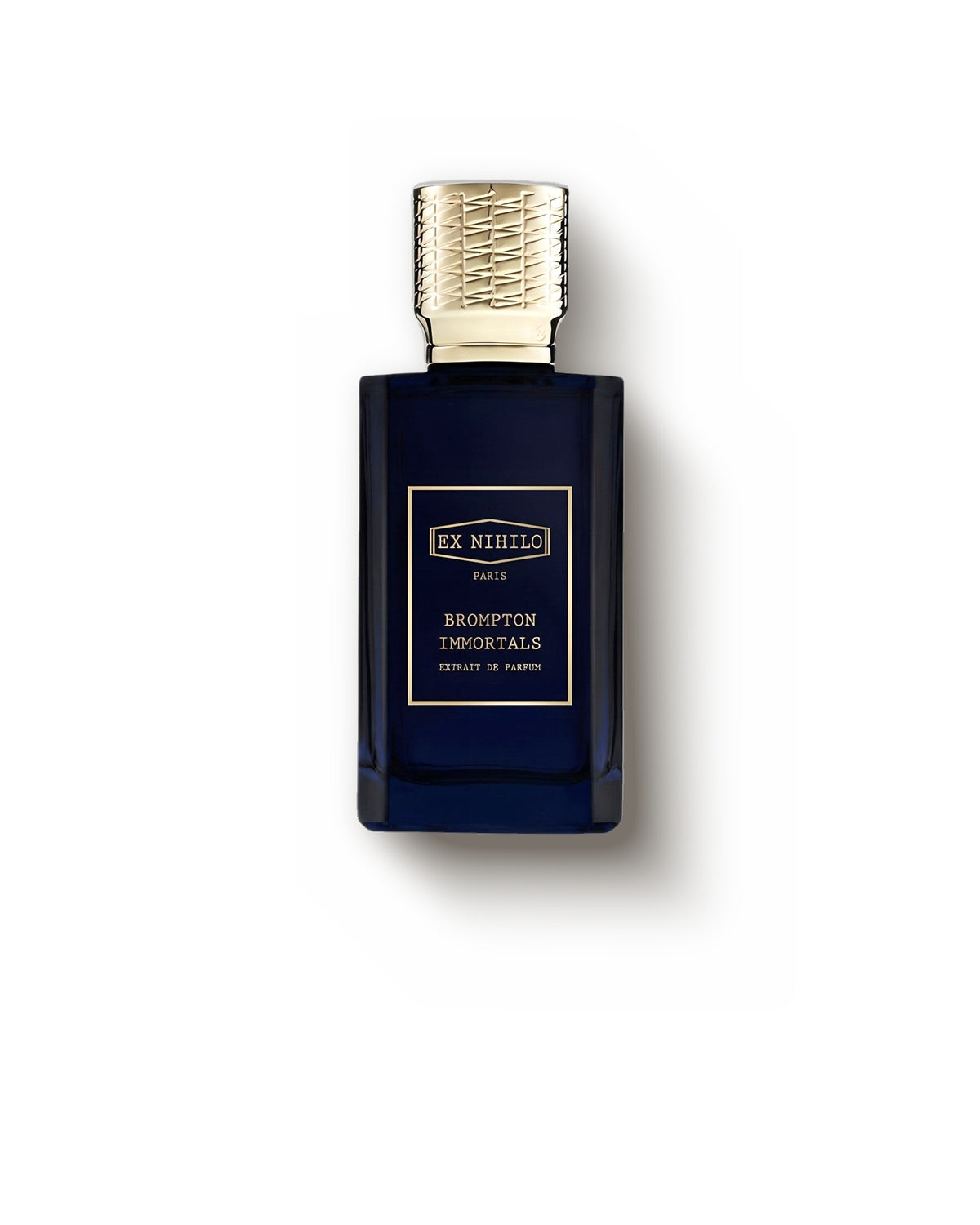
Brompton Immortals
The Story
Brompton Immortals was made as a tribute to Harrods, which stands on Brompton Road, and Jordi Fernández took the ancient Egyptian legend of immortality as its frame. Saffron, pink pepper and Bulgarian rose put English restraint next to something considerably warmer.

Warm Spicy
Glowing embers of the spice drawer
The rounded heat of cinnamon, clove, and nutmeg, dry and slightly resinous, like a baking pantry rather than a sharp kitchen. It creates a flushed, enveloping warmth that feels intimate and cool-weather, hugging the skin from within.


Vanilla
Cured pod, boozy under the cream
Cured pods, not frosting. The sweetness here is custardy and balsamic, with something dark and boozy under it, closer to rum and woodsmoke than to sugar. It warms everything above it, blunting sharp edges and slowing the whole thing down.


Woody
Dry grain of cut timber
The smell of cedar shavings, sandalwood, and dry vetiver roots, a sanded, resinous warmth with a faint pencil-box rasp. It feels grounded and composed, the quiet backbone that makes a scent read as serious and lasting.


Patchouli
Damp earth and dark cocoa
A deep, earthy darkness that smells of damp soil, dry wood, and a faint bitter-sweet cocoa, with a cool, almost camphorous edge. It feels grounding and a little mysterious, lending weight and shadow to whatever it touches.


Rose
Velvet petals, honey and thorn
Dewy and fruity on top, then a jammy, honeyed heart with a green peppery bite underneath. Very little of it is distilled flower. A rose accord is built, and a good one can smell more like a rose than the rose does.


Amber
Resin warmed until it goes sweet
Labdanum, benzoin and vanilla melted together into something sweet but dusky, like tree sap gone soft in the sun with a thread of incense smoke through it. Amber does not sparkle or shout. It sits close to the skin and gives off heat for hours.


Saffron
Crimson threads breathing leather, honey and dry hay
What it is
Three crimson threads sit inside each autumn crocus flower, and a hand pulls every one. Dried, those stigmas are steeped into a tincture or extracted into an absolute. That is the entire supply chain.
How it smells
Hay and honey and warm toast first, then something metallic and leathery underneath, the work of a molecule called safranal. It dries down into suede, tobacco and dusty amber, bitter at the edges.
In perfumery
It lives in the heart, glowing reddish, the hinge between spice and leather. Perfumers wed it to rose so often the pairing became a genre, and entire leather accords get built on it alone.
Good to know
A kilogram of saffron costs about 150,000 hand-picked flowers and many days of stooped labor, which is why almost none of it reaches perfume. Most saffron notes are built from synthetic safranal instead.


Pink Pepper
Bright rosy berries with a spice fizz
What it is
It is not pepper. The rose-colored berries come from a South American tree with no botanical link to the pepper vine at all, dried and then steam-distilled or extracted with CO2.
How it smells
Rosier and fruitier than black pepper, with only a prickle of heat. Crushed berries, a juniper-ish resin, a flick of citrus. It flashes on the opening and is gone quickly, leaving a gentle warm spiciness behind.
In perfumery
Perfumers reach for it when a composition needs spice without heat. It puts a rosy fizz over florals, freshens woods and ambers, and sits well with bergamot and patchouli. The fizz is a signature of the modern fruity-floral.
Good to know
The family it actually belongs to is the cashews, close enough that people who react to cashew or mango sometimes react to these berries too. Worth knowing before you cook with them.


Bulgarian Rose
The fresh dawn breath of the Rose Valley
What it is
Damask roses around Kazanlak, in the valley Bulgaria named after them. Three to four tonnes of blossoms go into the still for a single kilo of rose otto. Solvent extraction gives a deep red absolute.
How it smells
Dewy and lemon-bright on top, then honey, then a velvet spice underneath. It is the clearer of the two great damask roses. Give it time and a clove warmth surfaces, with something waxy and close to black tea.
In perfumery
Transparency is what perfumers want from it: it holds its shape next to patchouli, oud, sandalwood or something fruity like lychee, and most of the great rose fragrances lean on it.
Good to know
The harvest is three or four weeks, mid-May into June, and that is the whole year. Pickers are out before sunrise because the day's heat drives the oil off. Left somewhere cool, the otto crystallises in the bottle.


Jasmine
The heady white flower at perfumery's beating heart
What it is
Picking runs by hand in the dark, from before first light into the morning. The blossoms are too fragile to distill, so solvent lifts their oil into a waxy concrete, and alcohol washes the absolute out of that.
How it smells
Sweet, heavy and honeyed, with something faintly animal underneath. Sambac reads green, tea-like and luminous; grandiflorum is fruitier, creamier, heavier on the skin. Both dry down warm and soft, with a mushroomy musk you notice only up close.
In perfumery
Put it in the heart and it ties a citrus opening to the woods underneath, adding volume to both. Rose, tuberose, sandalwood and musk all take it well. Plenty of perfumes are built on jasmine and nothing else.
Good to know
Roughly six thousand hand-picked blossoms go into one gram of absolute, among the costliest materials in perfumery. Part of its depth is indole, which smells like decay when concentrated and turns radiant at the trace the flower carries.


Lysylang
A ylang fraction, turned solar and creamy
What it is
Distil ylang-ylang and it comes off in grades: Extra first, then First, Second and Third, each smelling different from the last. Lysylang is a fraction of ylang-ylang oil from Robertet, separated out and kept for its own character.
How it smells
Softer and sweeter than raw ylang, without its banana-medicinal spike. What you get instead is sunlit: frangipani and jasmine over a creamy coconut and monoi warmth, with a thin lily-like spice running through it.
In perfumery
In the heart it does ylang's job without ylang's volume. It rounds white florals, sits easily with tuberose, coconut and soft musks, and supplies the warm beach-flower glow behind a lot of modern solar fragrances.
Good to know
Robertet did not invent a molecule here. They went back into the ylang oil and found a material in it, which is a quieter kind of ingenuity than synthesis.


Madagascar Vanilla
Cured black pods breathing deep boozy sweetness
What it is
An orchid pod, blanched, sweated, sun-dried and then left to condition for months until it turns black and pliable. Madagascar's northeast coast supplies more of it than anywhere else on earth, extracted as absolute or tincture.
How it smells
Custard and dried fruit over a rum-like depth, with smoke, wood and a faint tobacco curl that synthetic vanillin never has. Rich and balsamic at first, then a soft powdery sweetness that turns almost leathery.
In perfumery
Base note, fixative, and the reason a gourmand holds all day. It settles alongside amber, tonka, sandalwood and spice, and the natural material carries a depth that smoky orientals and vanilla soliflores are built on.
Good to know
Outside Mexico the orchid has no bee that will pollinate it, so every flower is fertilized by hand within hours of opening. The trick was worked out in 1841 by Edmond Albius, an enslaved twelve-year-old on Reunion.


Patchouli
Damp earth and dark wood after rain
What it is
Nobody guesses mint, but that is the family: a leafy bush whose leaves are dried and left to cure, close to fermenting, before distillation pulls out an oil thick and dark as syrup.
How it smells
Wet soil, forest floor, an old cellar, with a winey sweetness underneath. Young oil can come at you sharp and green, almost camphorous. Aged oil goes the other way, into chocolate and leather, and stays put for hours.
In perfumery
Almost nothing holds a composition down like it. Chypres and orientals are built on that anchor, and a few drops under rose, vetiver or labdanum will hold the whole thing on skin for hours.
Good to know
Nineteenth-century Kashmiri shawls travelled packed in dried patchouli leaves to keep moths off, and Europeans learned to tell a real one by smell alone. The oil improves with age, which almost no essential oil does, mellowing like wine.


Olibanum
Sun-baked resin tears that smell of sacred smoke
What it is
Olibanum and frankincense are the same thing, one word older than the other. Harvesters score the bark of Boswellia trees in Oman, Yemen and Somalia; the milky sap bleeds out and hardens in the sun into amber tears.
How it smells
Bright and dry, lemon-peel and pine over a balsamic warmth, with pepper and a cool camphor lift running through it. It softens as it goes, turning ambery and still. Old stone, warm dust, an empty church.
In perfumery
Perfumers reach for it when a blend needs air: it gives incense and amber compositions lift and a cool radiance rather than weight. Myrrh, rose, citrus and labdanum all sit comfortably beside it.
Good to know
Frankincense was once valued like gold and moved north along the Arabian caravan roads, which is why it turns up in the Nativity. Overtapping, overgrazing and beetle damage are now thinning the wild stands.


White Musk
The laundered lab musk in almost everything
What it is
White musk names a shelf, not a material. Behind it sit clean synthetic musks, Galaxolide the most familiar, with lighter macrocyclics like Habanolide beside it, and together they anchor the base of nearly every fragrance made today.
How it smells
If you can smell it at all: soft, airy, weightless, reading as fresh cotton, warm skin and powdery soap, with a faint fruity shimmer where Galaxolide is doing the work. Laundered rather than alive.
In perfumery
This is the great diffuser and fixative: stable, forgiving, able to stretch everything around it, which is how a modern scent gets its second-skin drydown. Older polycyclic musks are under environmental review, pushing perfumers toward biodegradable macrocyclics.
Good to know
A fair number of people cannot smell Galaxolide, so the same fragrance vanishes on one wearer and blooms on the next. White musk is what most people now mean by musk: clean, soft, nothing animal about it.
Fragrance Character
Saffron's mineral bite arrives first, sharpened further by the faint crackle of pink pepper. In the heart, rose and jasmine absolute merge into a rich, warm bloom, Lisylang adding a waxy, almost narcotic depth. By drydown, patchouli and frankincense take over completely, resinous and close-sitting, the vanilla a quiet hum rather than sweetness.


Longevity
how long it stays on skin
The hourglass reads wear time: how many hours the fragrance keeps speaking before it fades. A bar that barely leaves the start means a few fleeting hours. One that runs the full length carries from morning into evening. Treat it as typical, not promised. Oily skin holds scent far longer than dry.


Sillage
the size of its scent trail
Sillage is French for a ship's wake, and that is exactly what this measures: how much of the scent reaches the room instead of staying on you. Low is a whisper only close friends catch. Enormous fills the room, then keeps filling it after you leave.


Experimental
Built to provoke, not to please
Some perfumes are made to be liked. These are made to be argued about: inky tar, hot rubber, fruit on the turn, metal and fur where you expected flowers. The coin glows for a scent that provokes and dims for one that plays it safe, which is sometimes the point.


Office
Polished, and never louder than the room
Scent is manners in a shared room. At this range it should reach the person across the desk and stop there: tidy citrus, soft musk, pale woods, all of it reading competent and considerate. A glowing coin means nobody has to mention it. A dim one means it travels.


Evening
After dark, when it deepens
Dinner, drinks, the night that runs long. Low light is where ambers, resins and smoky woods stop being polite, and where a plush floral finally blooms. A glowing coin means it is waiting for exactly this hour. A dim one means it did its best work in daylight.


Romantic
Close enough to be felt
A fragrance can hum against skin instead of announcing itself across a table. That is the register here: creamy florals, vanilla, soft musk, a thread of spice, warm enough to make someone lean in. The coin glows when a scent sets that mood and dims when it is more practical than seductive.


Formal
Quiet authority in a dressed-up room
A wedding, a ceremony, a room where everyone has thought about their shoes. What works here is structure, not volume: smooth woods, disciplined florals, soft leather. A glowing coin means it holds its posture all evening. A dim one means it is too casual for the room.


Casual
Easy comfort for unhurried days
Errands, coffee, a slow Saturday with nowhere to be. Nothing here has to impress anyone, so the fit is soft and easy: fresh citrus, light woods, a little warmth off the skin. A glowing coin says yes to all that. A dim one means the fragrance is asking for a bigger night.


Day to Night
where its mood naturally falls
A bar running from sun to moon, reading the hour the fragrance was made for. The more of it that stays gold, the more the scent belongs to daylight and open air. The further the blue reaches back toward the sun, the deeper and warmer it turns: evening, candlelight, low rooms.


Winter
Warmth that carries through cold air
Cold air mutes a fragrance and slows it down, which is why winter belongs to the dense and the warm: resin, smoke, vanilla, leather, ambered spice. The bar reads how well this one pushes back, glowing against the chill instead of thinning out in it.


Spring
Fresh blooms in mild, rising warmth
Mild, humid air lifts a light composition, so the season belongs to dewy florals, green stems, soft powder and citrus you can see through. Alive rather than heavy. The further the green runs along the bar, the more comfortably this one wears in that weather.


Summer
Bright and airy in real heat
Heat does the projecting for you, which is why the wrong perfume turns unbearable by noon. What survives is cool and breathable: sharp citrus, salt air, aromatic herbs, water. Things that refresh instead of cloy. A short bar here means save it for cooler months.


Fall
Spiced warmth for cooling days
As the air cools, the rich materials stop smothering and start reading clearly: dry woods, warm spice, tobacco, amber, fruit gone golden. It is the season perfume turns contemplative. The bar fills according to how naturally this one settles into crisp, cooling days.
Best Worn
Made for cold nights and formal interiors, the kind of occasion where a coat is shed and the fragrance finally breathes. Suits a wearer who dresses with deliberate weight.
Choose options
The Vibe


The Nose

Jordi Fernández
Senior perfumer
Self-taught Spanish perfumer based in Barcelona who began at Eurofragance and is now a senior perfumer at Givaudan, known for his oud work. He composed Maison Crivelli Oud Maracujá, D'Orsay Tonka Hysteria and Carner Barcelona Helix, and co-signed Montblanc Explorer with Antoine Maisondieu and Olivier Pescheux.
More by this noseOud MaracujáBlue Talisman ExtraitOutcast Blue Extrait
The Maison

Parisian modernity with a lab streak, sized to try before the flacon.
Ex Nihilo runs cool and self assured, chic minerality and clean florals set against dry woods and modern amber. Nothing shouts. Fleur Narcotique was the breakout that put the house on the map, and the line has kept that same quiet, bespoke feeling since.
- Origin
- Paris, France
- Founded
- 2013
- Known for
- Fleur Narcotique, cool modern woods

EVERY DECANT
From the original bottle to your door
We buy the original flacon at full retail price, direct from the house.
A medical grade Socorex syringe takes the exact millilitres straight from the flacon.
Packed into the hot foiled box and handed to DHL, every duty already paid. How a decant is made
More from Ex Nihilo
You may also like