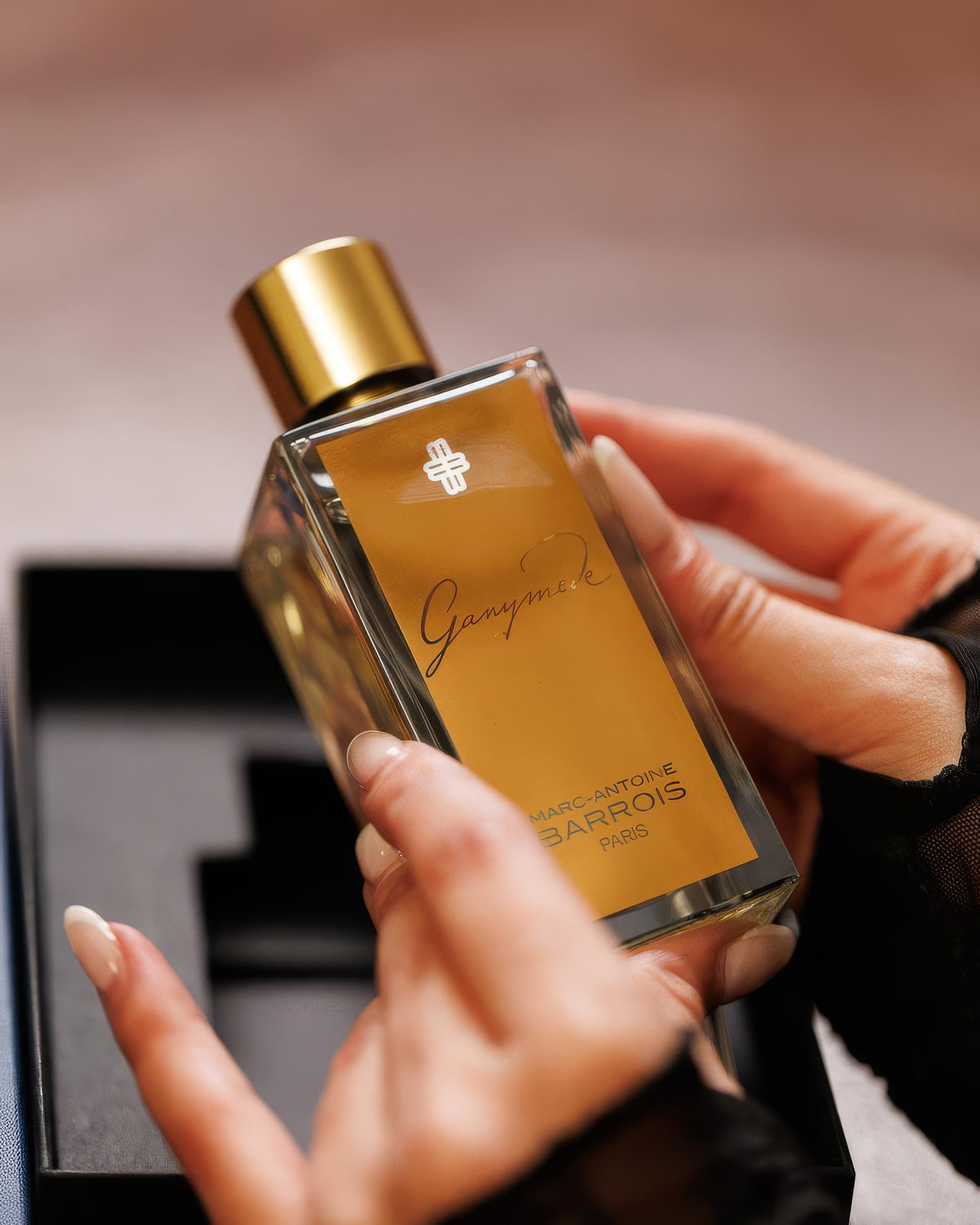


Marc Antoine Barrois
Ganymede
The Story
Ganymede is named after two things at once. In Greek myth he was the Trojan prince Zeus carried to Olympus and made cupbearer to the gods, granted eternal youth; in astronomy it is Jupiter's largest moon, found by Galileo in 1610 and thought to hide an ocean beneath its ice. Quentin Bisch built the scent on that pairing of warm skin and cold mineral.


Mineral
cool wet stone and salt
The cool, dry smell of wet pebbles, slate, and salt-flecked air, almost metallic and faintly oceanic. It reads clean and austere, adding a stony transparency that feels like rain on hot rock or breath drawn over a quarry.

Warm Spicy
Glowing embers of the spice drawer
The rounded heat of cinnamon, clove, and nutmeg, dry and slightly resinous, like a baking pantry rather than a sharp kitchen. It creates a flushed, enveloping warmth that feels intimate and cool-weather, hugging the skin from within.


Leather
A jacket with some miles on it
Tanned hide and birch tar, dry, smoky, a bitter rasp and tobacco under it. Sometimes new and lacquered, like a car interior; sometimes worn soft, like suede gloves gone thin. Either way, it smells used.


Woody
Dry grain of cut timber
The smell of cedar shavings, sandalwood, and dry vetiver roots, a sanded, resinous warmth with a faint pencil-box rasp. It feels grounded and composed, the quiet backbone that makes a scent read as serious and lasting.


Oud
What a tree makes when it is wounded
A dense, resinous wood that smells warm and slightly medicinal, with a leathery, animal-tinged smokiness and a sweet, almost barnyard funk underneath. It feels ancient and brooding, wrapping the skin in something thick and quietly powerful.


Musky
Warm breath of clean skin
A soft, slightly animalic warmth that smells like clean skin and freshly dried laundry, intimate and faintly sweet. It hums quietly underneath a fragrance, a second skin that only registers when someone is already standing close enough to catch it.


Saffron
Crimson threads breathing leather, honey and dry hay
What it is
Three crimson threads sit inside each autumn crocus flower, and a hand pulls every one. Dried, those stigmas are steeped into a tincture or extracted into an absolute. That is the entire supply chain.
How it smells
Hay and honey and warm toast first, then something metallic and leathery underneath, the work of a molecule called safranal. It dries down into suede, tobacco and dusty amber, bitter at the edges.
In perfumery
It lives in the heart, glowing reddish, the hinge between spice and leather. Perfumers wed it to rose so often the pairing became a genre, and entire leather accords get built on it alone.
Good to know
A kilogram of saffron costs about 150,000 hand-picked flowers and many days of stooped labor, which is why almost none of it reaches perfume. Most saffron notes are built from synthetic safranal instead.


Italian Mandarin
Sun-warmed Sicilian peel with green-gold sparkle
What it is
Thin-skinned, easy to peel, grown across southern Italy, Sicily above all, and the part perfumery wants is the part you throw away. The oil sits in the colored rind and comes out by cold pressing, no heat involved.
How it smells
Sweeter and rounder than orange, juicy like a tangerine, with a green, floral edge off the rind. Italian fruit reads brighter and more honeyed than Brazilian. It flares on the first spray, then thins to a zesty trace.
In perfumery
Perfumers reach for it when a fragrance needs to feel friendly in the first ten seconds. It rounds off sharper citruses, hands over neatly to neroli and petitgrain, and opens most sunny colognes and amber-citrus builds.
Good to know
One tree, three oils. Picked green it is sharp and bitter, yellow sits in the middle, red comes off ripe and sweetest. All vanish from skin fast, which is why perfumers pin the citrus down with heavier molecules.


Chinese Osmanthus
Apricot blossom brushed with soft warm leather
What it is
Flowers barely bigger than a grain of rice, gold and violently fragrant, from an evergreen that China grows almost to the exclusion of anywhere else. They are held in brine, then washed and solvent-extracted.
How it smells
Ripe apricot and peach, sweet enough to read as fruit rather than flower, and then a suede softness slides in underneath. It dries powdery and faintly animal, with honey holding the two halves together.
In perfumery
One material that is fruit, flower and leather at once, which is why perfumers build whole scents on it and leave them there. In a blend it warms rose, tea and woods without losing its apricot-suede signature.
Good to know
Harvest runs September to November, and the blossoms are knocked loose by beating the branches so they fall onto sheets spread below. It takes roughly 720 kilograms of them to make 750 grams of absolute.


Immortelle
Sun-baked hay laced with maple and curry
What it is
Gardeners call this silvery Mediterranean shrub the curry plant, and one crushed leaf explains the nickname. Its small yellow flower heads are steam-distilled for an oil or solvent-extracted into an absolute.
How it smells
Dried chamomile and hot straw, then a curry-leaf sharpness you will not expect. The sweetness follows: burnt maple syrup, caramel, a breath of tobacco. It ends honeyed and fenugreek-spiced, with something faintly medicinal underneath.
In perfumery
It works in the heart and base, where its tobacco-and-liqueur warmth sits easily with woods, leather and amber. Perfumers set it against lavender when they want the sweetness to read as contrast rather than dessert.
Good to know
Everlasting is the literal meaning: cut and dried, the flowers keep shape and colour for years, which won them a place in ancient funeral wreaths. Yields are tiny either way, so immortelle sits among the costlier naturals.


Violet
Powdery purple petals that vanish as you reach
What it is
Almost no violet in perfumery comes from violets. The flower yields so little oil that it is hardly produced any more, so the note is built from ionones, aroma-chemicals first made in a lab in the 1890s.
How it smells
Soft, cool and powdery, with a sugar-dusted candied sweetness and a thin green wetness behind it. It reads tender and nostalgic: Parma violet sweets, face powder, petals crushed in a pocket.
In perfumery
In the heart it does something unusual: it takes the sugar out of sweetness and leaves powder behind. Iris, rose, leather and almond all bend toward it, and violet soliflores wear it like an old makeup box.
Good to know
Ionones saturate the receptors fast, so the scent seems to vanish, then return as your nose recovers: perfumery's textbook case of olfactory fatigue. Violet leaf is another material entirely, green and cucumber-cool.


Mineral Notes
Cool breath of wet stone after rain
What it is
Rock gives up no essence, so this is a fabrication: calone for ozone, salty and metallic modifiers, woody-amber synthetics for the dry backbone, and geosmin at a trace far below the beetroot dose to bring the rain.
How it smells
Cool and dry, like damp slate, struck flint or wet concrete after a storm. There is chalk in it, a little salt and a faint metallic edge, all of it thin and airy rather than heavy.
In perfumery
Top and heart work, where it opens space and gives a composition a grey, geological floor. Aquatic and modern niche styles lean on it hard, usually with sea salt, ginger, vetiver or ambergris nearby.
Good to know
A human nose picks up geosmin at a few parts per trillion. That sensitivity is thought to be old and useful: rain on dry ground, smelled across a landscape long before there was anything to see.


Suede
Soft brushed leather without the tannery bite
What it is
The napped underside of a tanned hide barely smells of anything, which is the joke at the centre of this note. Perfumers build the impression instead, from soft musks, ionones and gentle leather molecules like Suederal and safraleine.
How it smells
Dry, powdery and soft, like the inside of a good glove. Where birch-tar leather shouts, this murmurs: a little almond, a little violet, warm skin underneath. It starts smooth and ends up sitting very close to you.
In perfumery
Base note, and the cushion the rest of a formula sits on. It takes the tannery out of leather, sands the edge off a wood, and gives iris, violet and amber somewhere soft to land.
Good to know
Suede takes its name from gants de Suede, gloves of Sweden, where the soft napped finish caught on. The French kept the country and dropped the glove, and perfumery kept the feel and dropped the leather entirely.


Akigalawood
Patchouli leftovers remade as peppery wood
What it is
The patchouli industry throws off a residue nobody wanted. Givaudan put an enzyme to work on it, with water and salts and no petrochemistry, and got a wood that had never existed before. It counts as natural.
How it smells
Patchouli with the cellar taken out. What is left is dry and warm, peppery in a pink-pepper way, with a thin line of agarwood running through it. Transparent where oud is dense, and unmistakably contemporary.
In perfumery
It runs from heart to base, giving woody radiance and an oud impression without the animalic weight, which is why it turns up in so much modern niche. Pink pepper, rose, leather and amber are its usual company.
Good to know
A captive material, so only perfumers inside Givaudan can use it: every fragrance that smells of it traces back to one house. It has become the flagship example of upcycling in fragrance.


Musk
One word for two entirely different materials
What it is
Two things answer to the name. A family of synthetic musks, built to carry warmth and softness, does most of the work in perfumery today. Deer musk is the older road, and traditional attar work still runs on it.
How it smells
Deer musk is animalic and heavy up close, and turns warm, sweet and radiantly skin-like the moment it is diluted to a whisper. The synthetics run cleaner: hot-ironed linen, warm cotton, skin rather than fur.
In perfumery
Musk is the floor a composition stands on: it fixes what sits above, stretches the wear and adds that second-skin glow. A lychee or a rose often has one underneath, holding the fruit in place long after it should have faded.
Good to know
One bottle can smell radiant on you and like almost nothing on the next person. A large number of people cannot smell certain synthetic musks at all, a quirk called specific anosmia.


Cedar
Dry sharpened pencils and sun-warmed timber
What it is
Most perfumery cedar is not cedar. It is juniper, from the Virginia and Texas trees, steam-distilled from chips and sawmill shavings. True Atlas cedar exists and is used, but it is the smaller source.
How it smells
Freshly sharpened pencils, then the inside of a cedar-lined closet. Atlas leans warm, smoky and balsamic; Virginia reads sharper and cleaner. Either way it settles into soft sawdust warmth and stays there for hours.
In perfumery
A workhorse. It gives woody compositions their backbone and holds lighter materials in place, sitting comfortably beside vetiver, rose, citrus and amber. Its plummy-woody core runs through most modern unisex woods.
Good to know
Egyptian embalmers poured cedar oil into the body rather than burning it, and cedar timber lined the tombs and coffins they meant to outlast them. The true cedars and the junipers share a name through smell, not lineage.


Patchouli
Damp earth and dark wood after rain
What it is
Nobody guesses mint, but that is the family: a leafy bush whose leaves are dried and left to cure, close to fermenting, before distillation pulls out an oil thick and dark as syrup.
How it smells
Wet soil, forest floor, an old cellar, with a winey sweetness underneath. Young oil can come at you sharp and green, almost camphorous. Aged oil goes the other way, into chocolate and leather, and stays put for hours.
In perfumery
Almost nothing holds a composition down like it. Chypres and orientals are built on that anchor, and a few drops under rose, vetiver or labdanum will hold the whole thing on skin for hours.
Good to know
Nineteenth-century Kashmiri shawls travelled packed in dried patchouli leaves to keep moths off, and Europeans learned to tell a real one by smell alone. The oil improves with age, which almost no essential oil does, mellowing like wine.
Fragrance Character
Saffron opens sharp and golden against a burst of cold Italian mandarin, all bright metal and sun-warmed spice. The heart is where it turns strange, osmanthus and immortelle melding into something hushed and apricot-tinged, threaded with the soft powdery hush of violet. The drydown is the signature: mineral stillness and pale suede over cedar, patchouli and the smoky, resinous whisper of akigalawood, projecting hugely while somehow still holding the room at arm's length.


Longevity
how long it stays on skin
The hourglass reads wear time: how many hours the fragrance keeps speaking before it fades. A bar that barely leaves the start means a few fleeting hours. One that runs the full length carries from morning into evening. Treat it as typical, not promised. Oily skin holds scent far longer than dry.


Sillage
the size of its scent trail
Sillage is French for a ship's wake, and that is exactly what this measures: how much of the scent reaches the room instead of staying on you. Low is a whisper only close friends catch. Enormous fills the room, then keeps filling it after you leave.


Experimental
Built to provoke, not to please
Some perfumes are made to be liked. These are made to be argued about: inky tar, hot rubber, fruit on the turn, metal and fur where you expected flowers. The coin glows for a scent that provokes and dims for one that plays it safe, which is sometimes the point.


Office
Polished, and never louder than the room
Scent is manners in a shared room. At this range it should reach the person across the desk and stop there: tidy citrus, soft musk, pale woods, all of it reading competent and considerate. A glowing coin means nobody has to mention it. A dim one means it travels.


Evening
After dark, when it deepens
Dinner, drinks, the night that runs long. Low light is where ambers, resins and smoky woods stop being polite, and where a plush floral finally blooms. A glowing coin means it is waiting for exactly this hour. A dim one means it did its best work in daylight.


Romantic
Close enough to be felt
A fragrance can hum against skin instead of announcing itself across a table. That is the register here: creamy florals, vanilla, soft musk, a thread of spice, warm enough to make someone lean in. The coin glows when a scent sets that mood and dims when it is more practical than seductive.


Formal
Quiet authority in a dressed-up room
A wedding, a ceremony, a room where everyone has thought about their shoes. What works here is structure, not volume: smooth woods, disciplined florals, soft leather. A glowing coin means it holds its posture all evening. A dim one means it is too casual for the room.


Casual
Easy comfort for unhurried days
Errands, coffee, a slow Saturday with nowhere to be. Nothing here has to impress anyone, so the fit is soft and easy: fresh citrus, light woods, a little warmth off the skin. A glowing coin says yes to all that. A dim one means the fragrance is asking for a bigger night.


Day to Night
where its mood naturally falls
A bar running from sun to moon, reading the hour the fragrance was made for. The more of it that stays gold, the more the scent belongs to daylight and open air. The further the blue reaches back toward the sun, the deeper and warmer it turns: evening, candlelight, low rooms.


Winter
Warmth that carries through cold air
Cold air mutes a fragrance and slows it down, which is why winter belongs to the dense and the warm: resin, smoke, vanilla, leather, ambered spice. The bar reads how well this one pushes back, glowing against the chill instead of thinning out in it.


Spring
Fresh blooms in mild, rising warmth
Mild, humid air lifts a light composition, so the season belongs to dewy florals, green stems, soft powder and citrus you can see through. Alive rather than heavy. The further the green runs along the bar, the more comfortably this one wears in that weather.


Summer
Bright and airy in real heat
Heat does the projecting for you, which is why the wrong perfume turns unbearable by noon. What survives is cool and breathable: sharp citrus, salt air, aromatic herbs, water. Things that refresh instead of cloy. A short bar here means save it for cooler months.


Fall
Spiced warmth for cooling days
As the air cools, the rich materials stop smothering and start reading clearly: dry woods, warm spice, tobacco, amber, fruit gone golden. It is the season perfume turns contemplative. The bar fills according to how naturally this one settles into crisp, cooling days.
Best Worn
A refined choice for dressed-up occasions across autumn and spring, its saffron-and-suede character carrying with quiet confidence from the workday into the evening, and rewarding the fragrance lover who looks closer.
Choose options
The Vibe


The Nose

Quentin Bisch
Perfumer
Givaudan perfumer based in Paris. He spent a year as an assistant perfumer at Robertet in Grasse under Michel Almairac, then trained at the Givaudan Perfumery School. His work includes Parfums de Marly Delina, Chloé Nomade, Ex Nihilo Fleur Narcotique and Mugler Angel Muse.
More by this noseGuidance 46Delina ExclusifValaya
The Maison

A tailor’s house, where a fragrance is cut rather than blended.
Marc-Antoine Barrois came to perfume from couture, and it shows in how few releases there are and how carefully each is finished. Ganymede is the one that made the house, a strange suede and mineral saffron that reads like nothing else, and it is worth a full day on skin before any verdict.
- Origin
- Paris, France
- Founded
- 2009, perfumes since 2016
- Known for
- Ganymede, B683

EVERY DECANT
From the original bottle to your door
We buy the original flacon at full retail price, direct from the house.
A medical grade Socorex syringe takes the exact millilitres straight from the flacon.
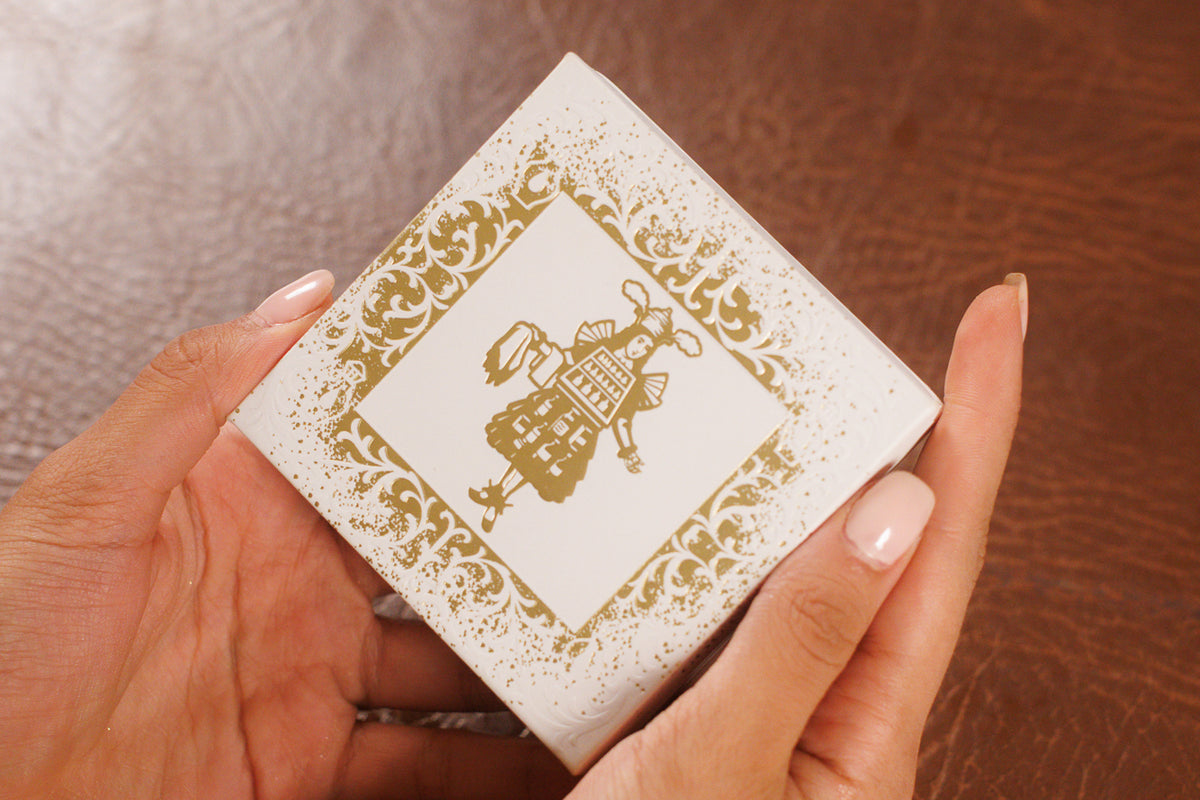
Packed into the hot foiled box and handed to DHL, every duty already paid. How a decant is made
You may also like