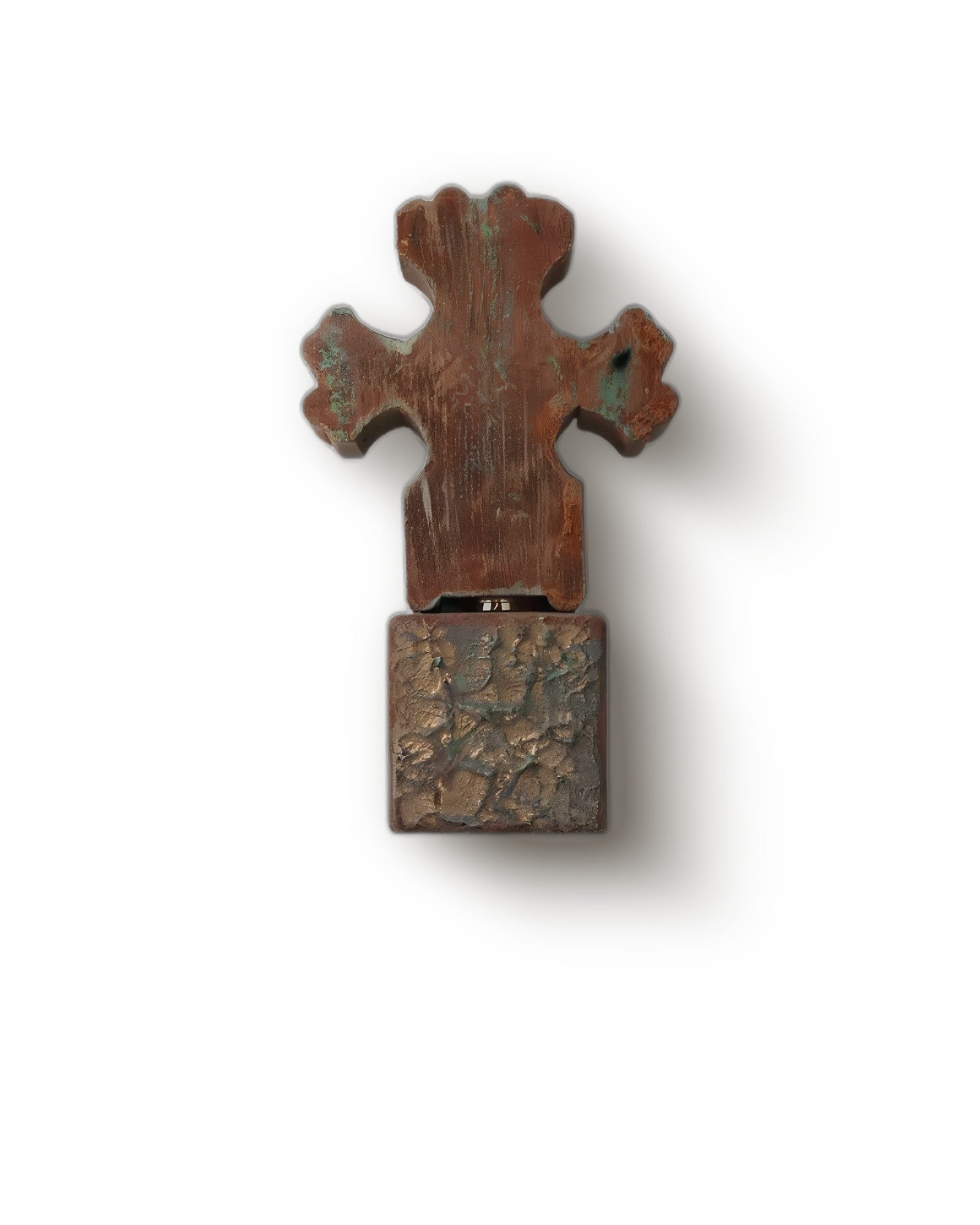


Adi Ale Van
Afterlife Potion
Afterlife Potion opens on a breath of white flowers, narcotic tuberose and jasmine, before the floor gives way to something older and darker: dry nagarmotha, pale white oud and agarwood threaded with spikenard, sinking into incense, dust and a frankly animalic base of castoreum and civet. It smells like a sacred room sealed for a very long time.
The Story
Adi Ale Van builds Afterlife Potion as a passage rather than a perfume, from the living brightness of fresh blooms into the still, resinous air of what comes after. Natural oud, labdanum and raw animalics are left deliberately untamed, giving it the weight and shadow of a ritual.
The Nose
Composed by Giovanni Festa for Adi Ale Van, also behind Perseide - Elixir of Stars Dust and The Book of Wisdom - Elixir Fatal.


Amber
Golden resin glowing warm
A soft, resinous glow built from labdanum, benzoin, and vanilla, sweet but dusky, like sun-warmed tree sap with a hint of incense smoke. It radiates a cozy, golden heat that wraps close to the skin and lingers.


Oud
Dark resinous wood with depth
A dense, resinous wood that smells warm and slightly medicinal, with a leathery, animal-tinged smokiness and a sweet, almost barnyard funk underneath. It feels ancient and brooding, wrapping the skin in something thick and quietly powerful.


Earthy
Damp soil after the rain
The mineral smell of wet ground, root vegetables pulled from the dirt, and beets turned over in a garden. Cool, raw, and faintly bitter, it grounds a fragrance with the dark, humid breath of the forest floor.


Woody
Dry grain of cut timber
The smell of cedar shavings, sandalwood, and dry vetiver roots, a sanded, resinous warmth with a faint pencil-box rasp. It feels grounded and composed, the quiet backbone that makes a scent read as serious and lasting.


Smoky
Charred wood and rising embers
The dry, charred scent of burning wood, smoldering incense, and lingering ash, sometimes tarry, sometimes wispy and gray. It feels brooding and atmospheric, conjuring a dying fire and a cool current of air carrying its last breath.


Balsamic
Warm resin and sweet amber
A warm, syrupy richness of tree resins and golden amber, soft and slightly sweet with a vanillic, almost honeyed glow. It feels enveloping and slow, settling into the skin like candlelight, comforting and faintly sacred.


Tuberose
Carnal white flower that opens after dark
What it is
The waxy white flower of Polianthes tuberosa, a bulb native to Mexico and now grown chiefly in India and Egypt. Historically captured by enfleurage onto fat; today the picked blossoms are solvent-extracted to a concrete, which is then washed with alcohol to yield the absolute.
How it smells
A heady, creamy white floral with a buttery lactonic richness, green sappy edges and a mentholated coolness on top. Beneath runs a warm, almost fleshy and indolic depth tinged with eugenol spice, giving tuberose its famously narcotic, sometimes overwhelming character.
In perfumery
A powerful heart note prized for its diffusive, three-dimensional presence, often built around gardenia, jasmine, orange blossom and coconut-lactonic accords. It defines bold white florals and the great tuberose soliflores, the benchmark by which others are judged.
Good to know
Tuberose absolute is among the costliest florals, with sources citing roughly 6,000 to 8,000 kilograms of fresh flowers for a single kilogram of absolute. The blossoms keep releasing scent after picking, the very property that once made the slow enfleurage method worthwhile.


Jasmine
The heady white flower at perfumery's beating heart
What it is
Jasmine is the blossom of climbing shrubs in the olive family, chiefly Jasminum grandiflorum, grown in Egypt, India and Morocco, plus Jasminum sambac from India. The fragile flowers are hand-picked at dawn, solvent-extracted with hexane into a waxy concrete, then washed with ethanol to yield the absolute.
How it smells
A warm, lush white floral, sweet and honeyed with an animalic underside. Sambac leans fruity, tea-like and dense; grandiflorum reads creamier and greener on top. Both carry a heady, narcotic richness over a green-fruity opening, drying to a soft, skin-warm, faintly mushroomy-musky base.
In perfumery
A heart-note cornerstone, bridging citrus tops and woody bases while lending volume, sensuality and rounded floral body. It pairs with rose, tuberose, ylang-ylang, sandalwood and musk. Jasmine anchors many of the great classic florals and can stand alone as a radiant soliflore.
Good to know
Roughly eight thousand hand-picked flowers yield a single gram of absolute, ranking natural jasmine among the costliest perfume materials. Much of its depth comes from indole, a molecule smelling of mothballs or decay when concentrated, yet radiant and living in the trace amounts the flower naturally holds.


Nagarmotha
Indian sedge root, smoky earth and dry wood
What it is
Also called cypriol, the essential oil steam-distilled from the dried tuberous roots of Cyperus scariosus, an aromatic sedge native to India and grown in marshy ground across Rajasthan and Madhya Pradesh. Yields are low, giving a dark, viscous oil; the name traces to Sanskrit nagaramusta.
How it smells
Deeply woody, earthy and dry, with a peppery bite from rotundone, the same molecule behind black pepper and Syrah wine. A smoky, leathery thread runs through it, recalling vetiver, cedar and patchouli edged with dry-resinous coolness. It feels rooty and austere, never sweet.
In perfumery
A long-lasting base note used for grounding and a smoky woody spine, often standing in for patchouli or as an affordable natural nod toward oud. It blends with iris, ionones, oakmoss, labdanum and frankincense, lending dry smoke to many modern oud-leaning compositions.
Good to know
The plant is a relative of papyrus and is widely treated as a weed in India, yet its underground tubers are valued in both Ayurvedic medicine and perfumery. Its smoky-woody depth makes it a frequent natural substitute when genuine agarwood is too costly.


White Oud
Marketing's clean oud, rarely real agarwood
What it is
A modern label rather than a single material. Usually a synthetic oud accord built from guaiacwood, cypriol, Iso E Super and amber-smoke molecules. Occasionally it names real Aetoxylon sympetalum oil from Borneo, a separate species marketed as oud but not true Aquilaria agarwood at all.
How it smells
Clean, dry and polished, with the heavy fermented and fecal facets stripped away. Soft creamy woods, faint sweetness, a whisper of smoke and fresh-linen musk. The Aetoxylon version reads as grey wood, peppery balsam and light leather, smoky and faintly animalic but never barnyard.
In perfumery
The dominant face of Western oud, since the overwhelming majority of commercial oud fragrance is reconstructed rather than distilled. White oud lets houses market the prestige of agarwood at a fraction of the cost, with stable, crowd-pleasing performance and none of the polarizing funk of the natural oil.
Good to know
White oud almost never contains distilled Aquilaria agarwood. The phrase signals a cleaned-up impression, whether a synthetic accord or the real but botanically distinct Aetoxylon wood. It is a legitimate aesthetic, not a deception, so long as it is not sold as the genuine resinous article.


Costus
Warm hair and skin, animalic and unsettling
What it is
Costus root oil is steam-distilled or solvent-extracted from the dried roots of Saussurea costus, a tall thistle-like herb of the high Himalayas, known in India as kuth. The aged roots are processed to yield a thick, dark, intensely odorous oil rich in sesquiterpene lactones.
How it smells
Deeply animalic and warm, smelling of unwashed human hair, scalp and worn wool, with a greasy, slightly fatty earthiness. Some find a dry-orris violet facet beneath the funk; others read it as wet dog or old leather. It is dense, lingering and faintly sweet on the dry-down.
In perfumery
Historically a base-note fixative lending startling skin-like warmth and animalic depth to chypres, leathers and orientals, smoothing rough edges and adding lived-in intimacy. It textured many vintage classics. Today perfumers reach for synthetic recreations such as Costus Oliffac to capture its wet-dog, hair-like signature safely.
Good to know
Natural costus has effectively vanished from modern perfumery. IFRA prohibited its oil, absolute and concrete in 2006 as a potent skin sensitizer, and Saussurea costus has been CITES Appendix I protected since 1985 and listed as critically endangered after steep declines from overharvesting.


Natural Oud
Real distilled agarwood, alive and animalic
What it is
Oil distilled from genuine agarwood: the dark resin a wild or cultivated Aquilaria tree forms to defend itself against mould and injury. The infected heartwood is ground, soaked, fermented and slowly distilled, then often aged for years. A single oil can carry well over a hundred volatile compounds.
How it smells
A shifting, living scent rather than a fixed note: resinous and smoky, swinging between barnyard and incense, leather, dried fruit, honey, earth and warm skin. It often opens raw and animalic, then settles into something meditative and golden, rarely the same twice across an evening.
In perfumery
Real distilled oud is rare in commercial scent because the oil outprices gold and Aquilaria sits under CITES protection. Mostly it lives in artisanal all-natural houses that distill and age their own oils for connoisseurs rather than mass markets.
Good to know
Origin and distillation decide everything: species, soil, fermentation time and the still itself. Quality also rises with age, as harsh fermented top notes mellow into smoother resin. The barnyard funk that startles newcomers is the signature of the genuine article, not a flaw to be scrubbed away.


Nard Himalayan (Jatamansi)
High-mountain root of damp earth and old wood
What it is
Spikenard, the amber oil steam-distilled from the rhizomes of Nardostachys jatamansi, a small flowering perennial of the Himalayas growing at roughly three to five thousand metres through Nepal, Sikkim, Kumaon and Bhutan. The aromatic underground rhizomes are dug by hand, dried, then distilled.
How it smells
Heavy, rooty and musty, smelling of damp earth, old wood and moss with a faintly animalic edge. Close to its relative valerian but darker and warmer, it carries a spicy-bitter undertone that can read almost goat-like at full strength, settling into a deep, calming, soil-like base.
In perfumery
A grounding base note adding earthy gravity and a strange, ancient depth. It works in chypres, incense blends and meditative orientals, pairing with vetiver, patchouli, oakmoss, frankincense and rose to lend a rooted, primeval quality beneath brighter heart notes.
Good to know
This is the biblical nard the Gospel describes being poured over Christ's feet, prized in the ancient world as costly perfume. Overharvesting has made wild Nardostachys jatamansi a protected, threatened species, so responsible sourcing and cultivation now matter greatly.


Labdanum
Sticky amber resin scraped from sun-baked rockrose
What it is
Labdanum is a dark, sticky resin from the rockrose shrub Cistus ladanifer, native to the western Mediterranean. The plant exudes a fragrant gum on its leaves and twigs in summer heat; branches are boiled or scraped to recover the crude resin, which is then solvent-extracted into absolute and resinoid.
How it smells
Deep, warm and balsamic with leathery, animalic and faintly sweet facets that read as soft amber. Dried-fruit, honey, smoke and pine undertones run through it. It opens resinous and almost ambergris-like, then dries into a brown tobacco-and-leather warmth that lingers for hours.
In perfumery
A foundational base note and the natural backbone of most amber accords, usually built with vanilla and benzoin. A strong fixative, it deepens chypres, orientals and leathers and pairs with rose, oakmoss and incense. It underpins many golden-age oriental classics and countless amber compositions.
Good to know
In antiquity labdanum was combed from the matted beards and thighs of goats and sheep that had browsed through cistus thickets, then raked off with a toothed tool called a ladanisterion. It is one of the oldest aromatic materials, predating distillation by millennia.


Incense
Sacred smoke curling from resin and embers
What it is
In perfumery, incense usually means olibanum, the oleo-gum-resin of Boswellia trees from Oman, Somalia and Ethiopia. The bark is slashed, weeps a milky exudate that hardens into amber tears, and these are steam-distilled to an essential oil or solvent-extracted to an absolute; blends often add labdanum and styrax.
How it smells
Cool, dry and resinous, with a sharp citrus-pine lift over smoky, peppery warmth. There is a clean church-air quality: balsamic, slightly soapy, faintly green. It opens bright and turpentine-fresh, then settles into a meditative, ashen-sweet woodiness that lingers close to the skin.
In perfumery
A heart-to-base material prized for its contemplative, smoky-resinous character. It cools florals, sharpens woods and lends ritual gravity to oriental and chypre accords. It defines the great church-incense scents and the cold, mineral incense of many a meditative niche composition.
Good to know
Frankincense was once worth its weight in gold, carried along ancient Arabian caravan routes to temples across the Mediterranean and beyond. Wild Boswellia stands are now threatened by over-tapping, grazing and climate stress, prompting growing interest in sustainable harvesting and tapping quotas.


Dust
The dry mineral hush of forgotten rooms
What it is
Dust is an abstract, conceptual note rather than a single raw material, evoking the scent of fine settled particles, dry earth and aged paper. Perfumers build it from mineral, papery and faintly metallic materials, often combining dry woods, ambergris-like molecules, chalky isolates and traces of synthetic earth and stone accords.
How it smells
Dry, still and faintly mineral: warm stone in sunlight, chalk, old books and yellowed paper, with a powdery, almost electric tang of static and sun-baked particles. It carries no sweetness or freshness, reading instead as silent, suspended and slightly melancholic, like the air in a closed attic.
In perfumery
A textural heart-to-base effect used to add atmosphere, age and quiet stillness. It deepens woody, mineral and incense compositions and lends gourmand or floral scents a haunted, antique edge. It appears in conceptual paper-and-stone fragrances and the parched mineral facets of avant-garde houses.
Good to know
The smell people associate with dust is largely the scent of its contents: shed skin cells, textile fibers, paper, soil minerals and microbes. Rendering it in perfume is an act of pure suggestion, since no single flower or resin actually smells of dust on its own.


Resins
The amber backbone of incense and warmth
What it is
Resins are aromatic exudates that trees and shrubs secrete to seal wounds in their bark. Tapping species like Boswellia (frankincense), Commiphora (myrrh), Styrax (benzoin) and Cistus (labdanum) yields milky tears that harden in air, then become resinoids and absolutes through solvent extraction or steam distillation.
How it smells
Warm, sweet and balsamic at the core, ranging from frankincense's cool, peppery, lemon-pine smoke to myrrh's bittersweet medicinal earth, benzoin's vanilla-cinnamon caramel and labdanum's leathery, ambered honey. Most open with terpenic brightness, then dry down to a rounded, glowing, sticky-sweet base.
In perfumery
Resins anchor the base, adding warmth, fixation and an incense or oriental character that extends wear. They pair with amber, vanilla, spice, rose and woods. Frankincense drives some of perfumery's great incense compositions, while benzoin and labdanum build the classic sweet ambers.
Good to know
Frankincense and myrrh were once valued like gold, traded along the ancient Incense Route and named among the Magi's gifts. Today wild Boswellia stands are declining from over-tapping and habitat loss, prompting sustainability concern over one of perfumery's oldest materials.


Amber
A warm resinous glow built, not harvested
What it is
Amber is not one ingredient but a perfumer's accord, most often blending labdanum (a sticky resin from the Mediterranean rockrose shrub Cistus ladanifer), benzoin and vanilla, sometimes with tonka or Peru balsam. Despite the name, it has no link to fossilized tree amber, which stays odorless on skin.
How it smells
Warm, soft and balsamic, a powdery sweetness sitting over dry resin. It opens honeyed and faintly animalic from labdanum, then settles into rounded golden warmth recalling beeswax, tobacco and worn leather, threaded with a quiet smoky, incense-like undertone that lingers close to the skin.
In perfumery
A base note prized for warmth, depth and long persistence, anchoring oriental and amber compositions. It pairs naturally with vanilla, patchouli, sandalwood and spices. The sweet vanilla-amber template is a perfumery classic, while drier, resin-forward and herbal readings show its other face.
Good to know
The word once meant ambergris, the waxy intestinal secretion of sperm whales, fueling centuries of confusion among three unrelated things: fossil tree amber, whale ambergris and the resin accord. Modern amber bases are wholly plant and synthetic, leaning on molecules like Ambroxan rather than any animal source.


Castoreum
Leather and warmth drawn from the beaver
What it is
An animal secretion from the castor sacs, scent glands near the base of the tail in both male and female beavers, where it blends with urine to mark territory. Trappers dry the sacs, then extract a tincture, resinoid or absolute. Most modern perfumery now relies on synthetic recreations.
How it smells
Dark, warm and leathery, with smoky, tar-like and faintly medicinal birch-tar facets. Beneath the animalic depth sit sweeter tones of dried fruit, hay and vanilla, plus a whiff of new leather and woodsmoke. Heavily diluted, it turns soft, suede-like and skin-warm.
In perfumery
A base-note fixative bringing leather, animalic warmth and long tenacity. It anchors chypres, fougeres and leather scents, pairing with birch tar, labdanum, oakmoss and tobacco. Castoreum builds the hide of leather scents, the warm drydown of classic orientals and the smoky depth of vintage Russian-leather styles.
Good to know
Beavers eat willow and poplar bark rich in salicin, giving castoreum a salicylate, almost aspirin-like character. It has long been a food flavoring labeled as natural flavors, classed GRAS, though falling use and ethical concerns mean genuine castoreum is now rare and mostly synthetic.


Civet
Animal warmth that makes flowers bloom indecent
What it is
A glandular paste from the African civet, a nocturnal cat-like mammal secreting it from a perineal pouch, historically scraped out by hand and tinctured in alcohol. Modern perfumery instead uses synthetic civetone, a large-ring ketone whose macrocyclic structure was elucidated by Leopold Ruzicka in 1926.
How it smells
Raw and undiluted it is shockingly fecal, pungent and indolic, edged with skatole and sour butter. Diluted to traces it turns warm, honeyed and slightly leathery, with a tobacco hum and skin-like radiance. The shift from repellent to alluring happens entirely through dilution.
In perfumery
A base-note fixative valued for radiance and carnal warmth, lending florals a living, skin-like glow. Classic alongside jasmine and rose in animalic chypres and orientals. Trace civet shaped many vintage aldehydic florals and ambery orientals before synthetic civetone displaced the natural material.
Good to know
Traditional civet farming caged animals in cruel conditions to harvest the paste, driving a near-total switch to synthetic civetone on ethical grounds. This perfumery civet is unrelated to the Asian palm civet behind kopi luwak coffee, a separate species entirely.
Fragrance Character
The opening is luminous and heady, tuberose and jasmine projecting strongly, before the oud-and-incense heart pulls everything into shadow. Spikenard and costus add a green, rooty bitterness; labdanum and amber warm the drydown while castoreum and civet keep it close, leathery and alive, dust and resin settling over it like the patina of age.


Longevity
how long it stays on skin
This gauge reads the expected wear time, how many hours the fragrance keeps speaking on skin before it fades. A marker near the low end means a few fleeting hours, while a marker pushed to the far end promises a scent still present from morning into night.


Sillage
the size of its scent trail
This reads how far the fragrance reaches beyond you and the trail it leaves behind. Low sits soft against the skin, an intimate whisper noticed only up close; high climbs through moderate and strong toward enormous, filling a room and lingering in the air after you have left it.


Experimental
For the bold and curious
Unconventional, boundary-pushing scents for someone who wants to provoke a reaction and stand apart. Suited to artistic, challenging compositions: inky tar, rubber, fermented fruit, metallic or animalic facets that defy easy liking. On this wheel a glowing coin means it rewards the adventurous nose, a dim one means it plays things safe.


Office
Polished but never overpowering
Close-quarters professional settings where a scent should be noticed only by those near you. Suited to restrained, clean compositions with modest projection: tidy citrus, soft musk, pale woods that read competent and considerate. On this wheel a glowing coin means it works in shared workspaces, a dim one means it carries too far.


Evening
After dark, turned up
Dinners, drinks, and nights out when a fragrance can deepen and project with confidence. Suited to richer, warmer compositions: ambers, resins, smoky woods, or plush florals that bloom under low light. On this wheel a glowing coin means the scent comes alive after sundown, a dim one means it stays better suited to daytime.


Romantic
Close enough to be felt
Intimate moments and date nights meant to draw someone nearer. Suited to warm, sensual compositions that hum against skin: creamy florals, vanilla, soft musk, a touch of spice or amber that invites closeness. On this wheel a glowing coin means it sets an alluring mood, a dim one means it leans more practical than seductive.


Formal
Refined for the occasion that matters
Weddings, ceremonies, galas, and dressed-up affairs that call for composure and elegance. Suited to polished, structured scents with quiet authority: smooth woods, refined florals, soft leather, nothing loud or playful. On this wheel a glowing coin means it carries the right gravitas, a dim one means it feels too casual for the room.


Casual
Easy comfort for unhurried days
Everyday wear with no agenda: errands, coffee, friends, a slow weekend. Suited to soft, approachable scents that feel clean and natural, like fresh citrus, light woods, or a gentle skin warmth. On this wheel a glowing coin means the fragrance fits these laid-back moments, a dim one means it asks for more.


Day to Night
where its mood naturally falls
This slider reads the hour the fragrance was made for. A marker to the left leans luminous and bright, easy in daylight and open air; slide it right and the character turns deeper and warmer, the kind of presence that belongs to evening and candlelit rooms.


Winter
Warmth that carries through cold air
Cold air mutes and slows a fragrance, so winter rewards the dense and the warm: resins, smoke, vanilla, leather, and ambered spice that radiate heat against the chill. The bar shows how strongly this particular scent holds up and glows in cold weather.


Spring
Fresh blooms in mild, rising warmth
Mild, humid air lifts lighter compositions beautifully, so spring favors dewy florals, green stems, soft powder, and transparent citrus that feel alive rather than heavy. The bar shows how well this particular scent matches that fresh, gently warming season.


Summer
Bright and airy in real heat
Heat amplifies and projects scent hard, so summer calls for cool, crisp, breathable things: sharp citrus, salty marine air, aromatic herbs, and watery freshness that refresh instead of cloy. The bar shows how comfortably this particular scent wears in real warmth.


Fall
Spiced warmth for cooling days
As temperatures drop, richer materials read clearly without smothering, so autumn suits dry woods, warm spice, tobacco, amber, and golden fruit that feel cozy and contemplative. The bar shows how naturally this particular scent settles into crisp, cooling days.
Best Worn
For the fragrance lover who relishes the unexpected, this is a deep-winter, after-dark composition for late autumn nights out and intimate evenings where its heady florals and shadowed oud are worn close.
Why the Afterlife Potion Decant
An uncompromising, animalic all-natural composition, exactly the kind of scent to live with on skin for an evening before committing to a full bottle.
Official Notes
Tuberose · Jasmine · Nagarmotha · White Oud · Costus · Agarwood · Nard Himalayan (Jatamansi) · Labdanum · Incense · Dust · Resins · Amber · Castoreum · Civet
Choose options
The Vibe


More from Adi Ale Van
You may also like
Select your decant size

You are selecting a decant size, not the full bottle