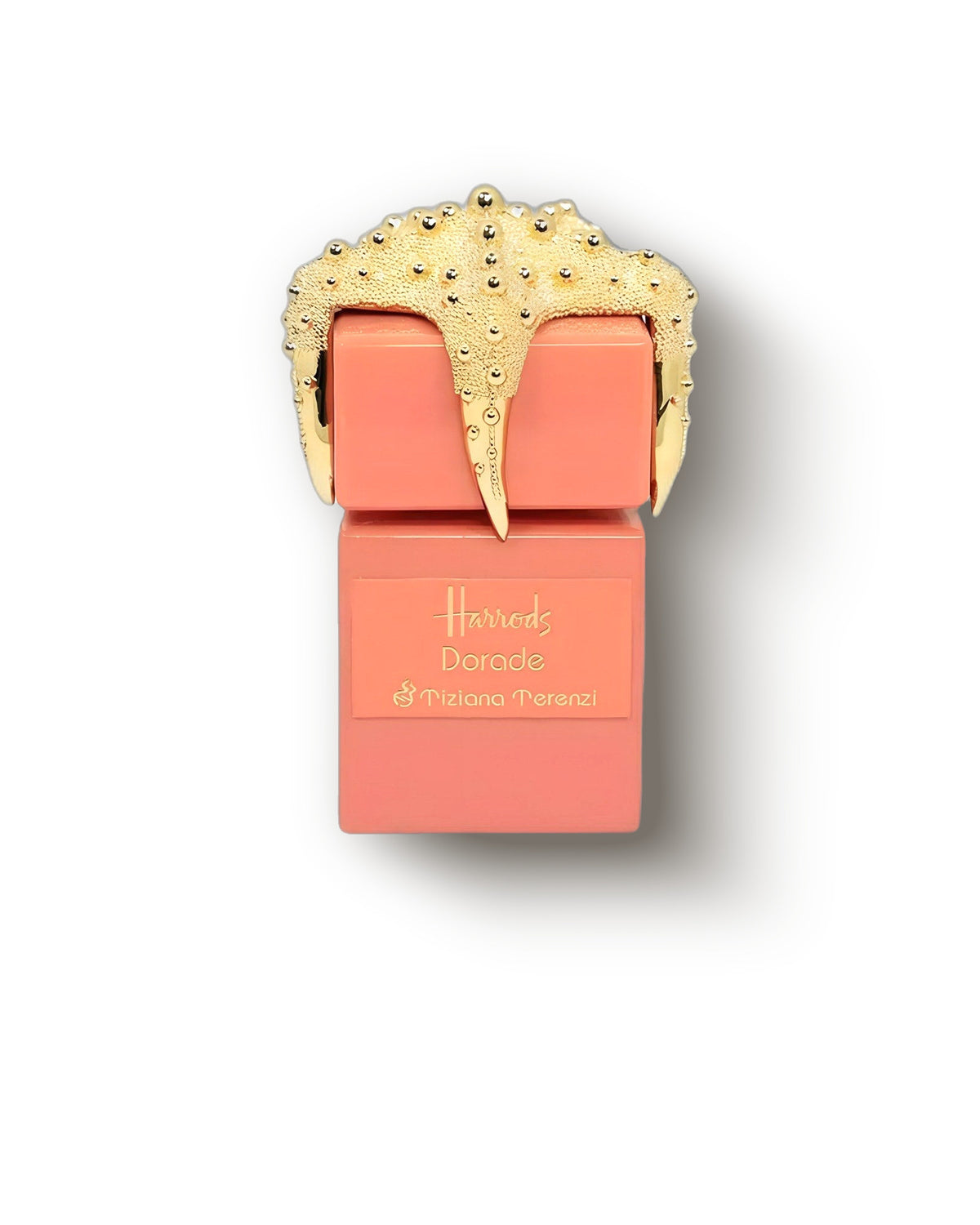
Tiziana Terenzi
Dorade
The Story
Dorade is named for the yacht designed in 1929 that changed offshore racing, and it was made as a Harrods exclusive for the Sea Stars collection. The maritime reference is structural rather than decorative, salt and air held over a warm base.


Woody
Dry grain of cut timber
The smell of cedar shavings, sandalwood, and dry vetiver roots, a sanded, resinous warmth with a faint pencil-box rasp. It feels grounded and composed, the quiet backbone that makes a scent read as serious and lasting.


Aromatic
Crushed herbs in cool air
The green, camphorous coolness of lavender, rosemary, sage, and thyme, like herbs bruised between the fingers. It feels clean, invigorating, and a touch austere, the crisp backbone of a classic barbershop freshness.


Amber
Resin warmed until it goes sweet
Labdanum, benzoin and vanilla melted together into something sweet but dusky, like tree sap gone soft in the sun with a thread of incense smoke through it. Amber does not sparkle or shout. It sits close to the skin and gives off heat for hours.


Camphor
cool medicinal vapor that clears the head
A sharp, cooling, almost menthol vapor with a piney, medicinal bite that tingles in the nose. It feels bracing and austere, conjuring eucalyptus rubs and old apothecary shelves, mysterious and faintly ascetic against richer resins.


Yellow Floral
Sunlit mimosa, ylang and champaca
Mimosa, ylang-ylang, champaca, broom: the flowers that smell yellow. Honeyed and faintly buttery, with an indolic hum under the sweetness and none of a white floral's coolness. A garden at noon, pushed to the edge of overripe.


White Floral
The flowers you smell across a garden
Jasmine and tuberose share it: thick creamy petals with a ripe, almost animal sweetness underneath, the indole that keeps big florals from ever smelling polite. Green at the edges, overripe fruit in the middle, and louder on warm skin.


Eucalyptus
Sharp medicinal vapor that clears the head
What it is
Australian trees whose leaves carry so much oil that a hot day makes the whole grove smell of them. Steam-distil the leaves and you get an oil built almost entirely on one molecule: eucalyptol.
How it smells
Cool and penetrating, a sharp medicinal bite that seems to physically open the sinuses. Green, faintly woody facets sit under the ice. It reads clean to the point of clinical, then fades to dry leaf.
In perfumery
Perfumers buy it for one thing: the cooling rush at the top of a fragrance. It lifts lavender, rosemary and mint, sharpens green and marine accords, and gives aromatic fougeres and spa-style scents their bracing edge.
Good to know
The oil that scents the air on a hot day is the same oil that helps a bushfire run through the canopy. It is just as forceful in a formula: one drop can take over a blend.

Santolina
Cotton lavender, and no relation to lavender
What it is
It is called cotton lavender and it is a daisy. Low silver mounds of feathery foliage and yellow button flowers, grown across the western Mediterranean and steam-distilled into a sunshine-yellow oil.
How it smells
Dry, camphorous and properly bitter, closer to chamomile and yarrow than to anything soft. A flash of red berry opens it, then a green, slightly boozy medicinal heart that stays sharp all the way down.
In perfumery
Perfumers use it in small strokes, at the top and into the heart, to scorch a fougere or a chypre with dry bitter green. Lavender, sage and oakmoss take it well. It accents; it never carries.
Good to know
Its name is usually traced to the Latin for holy flax, and sprigs hung in wardrobes and rooms were used to keep moths and fleas away. Renaissance gardeners clipped it into knot gardens.


Lemon
Cold yellow zest snapping into bright sun
What it is
Squeezed, not distilled: the colored rind is pressed and scraped until the glands give up their oil. Argentina presses the most, and Sicily gives the classic perfumery grade. The tree's white blossom is a different note entirely.
How it smells
Tart, green and fizzing, all cold rind and mouth-watering sourness, with a faint sweet pith underneath and a waxy edge from the peel itself. Enjoy it fast: it is gone within minutes.
In perfumery
It powers the eau de cologne tradition, working with bergamot, neroli and petitgrain to open a fragrance in full sunlight. Because it burns off so fast, perfumers reinforce it with citral.
Good to know
Cold-pressed lemon carries furocoumarins that leave skin liable to burn in sunlight, so perfumers often reach for a grade with the sun-sensitizing compounds removed. It also spoils in the bottle, oxidizing toward turpentine, which is why citrus fragrances are hard to stabilize.


Palisander Rosewood
Creamy rose-wood with a peachy glow
What it is
Perfumery's rosewood is bois de rose, an Amazonian laurel whose freshly cut timber smells of roses. It is not the palisander of furniture and guitar backs, which is a different tree entirely.
How it smells
Sweet, rosy and creamy rather than dry, with a peachy blush and a faint camphor lift on the opening. Lighter than sandalwood, more floral than cedar. The drydown is warm, balsamic and rounded.
In perfumery
A heart note that sits between the florals and the woods, brightening both. Rose, jasmine, vetiver and citrus all take to it, and many of the great aldehydic florals leaned on Brazilian rosewood oil.
Good to know
Almost no plant carries more linalool: the oil ran up to ninety percent of it, and cutting for that molecule stripped out the wild stands. The sustainable route now is oil distilled from leaves and twigs pruned off planted trees, which are left standing.


Black Pepper
Dry heat that prickles and sharpens
What it is
Peppercorns start out green; drying is what turns them black and wrinkled. They grow on a climbing vine, and the scent is drawn out by steam or by CO2.
How it smells
Sharp and dry, a bite that tingles the inside of your nose. Underneath, woody and resinous with a lift of citrus. The distilled oil is airy; the CO2 extract smells like a peppercorn cracked a second ago.
In perfumery
It snaps a fragrance awake from the top, then works lower down as a foil for rose, vetiver and amber. Some are built on nothing but that dry crackle over cedar, which turns out to be enough.
Good to know
Pepper was once used as currency and accepted as rent. And the heat you taste is piperine, which is too heavy to travel in a distillation, so the oil smells peppery without burning anything at all.
Clary Sage
Herbal ambery haze with a wine-like lift
What it is
Cut in flower, this tall biennial of the mint family is steam-distilled from its tops and leaves; a heavier concrete and absolute are made too. Nothing about the plant hints at what perfumery does with it.
How it smells
Green and hay-like at first, with a nutty edge and something distinctly winey, as if the herb had been left to ferment. Underneath runs a clean musk. It dries down warm, rounded and faintly tobacco-sweet.
In perfumery
Perfumers place it between top and heart, where it adds roundness and holds the volatile notes down a little longer. It is the quiet backbone of the fougere, sitting beside lavender, bergamot and oakmoss in the barbershop classics.
Good to know
Clary sage gives sclareol, the natural starting point for Ambrox, the synthetic that stands in for ambergris in modern perfumery. A field herb underwrites the amber category. Folk tradition read the name as clear-eye, after an old remedy for sore eyes.

Jasmine
The heady white flower at perfumery's beating heart
What it is
Picking runs by hand in the dark, from before first light into the morning. The blossoms are too fragile to distill, so solvent lifts their oil into a waxy concrete, and alcohol washes the absolute out of that.
How it smells
Sweet, heavy and honeyed, with something faintly animal underneath. Sambac reads green, tea-like and luminous; grandiflorum is fruitier, creamier, heavier on the skin. Both dry down warm and soft, with a mushroomy musk you notice only up close.
In perfumery
Put it in the heart and it ties a citrus opening to the woods underneath, adding volume to both. Rose, tuberose, sandalwood and musk all take it well. Plenty of perfumes are built on jasmine and nothing else.
Good to know
Roughly six thousand hand-picked blossoms go into one gram of absolute, among the costliest materials in perfumery. Part of its depth is indole, which smells like decay when concentrated and turns radiant at the trace the flower carries.
Broom
Honeyed hay of the Mediterranean hillside
What it is
Spanish broom turns whole Mediterranean hillsides yellow, and the perfume trade calls its absolute genet. A tonne of those blossoms, run through solvent and washed with alcohol, comes back as under half a kilogram of it.
How it smells
Hay, but sweetened: dried meadow grass and tobacco leaf soaked in honey. A rosy brightness sits on top, something earthy and faintly animal underneath, and the whole thing thickens as it dries into a golden, almost waxy warmth.
In perfumery
Heart and base at the same time, rounding off sharp edges and giving tobacco, leather and florals somewhere soft to land. Put it next to rose, tuberose or mimosa. Chypres take their dried-grass sweetness from it.
Good to know
Before it was a perfume, broom was rope: Greeks and Romans retted its tough stems into cordage and fishing nets. The absolute is a far smaller trade, rarer than the mimosa it usually travels with.


Benzoin
Warm vanilla balsam wept from a tapped tree
What it is
Benzoin does not flow on its own. Someone cuts the bark of a styrax tree in Laos, Vietnam or Sumatra, and the wound weeps a gum that hardens over months into reddish tears.
How it smells
Sweet, warm, unmistakably vanillic, with a powdery amber softness underneath. Siam benzoin is rounder and creamier; Sumatra runs smokier, with a cinnamon bite. Left on skin it turns almost caramelized.
In perfumery
A base note that behaves like a fixative and a sweetener at once, giving amber accords their glow and holding the rest of the composition still. It softens sharp edges beside labdanum, tonka and incense.
Good to know
The word benzene comes from here. Chemists named benzoic acid after this resin, and benzene took its name from the acid. The resin's own name is a worn-down Arabic phrase, luban jawi, frankincense of Java.


Coumarin
White crystals that smell of mown hay
What it is
Tonka beans carry it, so do sweet clover, sweetgrass and woodruff, and in pure form it arrives as small white crystals. Almost all the coumarin in perfumery is now made rather than picked.
How it smells
Hay drying in a field, then almond, vanilla and a little tobacco behind it. It is soft rather than loud, powdery, faintly nutty, and it lingers as warmth more than as a smell you can point at.
In perfumery
Base note, and the quiet half of the fougere: lavender up front, oakmoss underneath, coumarin holding the two together. It also sweetens ambers and gourmands, leaving a faint hay hum under perfumes you would never call hay.
Good to know
In 1882 a commercial perfume used synthetic coumarin for the first time. That perfume founded the fougere family. The dose is capped now over skin sensitivity; the habit never broke.


Ambergris
A warm, salty glow that hangs in the air
What it is
On a note list, ambergris is almost always an accord built on Ambroxan-type molecules, since real ambergris is rare and turns up only by chance, on a shoreline or at sea.
How it smells
These accords smell warm, salty and skin-like, closer to a glow than to a smell. A dry mineral sweetness runs through them, with hints of driftwood, blond woods and sun-warmed skin, and no sharp edge anywhere.
In perfumery
An ambergris note works from the base. It lends radiance and hold, pushes woods and ambers outward and gives a composition the breathing, sun-warmed quality that so many modern scents share.
Good to know
Ambroxan-type molecules work in a curious way: right on the skin they can seem faint, yet a step away they fill the air. They are also remarkably long-lasting, often clinging to a scarf or a jumper long after the skin has let go.

Sequoia
A forest almost nobody distils
What it is
Almost no perfumer has ever had real redwood to work with. The wood gives almost nothing back, so the note is assembled instead from cedar fractions, vetiver, fir and mossy amber bases that stand in for standing timber.
How it smells
Dry timber and warm bark dust threaded with cool coniferous resin and damp earth. It opens green and mineral, like fog settling into fissured red bark, then shades into a quiet woodiness with smoke somewhere underneath.
In perfumery
A base accord lending weight and shade to woody compositions, pairing with cedar, vetiver, moss and incense. A few niche houses frame the idea head-on and build a whole fragrance around timber nobody can bottle.
Good to know
Coast redwoods are the tallest living things on Earth, and some giant sequoias were standing before Rome. The giant groves sit mostly on protected public land, while coast redwood is an ordinary timber tree. Neither is much use to a distiller.


Australian Sandalwood
Drier, resinous cousin of the milky woods
What it is
The tree is pulled out of the ground, not cut down: its roots hold the richest oil. A hemiparasite of Western Australia's dry rangelands, it is chipped and steam-distilled over several days.
How it smells
Drier and sharper than the Indian wood, with a resinous, faintly bitter edge where you expect cream. A soft milky balsam sits underneath, a little spice, a little amber. It dries down suede-smooth and stays for hours.
In perfumery
In the base it holds everything else still, smoothing sharp florals and deepening rose, amber and incense. Vetiver and patchouli are natural partners. It stands in for vulnerable Mysore sandalwood, and its supply can be traced.
Good to know
The colony ran on it. By 1848 sandalwood rivalled wool and whale oil among Western Australia's leading exports, shipped to Asian incense markets decades before anyone distilled the oil. Most is still cut from wild rangeland under a state quota.


Birch
Charred bark, old saddles, cool green sap
What it is
Two very different things come off a birch. Bark cooked without air gives birch tar, a black oil thick with phenols, the reason it smells of leather. The leaves and buds give something far greener and lighter.
How it smells
Tar first: a campfire you cannot walk away from, charred wood, old saddle leather, a medicinal sting behind it. The leaf side is the opposite, cool and wet, like snapped green twigs in damp woodland.
In perfumery
In the base it builds the smoky half of leather and the ruggedness of a chypre. Green birch facets do lighter work up top. The dry, tarry leathers of the early twentieth century were built on it.
Good to know
Birch tar was rubbed into Russian leather, or yuft, and that is why the whole genre smells of smoke rather than hide. The crude tar carries compounds no one wants on skin, so perfumers work with purified grades.


Vetiver
Cool damp earth pulled from tangled roots
What it is
Everything worth having is underground. Vetiver grows as a tall tropical grass, but the perfume lives in its roots, a dense fibrous mat that gets dug up, washed, dried and steam-distilled into a thick amber-brown oil.
How it smells
Cool damp soil and cut grass over dry wood. Haitian oil runs smoother and faintly hazelnut-sweet; Java is darker, smokier, more leathery. Underneath both, a bitter grapefruit edge and a green mineral streak that holds for hours.
In perfumery
Perfumers use it to hold a formula down, which is why fougères and chypres reach for it. Citrus, leather and tobacco sit well on top. Push its ashier side forward and it turns severe beside cypress and cedar.
Good to know
The same roots that end up in a bottle get planted on hillsides to hold the soil, gripping ground where nothing else will. Haiti supplies about half the world's vetiver oil, most of it grown on smallholder farms.
Fragrance Character
The first minutes are bright and slightly medicinal, the eucalyptus and pepper cutting through the citrus before the herbaceous heart takes hold. Clary sage and broom give the mid-stage a dry, almost dusty quality, softened by the warm resin of benzoin and coumarin. On the drydown, sequoia and vetiver ground everything in cool wood and earth, with sandalwood and ambergris drawing it close to skin.


Longevity
how long it stays on skin
The hourglass reads wear time: how many hours the fragrance keeps speaking before it fades. A bar that barely leaves the start means a few fleeting hours. One that runs the full length carries from morning into evening. Treat it as typical, not promised. Oily skin holds scent far longer than dry.


Sillage
the size of its scent trail
Sillage is French for a ship's wake, and that is exactly what this measures: how much of the scent reaches the room instead of staying on you. Low is a whisper only close friends catch. Enormous fills the room, then keeps filling it after you leave.


Experimental
Built to provoke, not to please
Some perfumes are made to be liked. These are made to be argued about: inky tar, hot rubber, fruit on the turn, metal and fur where you expected flowers. The coin glows for a scent that provokes and dims for one that plays it safe, which is sometimes the point.


Office
Polished, and never louder than the room
Scent is manners in a shared room. At this range it should reach the person across the desk and stop there: tidy citrus, soft musk, pale woods, all of it reading competent and considerate. A glowing coin means nobody has to mention it. A dim one means it travels.


Evening
After dark, when it deepens
Dinner, drinks, the night that runs long. Low light is where ambers, resins and smoky woods stop being polite, and where a plush floral finally blooms. A glowing coin means it is waiting for exactly this hour. A dim one means it did its best work in daylight.


Romantic
Close enough to be felt
A fragrance can hum against skin instead of announcing itself across a table. That is the register here: creamy florals, vanilla, soft musk, a thread of spice, warm enough to make someone lean in. The coin glows when a scent sets that mood and dims when it is more practical than seductive.


Formal
Quiet authority in a dressed-up room
A wedding, a ceremony, a room where everyone has thought about their shoes. What works here is structure, not volume: smooth woods, disciplined florals, soft leather. A glowing coin means it holds its posture all evening. A dim one means it is too casual for the room.


Casual
Easy comfort for unhurried days
Errands, coffee, a slow Saturday with nowhere to be. Nothing here has to impress anyone, so the fit is soft and easy: fresh citrus, light woods, a little warmth off the skin. A glowing coin says yes to all that. A dim one means the fragrance is asking for a bigger night.


Day to Night
where its mood naturally falls
A bar running from sun to moon, reading the hour the fragrance was made for. The more of it that stays gold, the more the scent belongs to daylight and open air. The further the blue reaches back toward the sun, the deeper and warmer it turns: evening, candlelight, low rooms.


Winter
Warmth that carries through cold air
Cold air mutes a fragrance and slows it down, which is why winter belongs to the dense and the warm: resin, smoke, vanilla, leather, ambered spice. The bar reads how well this one pushes back, glowing against the chill instead of thinning out in it.


Spring
Fresh blooms in mild, rising warmth
Mild, humid air lifts a light composition, so the season belongs to dewy florals, green stems, soft powder and citrus you can see through. Alive rather than heavy. The further the green runs along the bar, the more comfortably this one wears in that weather.


Summer
Bright and airy in real heat
Heat does the projecting for you, which is why the wrong perfume turns unbearable by noon. What survives is cool and breathable: sharp citrus, salt air, aromatic herbs, water. Things that refresh instead of cloy. A short bar here means save it for cooler months.


Fall
Spiced warmth for cooling days
As the air cools, the rich materials stop smothering and start reading clearly: dry woods, warm spice, tobacco, amber, fruit gone golden. It is the season perfume turns contemplative. The bar fills according to how naturally this one settles into crisp, cooling days.
Best Worn
Bright spring and summer daytime wear, a dry, green-edged freshness for unhurried casual hours and the workday, eucalyptus and herbs cutting clean through the light.
Choose options
The Vibe


The Nose

Paolo Terenzi
Perfumer
Nose of Tiziana Terenzi, the Italian house he runs with his sister Tiziana. He learned scent in the family candle and fragrance workshop, taught by his grandfather Guglielmo. He composed Tiziana Terenzi Kirkè and Tiziana Terenzi Dorade.
The Maison

Italian extraits with astronomy on the label and real weight in the bottle.
Tiziana Terenzi comes from a family of candle makers, and the fragrances carry that same interest in slow burn and depth. The extraits are strong, sweet and long lived, built around fruit, amber and resin, and they open very differently from how they finish.
- Origin
- Cattolica, Italy
- Founded
- 2012
- Known for
- Kirke, Orion, Cassiopea

EVERY DECANT
From the original bottle to your door
We buy the original flacon at full retail price, direct from the house.
A medical grade Socorex syringe takes the exact millilitres straight from the flacon.
Packed into the hot foiled box and handed to DHL, every duty already paid. How a decant is made
Similar fragrances
You may also like