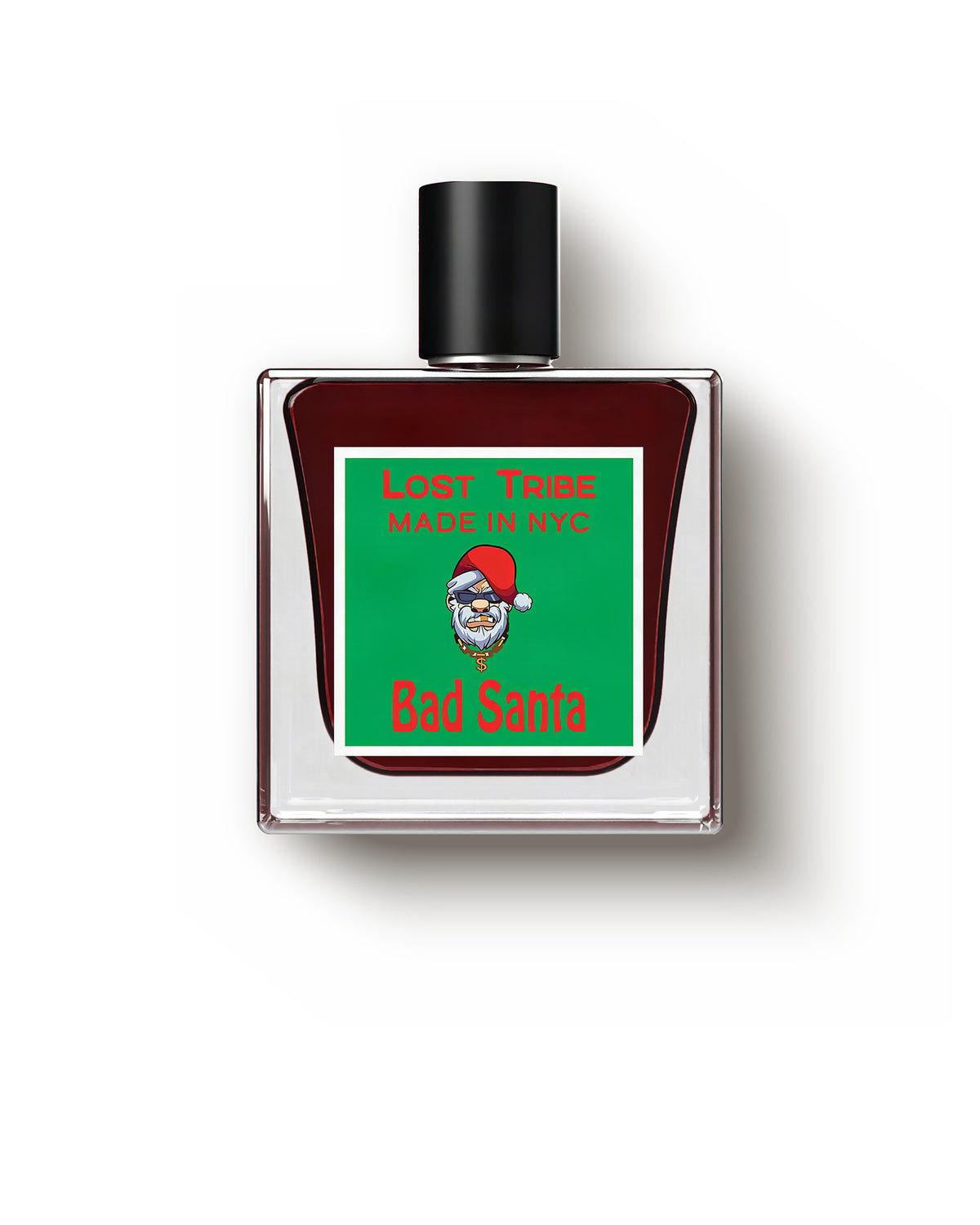
Lost Tribe
Bad Santa
The Story
Someone has hung a worn red suit in a cellar of French oak barrels, next to tobacco leaves and a freshly emptied cask. Lost Tribe took the name from the film and made a holiday amber, resins wrapped in vanilla and orange, with tobacco and dry oak so the sweetness never quite behaves.


Amber
Resin warmed until it goes sweet
Labdanum, benzoin and vanilla melted together into something sweet but dusky, like tree sap gone soft in the sun with a thread of incense smoke through it. Amber does not sparkle or shout. It gives off heat for hours.


Sweet
Warm sugar you cannot quite name
Caramel, honey, spun sugar: sweetness that hovers between all three and never settles on one. This is the gourmand pull, the thing that makes someone lean in closer than they meant to, warm and soft and a half step short of edible.


Powdery
Soft hush of dressed skin
A velvety, slightly dry softness of iris root, violet, and fine talc, like face powder or clean linen warmed by skin. It feels intimate, refined, and nostalgic, blurring a fragrance into a gentle, cushioned haze.


Vanilla
Cured pod, boozy under the cream
Cured pods, not frosting. The sweetness here is custardy and balsamic, with something dark and boozy under it. It warms everything above it, blunting sharp edges and slowing the whole thing down.


Woody
Dry grain of cut timber
The smell of cedar shavings, sandalwood, and dry vetiver roots, a sanded, resinous warmth with a faint pencil-box rasp. It feels grounded and composed, the quiet backbone that makes a scent read as serious and lasting.


Fruity
Peach skin, not lemon peel
Peach, pear, apple, berry: this is sweetness in the flesh rather than the rind, dewy and nectar-heavy where citrus is sharp and thin. It plays young and slightly greedy, the sort of ripeness you can almost feel running down a wrist.


Oud
What a tree makes when it is wounded
A dense, resinous wood that smells warm and slightly medicinal, with a leathery, animal-tinged smokiness and a sweet, almost barnyard funk underneath. It feels ancient and brooding, wrapping the skin in something thick and quietly powerful.


Jamaican Rum
Fermented cane, ripe fruit and boozy warmth
What it is
Some of Jamaica's rum feeds on its own leftovers: dunder, the thick liquid left in a still after a run, goes into the next ferment. Sugarcane molasses, weeks of fermenting and copper pot stills lead to the island's funkiest style.
How it smells
At its funkiest, overripe banana and pineapple, pungent and fermented, with a boozy warmth behind them. Rum drinkers call it funk, or hogo. One Jamaican white rum runs further, to pineapple skin, mango, olive brine, damp soil and petrichor.
In perfumery
A boozy top note that flatters vanilla and amber. Perfumers can use the real thing: an absolute made by distilling the alcohol out of brown rum, or a CO2 extract that sits well with tonka, oakwood and tobacco.
Good to know
Hogo comes from the French haut goût, high taste, first said of game left to hang. English rum merchants took it up for an off note. Now it sells: the funkiest rums go into blends, sweets and perfumes.


Orange
Sun in the rind, bright and bittersweet
What it is
Squeeze a fresh peel and the mist that flies off it is the perfume material, usually pressed cold from the rind, sometimes distilled. Bitter orange is a separate tree, its blossom giving neroli and its leaves petitgrain.
How it smells
Sweet pulp over a rind that bites back. It opens sparkling, sunlit and briefly tart, then rounds off into something candied. Next to lemon it is warmer and softer, less a knife than a glass of juice.
In perfumery
Nearly always a top note, quick to fade. Here it flickers on through the richer materials and keeps them from feeling heavy. It works with neroli, bergamot, clove and warm spice, and carries the whole eau de cologne tradition.
Good to know
Cold-pressed sweet orange peel carries almost none of the molecules behind citrus photosensitivity, so it is not treated as phototoxic the way bergamot, lime and bitter orange are. It is volatile, though, and oxidizes fast: brilliant, brief.


Powder Accord
Talcum, lipstick and warm clean skin
What it is
Nobody grows powder. It is an effect, conjured in all-natural work mostly from orris root, ambrette seed, benzoin and tonka, and the perfumer's aim is a texture rather than a smell: something you feel on the air.
How it smells
Dry, soft, a little sweet: talcum, the inside of a lipstick, warm skin just out of a bath. Orris pulls it cool and rooty, vanilla and tonka pull it almond-sweet. It hazes rather than announces.
In perfumery
Powder is connective tissue, usually running from the heart into the base. Here it sits in the top, rounding off sharp corners and helping a scent bloom outward. Florals, vanillas and musks all soften against it. Some compositions make the haze the whole point.
Good to know
Orris owes its powder to irones, violet-scented molecules that develop only as the peeled roots dry and age for years, and an all-natural powder is rootier and softer than one built on ionones. That is the trick: it smells less like anything growing than like a dressing table.


Ylang Ylang
Sun-warmed tropical bloom, banana-cream and jasmine
What it is
A drooping yellow star of a flower, hand-picked from a tropical tree and held in the still for fifteen to twenty hours. The run is drawn off in stages, each one a different grade, Extra down to Third.
How it smells
Creamy and heady, jasmine over something like banana custard, with rubber and clove threaded through. Extra grade is the bright, fruity, spicy one; the later fractions go deeper, fatter and faintly medicinal, drying down waxy and round.
In perfumery
Usually a heart note bridging jasmine, rose and tuberose, here it sits in the top. It keeps citrus tops from turning thin. It carries the floral bouquet inside the aldehydic classics, and it is the reason a solar tiare accord smells tropical.
Good to know
In Indonesia the blossoms are scattered over the beds of newlyweds. The name is Tagalog, ilang-ilang, from ilang, wilderness, after the wild places where the tree grows. The most fragrant blooms are taken at dawn, while they are still cool.


Brown Ambergris
Sea-aged whale gold breathing warm salt air
What it is
Perhaps one sperm whale in a hundred makes it: a waxy mass in the gut, thought to coat the squid beaks it cannot digest. Expelled, it drifts for years, curing in sun and salt before washing ashore.
How it smells
Fresh from the whale it is fecal and marine. Years later it is sweet, animalic, softly mineral, all tobacco and dry seaweed and old wood. It reads less as an odor than as warmth, diffusion and breath.
In perfumery
Here it anchors the top and lends skin-like radiance. Most ambergris notes in mainstream perfume are Ambroxan, the synthetic built around the molecule the sea makes; real tinctures survive in natural and artisanal perfumery, and in old bottles.
Good to know
Collecting or selling it is illegal in the United States, where the whale is protected, though some countries let a beachcomber keep what washes up. Boulder-sized lumps have sold for hundreds of thousands of dollars, hence floating gold.


Amber Accord
A warm resinous glow built from natural resins
What it is
There is no amber tree. Perfumers assemble the smell from labdanum, the sticky gum that bleeds off a Mediterranean rockrose in summer heat, plus benzoin and vanilla. The fossilized resin in museum cases is odorless on skin.
How it smells
Honeyed and faintly animalic at first, then it settles into golden powdery warmth: beeswax, old tobacco, worn leather, a thread of smoke underneath. It runs deep and textured, and it gives the whole perfume its tone.
In perfumery
Here it sits in the heart as the centre of gravity, holding everything around it in place, and oriental compositions lean on it for exactly that. Vanilla and patchouli push it sweet; more resin, spice and dry herbs push it austere.
Good to know
The word once meant ambergris, the waxy secretion of sperm whales, and the confusion never cleared. The trade now uses amber for two things: this resin accord, here built from natural resins and balsams, and the ambergris substitutes like Ambroxan.


Roasted Barley
Barley tea steam, toasted husk, faint smoke
What it is
Whole barley grain roasted as it is, never sprouted the way malt is. Brewed in water it becomes mugicha in Japan and bori-cha in Korea, and a roasted portion of the grain gives Guinness its dark colour and taste.
How it smells
Dry, toasty and a little bitter in the cup: scorched husk, popcorn, bread crust and a thread of smoke. The perfumery extract runs sweeter, toward caramel, mocha and honey, with a faint beer-like edge.
In perfumery
A natural exists: Biolandes in France makes a roasted barley extract, sold at 40 per cent in ethanol, and pairs it with orange and woody accords.
Good to know
Which barley matters. A 2020 study of Japanese barley tea found brews from hulled barley smokier than those from naked barley, with a faint clove-like spice inside the smoke.


Pink Frangipani
Tropical petals breathing coconut and almond cream
What it is
Five waxy petals on a small tropical tree, plumeria, grown across the Pacific, the Caribbean and India. Solvent lifts the scent from picked blooms into an absolute, CO2 into an extract, and few perfumers ever get to use either.
How it smells
Coconut and almond cream, ripe peach behind it, and a green spicy edge that stops it turning syrupy. Milkier and sunnier than jasmine or tuberose, and nowhere near as indolic. It smells like heat on skin.
In perfumery
In the heart it does the work of sunlight, turning a composition creamy. Coconut, ylang, jasmine, sandalwood and vanilla sit alongside it, and when a fragrance smells of hot skin on a beach, this is usually why.
Good to know
Yields run well under a tenth of a percent, so true frangipani absolute is scarce and most frangipani in mainstream perfume is a reconstruction. The name comes from a Renaissance Roman family whose almond-scented glove perfume it recalls.


Black Tea
Dry leaves, tannin and a whisper of smoke
What it is
Leaves withered, rolled, then left to oxidise right through: that is what turns them black and takes the smell from grassy to dark. China has done this for centuries. Real tea absolute is rare and costly, so a natural tea note draws on it, or on osmanthus, hay, tobacco and maté, which echo its facets.
How it smells
Dry and astringent, the way the third cup of the pot tastes. Hay and worn leather sit under it, with a rose-and-jasmine softness held down by powder. It starts crisp and airy, then goes quiet, smoky and woody.
In perfumery
A heart note that does the job of a brake: its tannin cuts sweetness and keeps a floral from turning syrupy. Citrus lifts it, woods carry it, and most modern tea fragrances are some version of this balance.
Good to know
Two molecules do much of the work, and in natural blends they come from the plants that hold them. Theaspirane, which osmanthus shares with tea, throws a blackcurrant brightness over a cool green edge; tabanone, found in cured tobacco, brings tobacco and something like acorn.


Tuscan Orris
Violet powder from a root dried for years
What it is
Iris grown for its roots, not its flowers, in the hills of Tuscany. The rhizomes are dug, dried, then left three to five years before anyone grinds and steam-distils them into a waxy ivory butter.
How it smells
Cool and powdery, a violet with no sweetness in it, closer to face powder and soft suede than to a flower. Raw carrot and flour, damp soil underneath, a faint metallic shine over all of it.
In perfumery
Perfumers use it for body: here in the heart it brings its own ambery side, rounds off sharp florals and raw woods and leaves powder behind. Violet, rose and ambrette are its company, and it underpins every great iris fragrance.
Good to know
Dig the root up and it has almost no scent, and nothing like a violet. The irones form as the dried rhizome oxidises, so the years make the violet, not the plant. A tonne gives two kilos of butter.

Tonka Bean
Warm almond-vanilla sweetness with a hay-tobacco shadow
What it is
Shelled seeds from a South American legume tree go into alcohol, then dry for weeks until coumarin crystallizes across their skins like frost. That frosted bean is what becomes the absolute perfumers use.
How it smells
Vanilla and bitter almond first, then hay, dried tobacco and something toasted. The opening is close to caramelized custard; the drydown goes powdery and boozy, with cinnamon and cut clover in it. Hazier than vanilla, softer than almond.
In perfumery
Between heart and base, it sweetens without turning sharp. Lavender, amber and tobacco all take to it. Coumarin, first pulled out of this seed, built the fougère family, though the 1882 original ran on the synthetic version.
Good to know
Tonka owes most of its scent to coumarin, which American food regulators banned in 1954 after high doses damaged the livers of lab animals. The bean is effectively illegal in a US kitchen and perfectly legal on skin.


Three Kings Hue Oud
Grounding depth beneath the amber and vanilla
What it is
A rare distillation that holds the sweetness in balance. The agarwood carries the name of Hue, the old imperial capital in central Vietnam, and that name is all that is printed about where it comes from.
How it smells
It gives depth, grounding the amber and vanilla from below. Burned as incense, agarwood is classically sweet and balsamic, with shades of vanilla, musk and amber.
In perfumery
It sits at the foundation of the base, connecting the notes rather than dominating them, with Sri Lankan sandalwood as the bridge to the vanilla. Peru balsam and benzoin tie their depth back to it.
Good to know
Lost Tribe gives no forest, species, distiller or year for this oud, and does not explain the name Three Kings.


Sri Lankan Sandalwood
Same species as Mysore, grown in Sri Lanka
What it is
The tree behind fabled Mysore sandalwood, Santalum album, also grows in the hills of Sri Lanka. Heartwood and roots from mature trees are ground and steam-distilled into a pale, heavy oil.
How it smells
Creamy and milky, closer to warm skin than to timber. Beside the drier Australian sandalwood it reads sweeter and rounder, with a balsamic depth that edges toward animalic. It has no real opening: it arrives, and it stays.
In perfumery
Base note, and a fixative that softens everything around it. Rose, jasmine, violet and vetiver all sit better on top of it, which is why orientals, chypres and woody florals keep coming back to that santalol drydown.
Good to know
Few cut one young: the heart is worth taking only after fifteen to twenty years at the earliest, and because the oil runs richest in the roots the tree is pulled up rather than felled. Mysore sandalwood was cut so hard that wild supply is a fraction of what it was, which is why other origins such as Sri Lanka matter.


Siberian Musk
The taiga's own musk, traded as Cabardine
What it is
Old traders called it Cabardine: deer musk from the Siberian taiga, a regional grade alongside the benchmark Tonquin. Lost Tribe uses Siberian deer musk on other releases but does not specify the source for Bad Santa.
How it smells
Fresh, it is startling: sharp, ammoniac, close to fecal. Months in alcohol turn that into something warm, dry and faintly leathery, with a powdery radiance that sits on skin like fur. Coarser than Tonquin, and less honeyed.
In perfumery
Fixative and animalic anchor, tinctured for months before it met a blend. Less muscone than Tonquin and a rougher edge put it a tier lower, yet it still commanded extraordinary sums back when natural musk underpinned the fougeres.
Good to know
When a modern list says musk, it almost never means this. Synthetics took the word over generations ago, and genuine Cabardine now turns up mostly in vintage bottles and the odd all-natural artisan release.


Peru Balsam
Warm vanilla cinnamon bleeding from wounded bark
What it is
Harvesters scorch the tree, beat the bark until it splits, then pack the wound with cloth and boil the resin out. Almost all of it comes from one stretch of El Salvador, the Costa del Balsamo.
How it smells
Vanilla and cinnamon in a deep sticky resin, with something almost cola-like underneath and a whisper of smoked leather. It starts tarry, then goes soft and powdery, with clove and dried fruit hanging around the edges.
In perfumery
Base note and fixative, the thing that makes an amber last, at home with vanilla, tonka, labdanum and tobacco. The raw exudation is a potent contact allergen, so only purified extracts and distillates ever reach a bottle.
Good to know
The name is a lie of logistics. The resin sailed for Europe out of a Peruvian port and Europe named it after the harbor, while the trees themselves stand in Central America.


Benzoin
Warm vanilla balsam wept from a tapped tree
What it is
Benzoin does not flow on its own. Someone cuts the bark of a styrax tree in Laos, Vietnam or Sumatra, and the wound weeps a gum that hardens over months into reddish tears.
How it smells
Sweet, warm, unmistakably vanillic, with a powdery amber softness underneath. Siam benzoin is rounder and creamier; Sumatra runs smokier, with a cinnamon bite. Left on skin it turns almost caramelized.
In perfumery
A base note that behaves like a fixative and a sweetener at once, giving amber accords their glow and holding the rest of the composition still. It softens sharp edges beside labdanum, tonka and incense.
Good to know
The word benzene comes from here. Chemists named benzoic acid after this resin, and benzene took its name from the acid. The resin's own name is a worn-down Arabic phrase, luban jawi, frankincense of Java.

French Vanilla
Cured orchid pods, custard and faint smoke
What it is
Green pods come off the orchid vine smelling of almost nothing. The scent is made, not found: months of blanching, sweating in the sun and slow drying before the vanillin appears. Mexico first, Madagascar now.
How it smells
Custard and caramel up front, then something darker underneath: dried fruit and a thread of tobacco smoke. It turns powdery as it dries. Real cured vanilla reads deeper than vanillin alone.
In perfumery
Perfumers use it to round off edges. Anything too sharp, too green, too austere gets warmth and body from a vanilla base, which is why it anchors many oriental and gourmand builds alongside tonka, amber, sandalwood and spice.
Good to know
Every flower opens for one day. Miss it and there is no pod, so all of it is pollinated by hand, a trick devised by Edmond Albius, a twelve-year-old enslaved boy on Réunion. Most vanilla flavour today is synthetic.

Gold Champaca
Golden petals of orange, tea and honey
What it is
Narrow petals, cream fading to orange, picked by hand at dawn from a tree in India and Southeast Asia while the scent is still at full strength. Solvent extraction gives a deep, resinous absolute.
How it smells
Orange blossom, black tea, dried hay and honey, all running through a fruity sweetness that edges toward bubblegum. The red absolute leans earthy and tannic; the orange type opens brighter and dries into a smooth ambery floral.
In perfumery
Usually a heart note, here set in the base, it throws a tea-like glow over white florals and orientals, and it can hold a soliflore alone: honey and tannin over a bed of woods. Neroli, jasmine and rice notes all take to it.
Good to know
The scent fades fast once the flower is off the tree, so blossoms are processed at once and the yield stays tiny. Across South and Southeast Asia they are strung into temple garlands and worn in the hair.

Green Labdanum
Sticky amber resin scraped from sun-baked rockrose
What it is
A Mediterranean rockrose sweats gum through its leaves in summer, dark and sticky enough to glue your fingers together. Harvesters boil or scrape the branches to get it off, then extract that crude gum into absolute and resinoid.
How it smells
Balsamic warmth, then leather, dried fruit, honey and a curl of smoke. There is something almost ambergris-like in the opening. Hours later it has settled into brown tobacco and worn skin, still going.
In perfumery
Take labdanum out and most amber accords collapse; it is what vanilla and benzoin get built on. It fixes a formula in place, gives chypres and leathers their depth, and sits well with rose, oakmoss and incense.
Good to know
Before there was distillation, there were goats. Herds browsed through cistus scrub all summer, the gum matted into their beards and thighs, and shepherds combed it out. Labdanum is one of the oldest aromatic materials still in use.


French Oakwood
The warm grain of the cooper's barrel
What it is
The scent lives in the heartwood, and perfumers take it three ways: distilled or extracted from chips, borrowed from the toasted staves of wine and whisky barrels, or rebuilt from vanillin and oak lactones.
How it smells
Dry sawdust grain that turns warm and vanillic once the wood is charred. Untreated it reads of pencil shavings and cool bark. Barrel-aged or smoked it goes nutty, tannic and faintly boozy, edging toward leather and toasted coconut.
In perfumery
It works as a backbone, the barrel-warm dryness holding up leather, tobacco and boozy gourmands, and it gives woody accords their structure. Add vanilla or whisky and the whole cask reassembles around it.
Good to know
Char a barrel and its lignin breaks down into vanillin, the molecule that makes vanilla smell like vanilla. Much of an aged spirit's sweetness came out of the wood, from a tree that took a century to grow.


Virginian Tobacco
Cured leaf, sweet hay, a thread of honey
What it is
The pouch and the cigar box, never the burning cigarette. Tobacco is a nightshade, kin to the tomato, and its leaves are cured by air, sun or fire before solvent draws them into a dark, syrupy absolute.
How it smells
Dry and sweet at once: cured leaf, hay drying in a barn, a curl of honeyed smoke. Cocoa, dried fig and worn leather run underneath. It ends soft, powdery and ambery on the skin.
In perfumery
Here it closes the base, giving warmth and a lived-in richness that reads as someone else's study. Vanilla, tonka and dried fruit sweeten it; leather and labdanum push it darker.
Good to know
Virginia and Burley are the milder leaf types behind many tobacco notes. Latakia is the outlier, fire-cured until it turns tarry and heavy, and a little darkens everything around it.
Fragrance Character
Rum flares up and fades fast, leaving a thick, resinous warmth with a faint smell of cake from the roasted barley. Through the evening, tobacco keeps dragging the sugar back, so it never turns sticky. By bedtime it is still warm and sweet, and anyone hugged goes home with some of it.


Longevity
how long it stays on skin
The hourglass reads wear time: how many hours the fragrance keeps speaking before it fades. A bar that barely leaves the start means a few fleeting hours. One that runs the full length carries from morning into evening. Treat it as typical, not promised. Oily skin holds scent far longer than dry.


Sillage
the size of its scent trail
Sillage is French for a ship's wake, and that is exactly what this measures: how much of the scent reaches the room instead of staying on you. Low is a whisper only close friends catch. Enormous fills the room, then keeps filling it after you leave.


Experimental
Built to provoke, not to please
Some perfumes are made to be liked. These are made to be argued about: inky tar, hot rubber, fruit on the turn, metal and fur where you expected flowers. The coin glows for a scent that provokes and dims for one that plays it safe, which is sometimes the point.


Office
Polished, and never louder than the room
Scent is manners in a shared room. At this range it should reach the person across the desk and stop there: tidy citrus, soft musk, pale woods, all of it reading competent and considerate. A glowing coin means nobody has to mention it. A dim one means it travels.


Evening
After dark, when it deepens
Dinner, drinks, the night that runs long. Low light is where ambers, resins and smoky woods stop being polite, and where a plush floral finally blooms. A glowing coin means it is waiting for exactly this hour. A dim one means it did its best work in daylight.


Romantic
Close enough to be felt
A fragrance can hum against skin instead of announcing itself across a table. That is the register here: creamy florals, vanilla, soft musk, a thread of spice, warm enough to make someone lean in. The coin glows when a scent sets that mood and dims when it is more practical than seductive.


Formal
Quiet authority in a dressed-up room
A wedding, a ceremony, a room where everyone has thought about their shoes. What works here is structure, not volume: smooth woods, disciplined florals, soft leather. A glowing coin means it holds its posture all evening. A dim one means it is too casual for the room.


Casual
Easy comfort for unhurried days
Errands, coffee, a slow Saturday with nowhere to be. Nothing here has to impress anyone, so the fit is soft and easy: fresh citrus, light woods, a little warmth off the skin. A glowing coin says yes to all that. A dim one means the fragrance is asking for a bigger night.


Day to Night
where its mood naturally falls
A bar running from sun to moon, reading the hour the fragrance was made for. The more of it that stays gold, the more the scent belongs to daylight and open air. The further the blue reaches back toward the sun, the deeper and warmer it turns: evening, candlelight, low rooms.


Winter
Warmth that carries through cold air
Cold air mutes a fragrance and slows it down, which is why winter belongs to the dense and the warm: resin, smoke, vanilla, leather, ambered spice. The bar reads how well this one pushes back, glowing against the chill instead of thinning out in it.


Spring
Fresh blooms in mild, rising warmth
Mild, humid air lifts a light composition, so the season belongs to dewy florals, green stems, soft powder and citrus you can see through. Alive rather than heavy. The further the green runs along the bar, the more comfortably this one wears in that weather.


Summer
Bright and airy in real heat
Heat does the projecting for you, which is why the wrong perfume turns unbearable by noon. What survives is cool and breathable: sharp citrus, salt air, aromatic herbs, water. Things that refresh instead of cloy. A short bar here means save it for cooler months.


Fall
Spiced warmth for cooling days
As the air cools, the rich materials stop smothering and start reading clearly: dry woods, warm spice, tobacco, amber, fruit gone golden. It is the season perfume turns contemplative. The bar fills according to how naturally this one settles into crisp, cooling days.
Best Worn
The Christmas party once the speeches are over and the ties come off. A clever Secret Santa for a lover of sweet amber and vanilla; skip it if sugary scents tire you.
Επιλέξτε χαρακτηριστικά
Η ατμόσφαιρα


Η Μύτη
Mathew Schmuelian
Ιδρυτής και αρωματοποιός
Ιδρυτής και αρωματοποιός της Lost Tribe, που πέρασε από τη συλλογή φυσικών υλικών βιοτεχνικής παραγωγής στο μακεράρισμα των δικών του μόσχων το 2022. Η πρώτη του κυκλοφορία, το Lost Tribe Hope You Like It, έφτασε τα δεκαέξι περίπου φιαλίδια. Συνέθεσε τα Lost Tribe Sultry Sambac, Lost Tribe Smoky Bear και Lost Tribe Prince of Persia.
Περισσότερα από αυτή τη ΜύτηNeon PalmsVanilla Waves V2 Extra MuskLost Lotus
Ο Οίκος

Μικρή φυλή, αληθινός μόσχος, χωρίς συμβιβασμούς, χύνεται όσο υπάρχει απόθεμα από τα πρωτότυπα.
Η Lost Tribe φτιάχνει αρώματα που μοιάζουν βιωμένα και δυνατά, από εκείνα που φτάνουν πριν από εσάς και μένουν αφού φύγετε. Μια μαξιμαλιστική φλέβα διατρέχει ολόκληρο τον οίκο, από τροπικά φρούτα μεθυσμένα από τον ήλιο έως βανίλια πυκνή σαν ρετσίνι και σπάνιο Ούντ χτισμένο σε ώριμο Kinam.
- Ξεχωρίζει για
- Μαξιμαλιστικά φυσικά υλικά, ώριμο Kinam

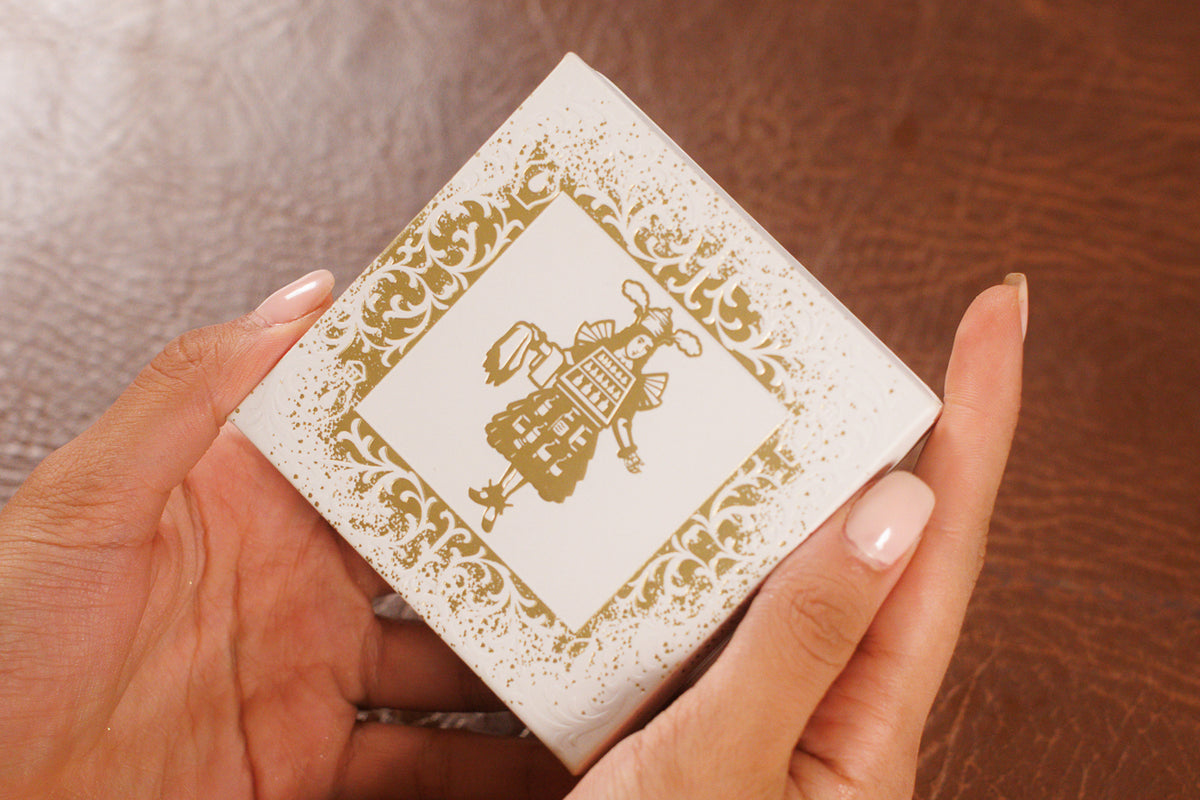
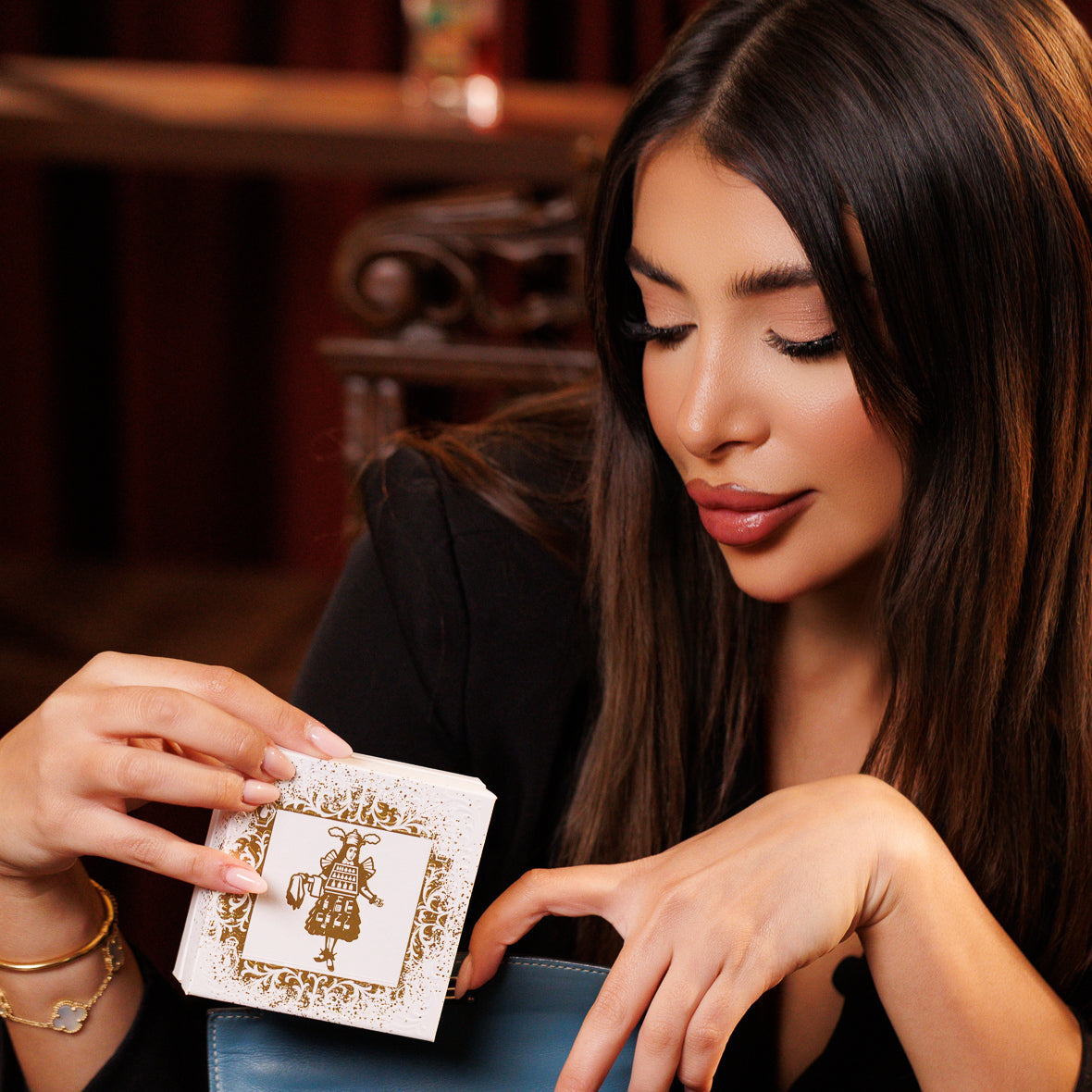
ΚΑΘΕ DECANT
Από το αυθεντικό μπουκάλι ως την πόρτα σας
Αγοράζουμε την αυθεντική φιάλη στην πλήρη λιανική τιμή, απευθείας από τον οίκο.
Μια σύριγγα Socorex ιατρικής κατηγορίας παίρνει τα ακριβή χιλιοστόλιτρα κατευθείαν από τη φιάλη.
Τοποθετείται στο κουτί με χρυσοτυπία και παραδίδεται στην DHL, με κάθε δασμό ήδη πληρωμένο. Πώς γίνεται ένα decant
Περισσότερα από Lost Tribe
Ίσως σας αρέσουν