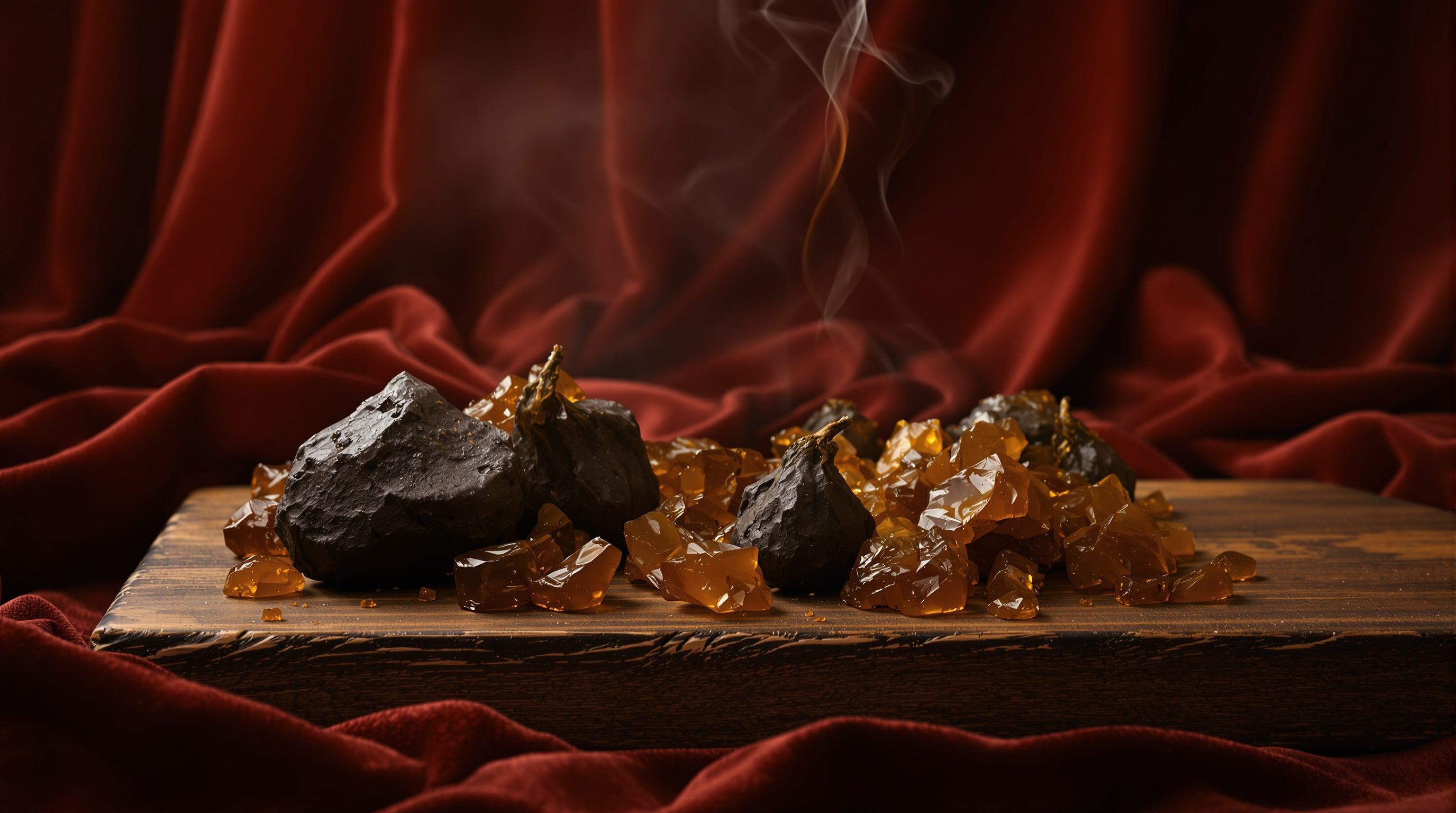
The Types of Natural Deer Musk: Tonkin, Tibetan, Mongolian and Siberian Compared
Deer musk gets bulked with dried blood and faked with lead shot, and the four grand names on the label, Tonkin, Tibetan, Mongolian, Siberian, will not save you. Two of them are the same animal.
The real thing smells of warm skin, faintly sweet, something animal underneath, and holds the rest of a bottle in place.

Not a deer, and not four species
The musk deer sits closer to goats and antelope than to anything with antlers. The males carry tusks instead, up to ten centimetres.
Musk is Sanskrit for testicle. The pod is a scent sac, not a gonad.
And the four trade names are shipping origins with reputations, not species. Oud is sold the same way, port first, tree second, untangled in the types of oud explained by region.

Tonkin is a reputation, not a lab result
Tonkin is the Red River delta of northern Vietnam, yet the top grade is recorded as coming from China and Tibet. The geography does not survive its own name.
There is no peer-reviewed comparison of one grade against another; the claims come from vendor pages, and quality varies pod to pod.
Our Tonkin exhibit is Ensar Oud EO2 Tonkin: pepper and cumin over Tonkin musk and civet.
The real thing smells of warm skin, faintly sweet, something animal underneath, and holds the rest of a bottle in place.


Mongolian and Siberian are the same animal
Mongolian and Siberian pods come from the same species, the Siberian musk deer, and they still do not smell alike. Siberian is direct and forceful, sharp and urinous, and fills a room. Mongolian pods are almost hairless, bitter and herbal with a sweetness underneath, faintly coastal, a little like ambergris but more truffly.
Tibetan musk comes from a different animal, on a different plateau.
Ensar Oud Mongolian Musk runs raw and animalic under sandalwood and smoky ouds. 8-10 hours, strong sillage. Folkwinds So Long, Honey sets Tibetan musk and clarified beeswax among three sandalwoods, under propolis, hay and August peaches. The material is not the composition.

Pod, grain, lead shot
The sac is walnut-sized and yields about twenty-five grams per animal per year. It sells as dried pods or loose grain, and muscone percentage is the adulteration tell.
Age matters too. Ensar Oud Tibetan Musk: Tyger Mylk was built on pods dated to the 1970s, worn skin on skin rather than across a room.


The law, and a sultan's treasury
The law is shorter than most retailers think. Wild musk is barred from commercial trade in only six countries; everywhere else, Russia and China included, export runs on permits. America has listed musk deer as Endangered since 1976 across the Himalayan states and China, Tibet included. Check the law where you live, not the treaty.
Legal does not mean harmless. Around eighty percent of musk deer killed in Russia appear to have been poached, and a snare cannot tell male from female: three to five animals per usable pod.
So provenance is the question. Ensar Oud stopped dealing in musk in 2004 as the deer declined, and went without for over a decade until Russia set legal licensing and harvest quotas for Siberian musk. Its Mongolian pods are another matter: they passed from custodian to custodian into the treasury of the late Sultan Qaboos of Oman, and musk handlers who have examined them believe they may be several centuries old.
The Siberian one: Areej Le Doré Nepalese Patchouli, built in a co-tincture of black truffle, orris root, wild Siberian deer musk and Ethiopian civet. The loud one: Lost Tribe Vanilla Waves V2 Extra Musk, French vanilla, balsam of Peru and cinnamon over Palembang oud and sweet Mongolian musk, with extra musk grains sealed in a fine mesh pouch inside the bottle.
Ensar Oud Borneo Trifecta holds vintage Tonkin, Tibetan and Mongolian grains in one base with old Mysore sandalwood, under jasmine and rose: three of the four names on one patch of skin.
Fragrances mentioned in this piece


 From the decanting room
Every guide here ends in a 2 ml decant.
Browse the discovery sets · $58+
From the decanting room
Every guide here ends in a 2 ml decant.
Browse the discovery sets · $58+