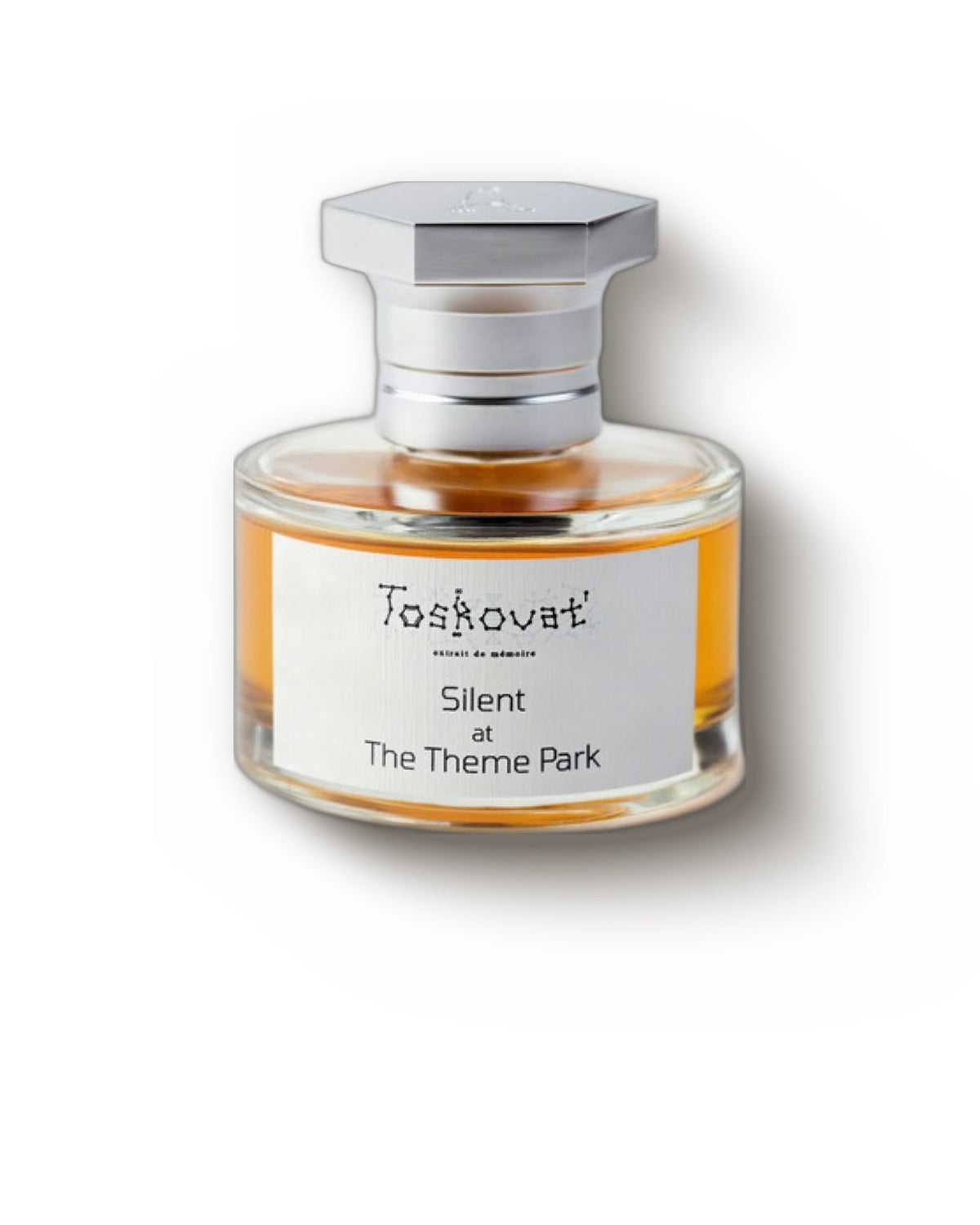
Toskovat
Silent at the Theme Park
The Story
Silent at the Theme Park is one of the eight perfumes Toskovat opened with in 2022, and David-Lev Jipa-Slivinschi built it from his memories: a theme park at five, his mother's sweater, a small lemon tart on his first flight, lilacs at the window. Three of them are notes in their own right.


Woody
Dry grain of cut timber
The smell of cedar shavings, sandalwood, and dry vetiver roots, a sanded, resinous warmth with a faint pencil-box rasp. It feels grounded and composed, the quiet backbone that makes a scent read as serious and lasting.


Sweet
Warm sugar you cannot quite name
Caramel, honey, spun sugar: sweetness that hovers between all three and never settles on one. This is the gourmand pull, the thing that makes someone lean in closer than they meant to, warm and soft and a half step short of edible.


Yellow Floral
Sunlit mimosa, ylang and champaca
Mimosa, ylang-ylang, champaca, broom: the flowers that smell yellow. Honeyed and faintly buttery, with an indolic hum under the sweetness and none of a white floral's coolness. A garden at noon, pushed to the edge of overripe.


Fresh
Cold water, open air, washed skin
Cool water, laundered cotton, air with nothing in it yet. The lift can go citrus-zesty or salt-aquatic, but the effect is the same either way: it registers as clean rather than as a scent, the way a room reads different five minutes after you open a window.


White Floral
The flowers you smell across a garden
Jasmine and tuberose share it: thick creamy petals with a ripe, almost animal sweetness underneath, the indole that keeps big florals from ever smelling polite. Green at the edges, overripe fruit in the middle, and louder on warm skin.


Citrus
First bright zest of morning
The juicy, rind-snapping brightness of lemon, bergamot, and orange peel, tart and effervescent with a clean bitter edge. It opens a scent with instant lift and sparkle, fresh and energizing, evaporating quickly like sunlight on water.


Gourmand
edible sweetness good enough to bite
A dessert-like warmth built from vanilla, ethyl maltol, caramelic furanones, and creamy lactones, the smells of sugar cooked rather than sugar itself. It feels cozy and comforting, wrapping the wearer in something soft, sweet, and almost edible.


Lemon Tart
Sharp lemon curd set in warm pastry
What it is
Tarte au citron, the French dessert: a sweet shortcrust shell filled with lemon curd and, in the classic version, no meringue. No material smells of it, so perfumers build the accord from lemon oil, creamy lactones, buttery diacetyl and vanilla.
How it smells
Sour and bright on top, the curd biting through the sugar like fresh-squeezed juice. Then the pastry comes up: warm butter, a soft milky creaminess, a pale baked crust with a faint vanilla sweetness. Tangy rather than syrupy.
In perfumery
The lemon carries the opening and fades fast, as citrus oils do. Lactones and vanilla last far longer, so the tart wears down from tang to warm crust. Theodoros Kalotinis built a whole fragrance on it, called simply Lemon Tart.
Good to know
The buttery side of the accord can lean on diacetyl, which with acetoin gives real butter its characteristic taste. Margarine makers add the same pair, with beta-carotene for colour, because their spreads would otherwise taste of very little.


Orange Blossom
White petals between honey and bitter green
What it is
Neroli and orange blossom absolute come off the same hand-picked white flower of the bitter orange tree: one steam-distilled, the other drawn out with solvent into a waxy concrete. Tunisia, Morocco and the Mediterranean supply most of it.
How it smells
Honeyed nectar at the centre, cut by a clean bitter-green edge and a faint metallic cool. Neroli is the brighter, soapier of the two; the absolute runs warmer and more indolic, with a musky depth under the sweetness.
In perfumery
It is the hinge between citrus and skin: bright enough to follow a lemon top, warm enough to melt into musk. Colognes use the sparkling side; big white florals use the plush, indolic one.
Good to know
Neroli is named for a seventeenth-century princess of Nerola who scented her gloves and her bathwater with it. A kilo of the oil takes roughly a tonne of hand-picked blossoms.


Linden Blossom
Green honey off a flowering lime tree
What it is
The lime tree here is not a citrus: it is the big European shade tree, Tilia, hung with pale yellow flower clusters. They give up so little oil that most linden notes are rebuilt from aroma molecules.
How it smells
Honeyed and green and see-through, with a tea-like warmth under it. Hay, a little wax, a cool dewiness like a flowering tree on a warm afternoon. Delicate, not heady; it fades airy and powdery.
In perfumery
In the heart it lifts spring bouquets with green honey and a nostalgic glow, keeping company with mimosa, hay, lily of the valley and white musks. D'Orsay Tilleul, reworked by Olivia Giacobetti, is the linden soliflore.
Good to know
Dried linden flowers are brewed as tilleul, the tisane French households drink before bed. For a lot of European wearers that is the whole association: they met this smell first in a cup, half asleep.


Lilac
Cool spring blossom with a green stem underneath
What it is
A few weeks of flowers in late spring, and almost nothing to show for it. Lilac gives up so little to distillation that no usable natural oil exists. Every lilac in perfumery is built by hand.
How it smells
Fresh, cool and powdery, a light sweetness over a green, watery stem. A faint bitterness and some almond keep it from going sugary. Where rose is warm and jasmine heavy, lilac stays airy and a little wistful.
In perfumery
The build usually runs on terpineol, cinnamic alcohol and heliotropin, with a trace of indole. It belongs to spring florals and pale, cool compositions, where it carries an old-garden nostalgia, and it sits easily with hyacinth and violet.
Good to know
Chasing the missing oil is one of perfumery's oldest frustrations. Enfleurage was tried, then headspace analysis, and both came back with an interpretation rather than the flower. What you smell is a portrait of lilac, painted from memory.


Lily of the Valley
Spring's white bell, rebuilt molecule by molecule
What it is
Tiny white bells on a shade-loving woodland perennial, and one of perfumery's great frustrations: the flower gives up no usable oil. For decades muguet was built from scratch, on hydroxycitronellal and Lyral, rather than taken from the plant.
How it smells
Cool, green and wet: white petals, crushed stem sap, rain. It never goes heady, staying crystalline where jasmine would thicken. The drydown turns soft and clean, faintly soapy, with a last lemony-green glow.
In perfumery
In the heart it works like a window opening: it lifts rose, jasmine and lilac and puts green sparkle into aldehydic bouquets. The great mid-century soliflores were built around this accord, and it still brightens most spring florals.
Good to know
Every part of the plant is poisonous. No still or solvent ever drew scent from those bells, and a first commercial extract appeared only in 2021; by then the Lyral ban had already forced perfumers to rebuild it.


Cacao
Roasted cocoa, bitter until the sugar arrives
What it is
Chocolate starts as a bean in a pod, packed in white pulp, on a shade-loving American tree now farmed mostly in West Africa. Ferment it, dry it, roast it, and the absolute smells of chocolate with nothing added.
How it smells
Dry, roasted and dusty, like cocoa powder or dark chocolate shaved thin. Bitter up front, with coffee, nut and damp earth behind it, drying to a powdery brown warmth that stays close to the skin for hours.
In perfumery
Heart to base, the note that makes a gourmand edible without making it sugary. It sits with vanilla, tonka, patchouli, orange and chili. Sweeten it and it drifts toward drinking chocolate; leave it bare and it stays bitter.
Good to know
The Maya and the Aztec drank it bitter, frothed and spiced, and held it sacred. Sugar arrived with Europe, centuries later. The material itself never took it up.


Ylang Ylang
Sun-warmed tropical bloom, banana-cream and jasmine
What it is
A drooping yellow star of a flower, hand-picked from a tropical tree and held in the still for fifteen to twenty hours. The run is drawn off in stages, each one a different grade, Extra down to Third.
How it smells
Creamy and heady, jasmine over something like banana custard, with rubber and clove threaded through. Extra grade is the bright, fruity, spicy one; the later fractions go deeper, fatter and faintly medicinal, drying down waxy and round.
In perfumery
In the heart it bridges jasmine, rose and tuberose, and it keeps citrus tops from turning thin. It carries the floral bouquet inside the aldehydic classics, and it is the reason a solar tiare accord smells tropical.
Good to know
In Indonesia the blossoms are scattered over the beds of newlyweds. The name is Tagalog, ilang-ilang, flower of flowers. The most fragrant blooms are taken at dawn, while they are still cool.


Clean Linens
Sun-dried cotton sheets pulled off the line
What it is
No linen extract exists, so this is an accord. Perfumers usually build it from clean white musks such as Galaxolide, soapy aldehydes, a floral touch of linalool, and dihydromyrcenol, a citrus-lavender molecule that smells of freshly washed laundry.
How it smells
Crisp and pale at first, a bright soapy-citrus lift like a sheet snapped open in the breeze. It settles into a sweet, faintly woody musk that stays close and soft, the smell of a pillowcase still holding yesterday's wash.
In perfumery
It reads as clean because the same materials scent the wash: Galaxolide and dihydromyrcenol turn up in detergents and fabric softeners. In a perfume the accord makes florals feel domestic and calm. On a blotter, Galaxolide lasts over a week.
Good to know
A 2020 University of Copenhagen study traced the line-dried smell. Sunlight on wet cotton towels formed aldehydes such as octanal and nonanal, which cling to the fibres. Towels dried indoors or in shade carried far less.


Mother's Sweater
The soft, powdery comfort of a mother's knit
What it is
Mother's Sweater is Toskovat's own name for a memory, not a raw material. Some stockists list it as Cashmere Musk. The house shares no formula, so what follows is how perfumers usually build a soft knitwear effect.
How it smells
A knitwear accord trades a sharp smell for a texture: dry, woody musk with a velvety, powdery finish, a creamy softness and a faint vanilla sweetness, like the shoulder of a sweater that has been worn and kept for years.
In perfumery
The usual backbone is Cashmeran, a woody, musky molecule found by John Hall at IFF and named for the feel of cashmere. Clean musks, creamy lactones and powdery orris or heliotropin are layered around it, often with a touch of cedar.
Good to know
Here it sits in the heart beside Clean Linens, drawn from the house's story of a mother and her sweater. Cashmeran, the usual core of a cashmere accord, is potent: around two percent of a formula is typical.


Olibanum
Sun-baked resin tears that smell of sacred smoke
What it is
Olibanum and frankincense are the same thing, one word older than the other. Harvesters score the bark of Boswellia trees in Oman, Yemen and Somalia; the milky sap bleeds out and hardens in the sun into amber tears.
How it smells
Bright and dry, lemon-peel and pine over a balsamic warmth, with pepper and a cool camphor lift running through it. It softens as it goes, turning ambery and still. Old stone, warm dust, an empty church.
In perfumery
Perfumers reach for it when a blend needs air: it gives incense and amber compositions lift and a cool radiance rather than weight. Myrrh, rose, citrus and labdanum all sit comfortably beside it.
Good to know
Frankincense was once valued like gold and moved north along the Arabian caravan roads, which is why it turns up in the Nativity. Overtapping, overgrazing and beetle damage are now thinning the wild stands.


Fir Balsam
Cold forest air and crushed evergreen needles
What it is
An evergreen of cold North American forests. Its needles and twigs give the absolute and the essential oil, while the bark does something else entirely, pushing a clear sticky resin called Canada balsam out through blisters.
How it smells
Crisp, green, resinous: a freshly cut Christmas tree standing in the room. Cool pine-needle sharpness first, then a soft sweet balsamic heart with a jammy stickiness that dries down woody and faintly coumarinic.
In perfumery
A heart-to-base note dosed low, where it lends forest freshness and sweet resinous warmth. Cedar, pine, incense and amber sit easily beside it, and it anchors most evergreen and fireside accords.
Good to know
Canada balsam, collected by hand from those bark blisters, bends light almost exactly as glass does. For generations it was the glue that mounted microscope slides. The same ooze that scents perfume helped scientists see.


Labdanum
Sticky amber resin scraped from sun-baked rockrose
What it is
A Mediterranean rockrose sweats gum through its leaves in summer, dark and sticky enough to glue your fingers together. Harvesters boil or scrape the branches to get it off, then extract that crude gum into absolute and resinoid.
How it smells
Balsamic warmth, then leather, dried fruit, honey and a curl of smoke. There is something almost ambergris-like in the opening. Hours later it has settled into brown tobacco and worn skin, still going.
In perfumery
Take labdanum out and most amber accords collapse; it is what vanilla and benzoin get built on. It fixes a formula in place, gives chypres and leathers their depth, and sits well with rose, oakmoss and incense.
Good to know
Before there was distillation, there were goats. Herds browsed through cistus scrub all summer, the gum matted into their beards and thighs, and shepherds combed it out. Labdanum is one of the oldest aromatic materials still in use.


Patchouli
Damp earth and dark wood after rain
What it is
Nobody guesses mint, but that is the family: a leafy bush whose leaves are dried and left to cure, close to fermenting, before distillation pulls out an oil thick and dark as syrup.
How it smells
Wet soil, forest floor, an old cellar, with a winey sweetness underneath. Young oil can come at you sharp and green, almost camphorous. Aged oil goes the other way, into chocolate and leather, and stays put for hours.
In perfumery
Almost nothing holds a composition down like it. Chypres and orientals are built on that anchor, and a few drops under rose, vetiver or labdanum will hold the whole thing on skin for hours.
Good to know
Nineteenth-century Kashmiri shawls travelled packed in dried patchouli leaves to keep moths off, and Europeans learned to tell a real one by smell alone. The oil improves with age, which almost no essential oil does, mellowing like wine.


Cedarwood
Dry pencil shavings and sun-warmed timber
What it is
The cedar in your pencil and your closet is usually a juniper. Virginia and Texas cedar both are; only Atlas and Himalayan cedars are true Cedrus. The oil is steam-distilled from heartwood chips and sawmill dust.
How it smells
Freshly sharpened pencils, and the inside of a cedar chest. Virginia leans pencil-dry and balsamic; Atlas is sweeter, almost honeyed. Both carry a clean, faintly camphor-cool smoke that settles into sappy warmth.
In perfumery
A heart-to-base workhorse: dry structure other materials can lean on. It sits well with vetiver, rose, citrus and incense, and it is the smoke in the drydown of countless modern woody-ambers.
Good to know
Cedar rarely appears alone. Its molecules, reworked in the lab, form the backbone of a great many contemporary woody fragrances, which is why so much of the modern woody shelf smells faintly of a sharpened pencil.


Oakmoss
The damp green soul of the forest floor
What it is
Not a moss at all, but a lichen, scraped off oak and other deciduous bark across temperate Europe, Russia and North Africa. Solvents turn the harvested growth into a dark, viscous concrete, then the absolute perfumers actually use.
How it smells
Wet stone, damp bark and something inky and leathery underneath, dry and faintly bitter. This is not fresh green: it is the cool floor beneath old trees after rain has soaked the ground.
In perfumery
The backbone of the chypre: a base note that gives a fragrance its shadow and its spine, classically under bergamot, beside labdanum and patchouli. Anything described as mossy, vintage or green-masculine is usually leaning on it.
Good to know
Oakmoss carries two allergens, atranol and chloroatranol, potent enough that the EU banned them from cosmetics outright. Perfumers use stripped grades now, but it was the earlier cap on the extract that changed how the classic chypre smells.


Vanilla
Cured orchid pods, custard and faint smoke
What it is
Green pods come off the orchid vine smelling of almost nothing. The scent is made, not found: months of blanching, sweating in the sun and slow drying before the vanillin appears. Mexico first, Madagascar now.
How it smells
Custard and caramel up front, then something darker underneath: dried fruit and a thread of tobacco smoke. It turns powdery as it dries and sits close to the skin. Real cured vanilla reads deeper than vanillin alone.
In perfumery
Perfumers use it to round off edges. Anything too sharp, too green, too austere gets warmth and body from a vanilla base, which is why it anchors many oriental and gourmand builds alongside tonka, amber, sandalwood and spice.
Good to know
Every flower opens for one day. Miss it and there is no pod, so all of it is pollinated by hand, a trick devised by Edmond Albius, a twelve-year-old enslaved boy on Réunion. Most vanilla flavour today is synthetic.
Fragrance Character
Lemon Tart opens it sweet and sharp, with orange blossom, linden blossom and lilac around it like a garden in full flower. The heart turns soft and laundered: lily of the valley and ylang ylang over clean linens and a sweater's warmth, cacao underneath. Olibanum, patchouli and fir balsam take the drydown, woody and close, softened by oakmoss and vanilla.


Longevity
how long it stays on skin
The hourglass reads wear time: how many hours the fragrance keeps speaking before it fades. A bar that barely leaves the start means a few fleeting hours. One that runs the full length carries from morning into evening. Treat it as typical, not promised. Oily skin holds scent far longer than dry.


Sillage
the size of its scent trail
Sillage is French for a ship's wake, and that is exactly what this measures: how much of the scent reaches the room instead of staying on you. Low is a whisper only close friends catch. Enormous fills the room, then keeps filling it after you leave.


Experimental
Built to provoke, not to please
Some perfumes are made to be liked. These are made to be argued about: inky tar, hot rubber, fruit on the turn, metal and fur where you expected flowers. The coin glows for a scent that provokes and dims for one that plays it safe, which is sometimes the point.


Office
Polished, and never louder than the room
Scent is manners in a shared room. At this range it should reach the person across the desk and stop there: tidy citrus, soft musk, pale woods, all of it reading competent and considerate. A glowing coin means nobody has to mention it. A dim one means it travels.


Evening
After dark, when it deepens
Dinner, drinks, the night that runs long. Low light is where ambers, resins and smoky woods stop being polite, and where a plush floral finally blooms. A glowing coin means it is waiting for exactly this hour. A dim one means it did its best work in daylight.


Romantic
Close enough to be felt
A fragrance can hum against skin instead of announcing itself across a table. That is the register here: creamy florals, vanilla, soft musk, a thread of spice, warm enough to make someone lean in. The coin glows when a scent sets that mood and dims when it is more practical than seductive.


Formal
Quiet authority in a dressed-up room
A wedding, a ceremony, a room where everyone has thought about their shoes. What works here is structure, not volume: smooth woods, disciplined florals, soft leather. A glowing coin means it holds its posture all evening. A dim one means it is too casual for the room.


Casual
Easy comfort for unhurried days
Errands, coffee, a slow Saturday with nowhere to be. Nothing here has to impress anyone, so the fit is soft and easy: fresh citrus, light woods, a little warmth off the skin. A glowing coin says yes to all that. A dim one means the fragrance is asking for a bigger night.


Day to Night
where its mood naturally falls
A bar running from sun to moon, reading the hour the fragrance was made for. The more of it that stays gold, the more the scent belongs to daylight and open air. The further the blue reaches back toward the sun, the deeper and warmer it turns: evening, candlelight, low rooms.


Winter
Warmth that carries through cold air
Cold air mutes a fragrance and slows it down, which is why winter belongs to the dense and the warm: resin, smoke, vanilla, leather, ambered spice. The bar reads how well this one pushes back, glowing against the chill instead of thinning out in it.


Spring
Fresh blooms in mild, rising warmth
Mild, humid air lifts a light composition, so the season belongs to dewy florals, green stems, soft powder and citrus you can see through. Alive rather than heavy. The further the green runs along the bar, the more comfortably this one wears in that weather.


Summer
Bright and airy in real heat
Heat does the projecting for you, which is why the wrong perfume turns unbearable by noon. What survives is cool and breathable: sharp citrus, salt air, aromatic herbs, water. Things that refresh instead of cloy. A short bar here means save it for cooler months.


Fall
Spiced warmth for cooling days
As the air cools, the rich materials stop smothering and start reading clearly: dry woods, warm spice, tobacco, amber, fruit gone golden. It is the season perfume turns contemplative. The bar fills according to how naturally this one settles into crisp, cooling days.
Best Worn
Spring and summer days, from the office to an afternoon outdoors, on anyone who likes a clean, sweet floral with a lemon pastry opening and soft woods underneath.
Escolher opções
A atmosfera


O Nariz

David-Lev Jipa-Slivinschi
Fundador e perfumista
Romeno baseado em Bucareste que chegou à perfumaria vindo do cinema e fundou a Toskovat' em 2022. Compôs Toskovat' Inexcusable Evil, Toskovat' Age of Innocence, Toskovat' Anarchist A_, Toskovat' In the Belly of the Beast e Adi ale Van Gethsemane.
Mais deste narizInexcusable EvilLast Birthday CakePornstar (Noyau Doux)
A Maison

Perfume como conto. Pólvora, iodo frio e açúcar queimado contam histórias que a maioria das casas jamais publicaria.
Uma Toskovat parece uma cena de um filme que você não tem certeza se deveria estar assistindo. Ar metálico e frio, fumaça, cera e uma doçura gourmand que sempre chega com uma sombra atrás. São extraits conceituais para quem quer que uma fragrância diga alguma coisa, e a projeção costuma acompanhar a intensidade da ideia.
- Origem
- Bucareste, Romênia
- Fundação
- 2022
- Conhecida por
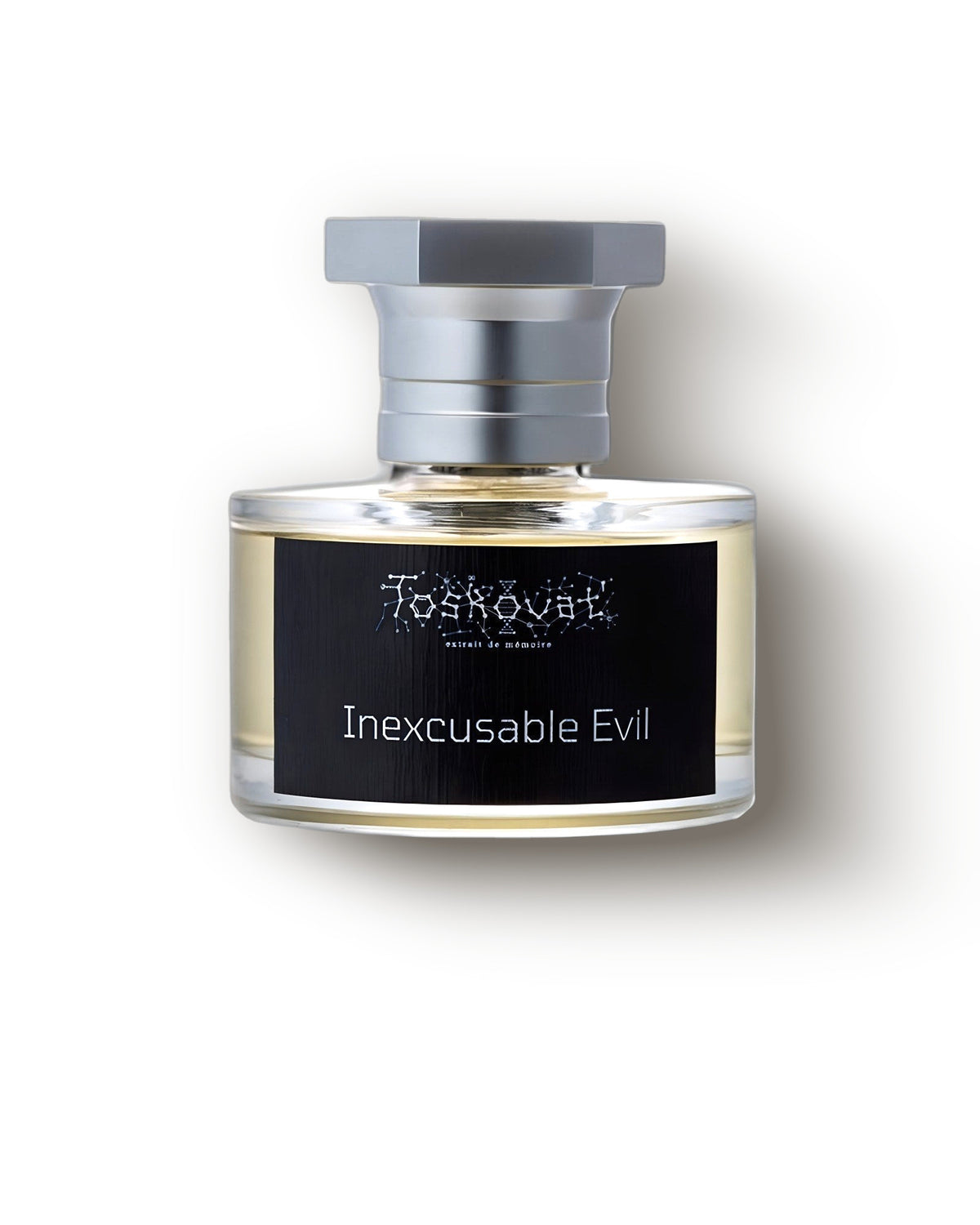
- Extraits conceituais, Inexcusable Evil

Mais de Toskovat
Você também pode gostar