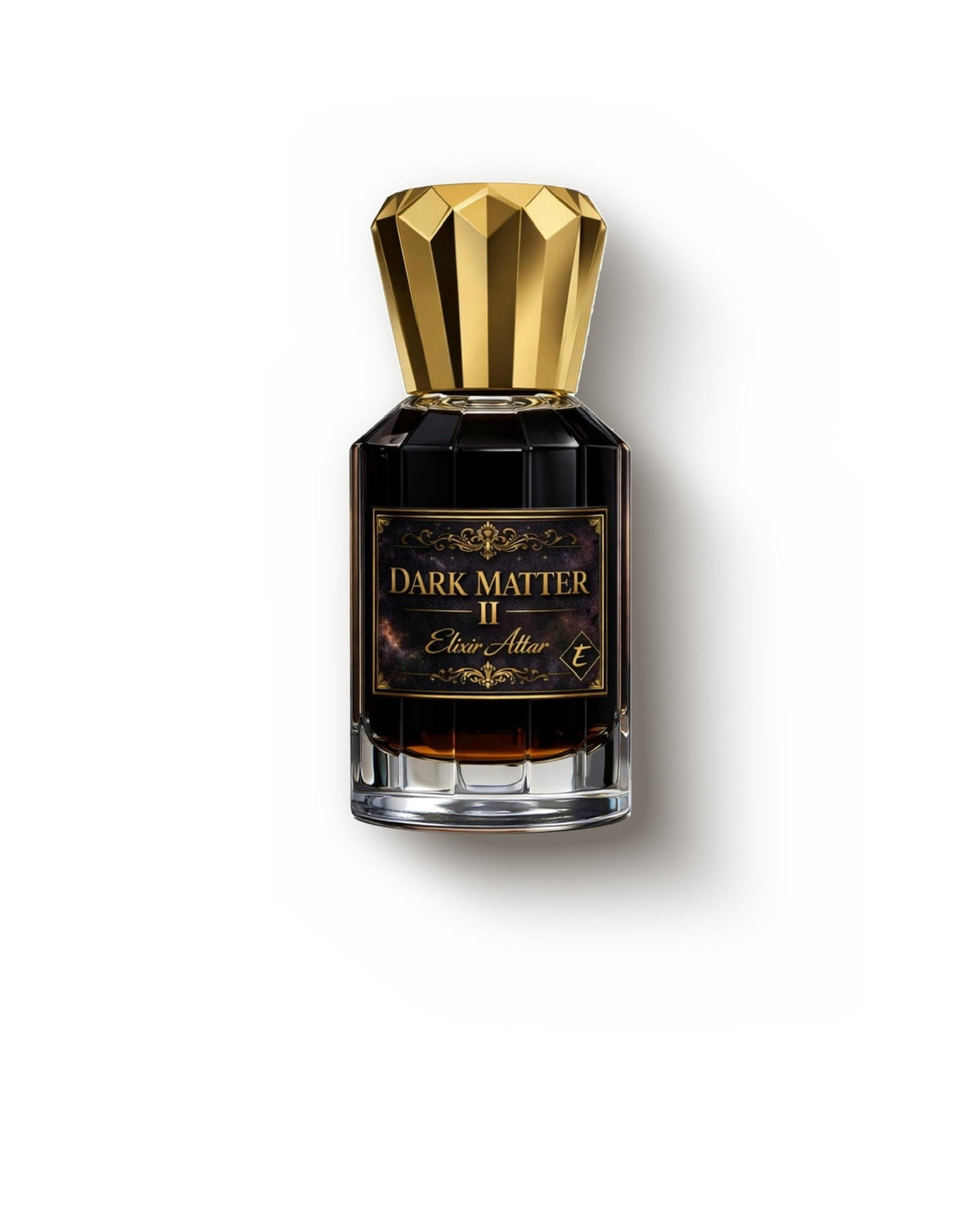
Elixir Attar
Dark Matter II
The Story
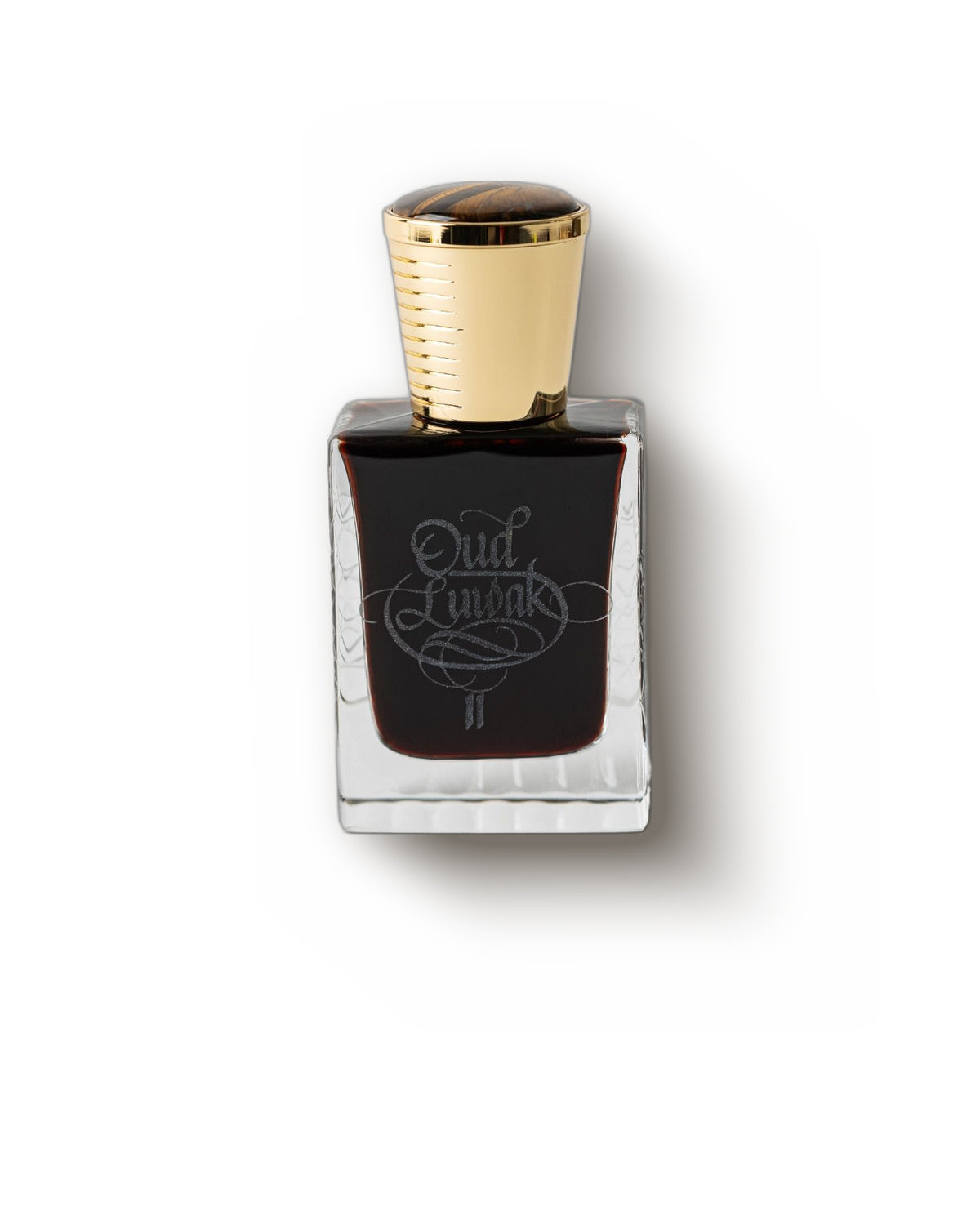
Dark Matter II is Elixir Attar's rebuilt second version of Dark Matter, an extrait released in 2026. It was made in a single batch, with no reformulation planned. What makes it itself is weight, saffron and clove over Taif rose, then oud and castoreum.


Oud
What a tree makes when it is wounded
A dense, resinous wood that smells warm and slightly medicinal, with a leathery, animal-tinged smokiness and a sweet, almost barnyard funk underneath. It feels ancient and brooding, wrapping the skin in something thick and quietly powerful.


Smoky
Charred wood and rising embers
The dry, charred scent of burning wood, smoldering incense, and lingering ash, sometimes tarry, sometimes wispy and gray. It feels brooding and atmospheric, conjuring a dying fire and a cool current of air carrying its last breath.


Warm Spicy
Glowing embers of the spice drawer
The rounded heat of cinnamon, clove, and nutmeg, dry and slightly resinous, like a baking pantry rather than a sharp kitchen. It creates a flushed, enveloping warmth that feels intimate and cool-weather, hugging the skin from within.


Balsamic
Tree sap gone thick and golden
Tree resins and golden amber, thickened to syrup and touched with vanilla. It does not sparkle or move; it settles, warming the skin the way candlelight warms a room, and it stays there long after the top notes have gone quiet.


Animalic
Skin, fur and something not quite tame
A raw, body-warm muskiness that reads of skin, hair and fur, sometimes sweet and powdery, sometimes sharp and faintly feral. At its best you cannot tell where the perfume stops and the wearer starts. At its strongest, it is the reason some people back away.


Rose
Velvet petals, honey and thorn
Dewy and fruity on top, then a jammy, honeyed heart with a green peppery bite underneath. Very little of it is distilled flower. A rose accord is built, and a good one can smell more like a rose than the rose does.


Saffron
Crimson threads breathing leather, honey and dry hay
What it is
Three crimson threads sit inside each autumn crocus flower, and a hand pulls every one. Dried, those stigmas are steeped into a tincture or extracted into an absolute. That is the entire supply chain.
How it smells
Hay and honey and warm toast first, then something metallic and leathery underneath, the work of a molecule called safranal. It dries down into suede, tobacco and dusty amber, bitter at the edges.
In perfumery
It lives in the heart, glowing reddish, the hinge between spice and leather. Perfumers wed it to rose so often the pairing became a genre, and entire leather accords get built on it alone.
Good to know
A kilogram of saffron costs about 150,000 hand-picked flowers and many days of stooped labor, which is why almost none of it reaches perfume. Most saffron notes are built from synthetic safranal instead.


Clove
Warm spice with a numbing, dentist-chair bite
What it is
The clove you know is a flower stopped before it opened. Buds come off the tree as they flush pink, dry to small brown nails, and go to the still as clove bud oil.
How it smells
Hot and dry, with a tingle that turns numb: eugenol, the same compound a dentist uses. Under the burn sits a woody, fruity sweetness and a slow balsamic trail of pomanders and mulled wine.
In perfumery
Perfumers use it in the heart for heat and old-world richness, beside carnation, rose and vanilla. Caron's Poivre opens on clove and pepper over a carnation heart, and the same spice warms a shelf of chypres and fougeres.
Good to know
Clove once outvalued its weight in gold, and the Dutch razed whole groves in the Spice Islands to control supply. Eugenol can turn skin allergic, so its dose is capped in every material that carries it.


Cardamom
Green spice cracking open with citrus heat
What it is
Pickers take the pods before they ripen, which means doing it by hand. A ginger relative from the forests of southern India, now farmed widely in Guatemala. The seeds inside are what gets distilled.
How it smells
Crack one and you get cool eucalyptus lift over warm pepper, lemon peel and a little pine resin. There is a smoky breadiness in it too, the smell of chai. Sharp and effervescent first, then soft and balsamic.
In perfumery
It sits between top and heart, a spice sparkle that stays cool, letting a composition move from citrus into woody amber without the weight of clove or cinnamon. Rose, leather and oud all take it well.
Good to know
The pod is packaging. Sealed, it keeps the oil intact; cracked, the aroma starts escaping straight away, which is why distillers work fast and why pre-ground cardamom is a ghost of the whole pod.


Ginger
Fresh peppery zing with a fibrous warmth
What it is
Not a root, whatever the greengrocer calls it, but a swollen underground stem. Perfumers take it two ways: steam-distilled to an essential oil, or extracted with CO2, and the two are not interchangeable.
How it smells
Bright and dry, a fizzy lemon-pine sparkle with pepper behind it and a fibrous, earthy warmth underneath. None of the sweetness of cooked ginger. The CO2 extract is rounder and juicier, closer to a rhizome snapped in half.
In perfumery
It works between the top and the heart, waking up citrus, putting an edge on woods, keeping aquatic and fougere structures from going flat. When a crisp, peppery scent has a pulse to it, ginger is usually why.
Good to know
Ginger barely flowers in cultivation. Every plant is grown from a piece of another plant, which makes the world's ginger something close to one enormous clone, passed hand to hand along trade routes for five thousand years.


Blackcurrant
Tart cassis with a wild, animalic snarl
What it is
Perfumery mostly ignores the berry. The material that matters is cassis bud absolute, extracted from the sticky, resinous leaf buds of the shrub, usually propped up with sulphur molecules that carry the fruit's tart snap.
How it smells
Sharp, tart, unmistakably purple, then something feral cuts across it: a green, leafy, faintly sweaty pungency that sits closer to cat than to fruit. Ripe berry with a growl behind it.
In perfumery
A top note with claws. It cuts through sweetness, puts an edge on rose, and gives a fruity-floral something to push against. The classic chypre opening starts here, and it still jolts open modern fruity compositions.
Good to know
The catty edge comes from thiols your nose can catch at parts per trillion, the same family behind tomcat spray and a glass of Sauvignon Blanc. Perfumers dose cassis in drops, not millilitres.


Frankincense
Golden tears hardened on a cut trunk
What it is
A scored Boswellia bleeds a milky sap that hardens over weeks into golden tears. The sacra trees of Oman and Somalia give the most prized resin. Steam or solvent turns the tears into oil.
How it smells
Brighter than you expect from something called incense: cool, lemony, almost pine-fresh, with a peppery lift. Underneath it is dry and balsamic, and it ends in the warm dusty smoke you already know.
In perfumery
It does something odd for a resin: it makes heavy things lighter. Sitting in the heart and base, it opens up oud, labdanum and thick oriental accords, and gives rose a cool, quiet space to stand in.
Good to know
The trees are in trouble. Wild Boswellia stands are thinning under over-tapping, drought and grazing, and the long-term supply of a resin the world has burned for thousands of years is now a real question.


Sichuan Pepper
Bright citrus spice with a tingling edge
What it is
Not a peppercorn at all. The reddish husks come from a tree in the citrus family, closer kin to a lemon than to black pepper, and only the husk is used, distilled or taken with CO2.
How it smells
Grapefruit zest over a warm rosy spice, fizzing rather than burning. There is a metallic, faintly vetiver shadow underneath. In food the husk makes your tongue buzz; in perfume what carries over is the zest, not the numbness.
In perfumery
Perfumers use it up top for fizz and lift, a modern peppery sparkle that has opened a great many contemporary unisex scents. It plays well with citrus, rose, vetiver and incense.
Good to know
The tingle is neither taste nor heat. The molecule behind it excites the light-touch nerve fibers in your skin at roughly fifty times a second, so the brain reports a genuine vibration.


Violet
Powdery purple petals that vanish as you reach
What it is
Almost no violet in perfumery comes from violets. The flower yields so little oil that it is hardly produced any more, so the note is built from ionones, aroma-chemicals first made in a lab in the 1890s.
How it smells
Soft, cool and powdery, with a sugar-dusted candied sweetness and a thin green wetness behind it. It reads tender and nostalgic: Parma violet sweets, face powder, petals crushed in a pocket.
In perfumery
In the heart it does something unusual: it takes the sugar out of sweetness and leaves powder behind. Iris, rose, leather and almond all bend toward it, and violet soliflores wear it like an old makeup box.
Good to know
Ionones saturate the receptors fast, so the scent seems to vanish, then return as your nose recovers: perfumery's textbook case of olfactory fatigue. Violet leaf is another material entirely, green and cucumber-cool.


Bergamot
Sparkling citrus light with a bitter edge
What it is
Nobody eats bergamot. It is sour, seedy and disappointing, and almost the whole world's supply grows on one strip of Calabrian coast, farmed purely for the oil pressed cold from its green rind.
How it smells
Zest and green light in the first second, then something rounder than lemon: a floral, tea-like smoothness sitting on a faintly bitter warmth. It burns off fast. What stays behind is a quiet, slightly spiced hum.
In perfumery
It defines eau de cologne, and sits on top of nearly every fougère alongside lavender and oakmoss. Perfumers want the first bright second it gives, and the oil is also what makes Earl Grey smell like Earl Grey.
Good to know
The thing that makes it sparkle can also burn. Bergamot carries bergapten, which leaves skin hypersensitive to sunlight, so perfumers either keep the dose low or reach for a grade with the molecule stripped out.


Taif Rose infused with Musk
A desert rose picked before dawn
What it is
The oil of Rosa damascena trigintipetala, the thirty-petaled Damask rose grown on terraced slopes of the Hejaz mountains around Taif in western Saudi Arabia. Blossoms are hand-picked from before sunrise, when oil is highest, then steam-distilled in traditional copper stills into rose water and a precious attar.
How it smells
Deep, spicy and honeyed, darker than European roses, shaped by arid heat and altitude. It opens jammy and wine-rich, with peppery, clove-like edges, then dries into a warm, slightly leathery rose, holding little of the soft dewy freshness found in Bulgarian rose otto.
In perfumery
A heart note prized for spicy richness and depth, layered with oud, saffron and amber in Middle Eastern attars, or patchouli and oakmoss in Western chypres. Prestige perfumers have long drawn on Taif rose where a darker, more resinous rose is wanted.
Good to know
One kilogram of pure oil takes several tons of hand-picked petals, gathered in a harvest window of only a few weeks in spring. That scarcity makes top-grade Taif rose oil among the most expensive floral materials in perfumery, sold by the gram like a precious metal.


Jasmine Sambac
Tea-green jasmine that opens after dark
What it is
The flowers open after dark, which is when they smell strongest, so pickers take them as buds in the early morning, before they unfurl. Solvent extraction gives a waxy concrete, and washing that with alcohol gives the absolute.
How it smells
Greener and more tea-like than the grandiflorum kind, and much less fruity. It starts crisp and a little waxy, almost banana-tinged, then warms into indolic sweetness. That indole is the animal in it: heady up close, still luminous.
In perfumery
A heart note that gives white-floral bouquets their body and their lift. It works with rose, tuberose, sandalwood and green tea, rounds off sharp citrus, and some night-blooming soliflores are built on almost nothing else.
Good to know
This is sampaguita, the national flower of the Philippines, strung into garlands and used to scent Chinese tea. Tiny blooms picked by hand every morning across a long season put the absolute among the costliest florals.


Jasmine Grandiflorum
The heady white flower at perfumery's beating heart
What it is
Jasmine is the blossom of climbing shrubs in the olive family, chiefly Jasminum grandiflorum, grown in Egypt, India and Morocco, plus Jasminum sambac from India. The fragile flowers are picked by hand from before first light into the morning, solvent-extracted with hexane into a waxy concrete, then washed with ethanol to yield the absolute.
How it smells
A warm, lush white floral, sweet and honeyed with an animalic underside. Sambac leans green, tea-like and luminous; grandiflorum reads fruitier and creamier, with more weight. Both carry a heady, narcotic richness over a green-fruity opening, drying to a soft, skin-warm, faintly mushroomy-musky base.
In perfumery
A heart-note cornerstone, bridging citrus tops and woody bases while lending volume, sensuality and rounded floral body. It pairs with rose, tuberose, ylang-ylang, sandalwood and musk. Jasmine anchors many of the great classic florals and can stand alone as a radiant soliflore.
Good to know
Roughly five thousand hand-picked flowers yield a single gram of absolute, ranking natural jasmine among the costliest perfume materials. Part of its depth comes from indole, a molecule that smells frankly animalic, close to decay, when concentrated, yet reads radiant and living at the small percentage the flower naturally holds.


Champaca
Golden petals of orange, tea and honey
What it is
Narrow petals, cream fading to orange, picked by hand at dawn from a tree in India and Southeast Asia while the scent is still at full strength. Solvent extraction gives a deep, resinous absolute.
How it smells
Orange blossom, black tea, dried hay and honey, all running through a fruity sweetness that edges toward bubblegum. The red absolute leans earthy and tannic; the orange type opens brighter and dries into a smooth ambery floral.
In perfumery
It sits in the heart, throwing a tea-like glow over white florals and orientals, and it can hold a soliflore alone: honey and tannin over a bed of woods. Neroli, jasmine and rice notes all take to it.
Good to know
The scent fades fast once the flower is off the tree, so blossoms are processed at once and the yield stays tiny. Across South and Southeast Asia they are strung into temple garlands and worn in the hair.


Honey
Beeswax and dried fruit turning faintly feral
What it is
Bees concentrate flower nectar into a syrup that smells of whatever they foraged. Raw honey resists clean extraction, so the note in a bottle is nearly always built from beeswax absolute and aroma chemicals.
How it smells
Thick and golden, sticky with dried fruit and warm wax, and never quite polite. Under the sweetness runs something animal, closer to skin than to a jar. Push the dose and it turns leathery.
In perfumery
A heart-to-base warmth that rounds tobacco, orange blossom, immortelle and leather, softening their edges while smuggling in body heat. Orientals use it to make sweetness feel lived-in rather than confected.
Good to know
Most of that feral edge is one molecule, phenylacetic acid, which smells of honey and stale sweat at once and edges toward civet. Overdose it and the perfume goes barnyard, so perfumers weigh it in fractions.


Dates Accord
Sticky sweetness of sun-dried desert fruit
What it is
Dates are the fruit of the date palm, Phoenix dactylifera, cultivated across North Africa and the Middle East for millennia. The drupes ripen to deep amber-brown and concentrate sugar as they dry. There is no true date essential oil; the note is built as an accord from fruity, dried-fruit and caramelic aroma materials.
How it smells
Warm, syrupy and brown-sweet, like a pressed Medjool date: honeyed molasses with prune and fig facets, a faint rummy boozy edge and a leathery, almost tobacco-like depth underneath. It reads jammy and sticky rather than fresh, finishing dry and caramelized.
In perfumery
A heart-to-base sweetener lending oriental and amber compositions a dried-fruit roundness. It pairs naturally with amber, oud, rose, honey and warm spices in Middle Eastern styles, and adds chewy fruit warmth to gourmand orientals built around figgy or boozy amber bases such as those in the attar tradition.
Good to know
Date palms have nourished desert civilizations for over six thousand years, appearing in ancient Mesopotamian tablets and the Quran. A single mature palm can yield over a hundred kilograms of fruit a year, which helped earn the species its old epithet, the tree of life.


Lavender Absolute
Solvent-drawn lavender, dark and honeyed
What it is
The extract obtained by washing lavender flowers with solvent rather than steaming them, first to a waxy concrete and then to a deep green-brown absolute. Because it is never steamed, the absolute carries the heavier, less volatile parts of the flower that never survive a distillation, and it looks and behaves nothing like the pale essential oil.
How it smells
Far richer and darker than the oil: herbaceous and honeyed, with hay, tobacco and a jammy fruitiness where the distilled oil is cool and camphorous. The fresh green top is largely absent, and what is left is the deep floral body of the plant with a sweet, almost balsamic weight.
In perfumery
Used as a heart and base material rather than a top note, and often alongside the essential oil rather than instead of it, so a composition can have both lavender's cool lift and its warm depth. It sits naturally with tonka, tobacco, hay and amber, and it is a mainstay of the darker fougères.
Good to know
Absolute and essential oil are two different materials from one flower, and a formula naming both is not being redundant. Absolutes are extracted with solvent, which some natural-perfumery standards exclude, and the yield is very low, so the absolute costs considerably more than the distilled oil.


Cananga
Sun-warmed tropical bloom, banana-cream and jasmine
What it is
The drooping yellow star-shaped flower of Cananga odorata, a tropical tree native to Southeast Asia and now grown mainly in the Comoros, Madagascar and Mayotte. Hand-picked blossoms are steam-distilled for fifteen to twenty hours, the run siphoned off in stages into grades from Extra to Third.
How it smells
Creamy, heady and warm: jasmine-like florals over a soft banana-custard sweetness, threaded with rubber, clove and narcissus. The Extra fraction is bright, fruity and spicy on top; later grades turn deeper, fattier and more medicinal, drying down to a rounded, slightly waxy floral.
In perfumery
A heart-note workhorse adding tropical richness and lift to floral and oriental compositions, bridging jasmine, rose and tuberose while softening citrus tops. It forms part of the floral bouquet of the great aldehydic classics, drives many a legendary floral, and underpins countless solar tiare blends.
Good to know
The name traces to the Tagalog ilang-ilang, commonly glossed as flower of flowers, reaching European perfumery via Spanish. In Indonesia the blossoms are traditionally scattered over the beds of newlyweds. A single tree fruits for decades, with the most fragrant flowers picked at dawn while still cool.


Benzoin
Warm vanilla balsam wept from a tapped tree
What it is
Benzoin does not flow on its own. Someone cuts the bark of a styrax tree in Laos, Vietnam or Sumatra, and the wound weeps a gum that hardens over months into reddish tears.
How it smells
Sweet, warm, unmistakably vanillic, with a powdery amber softness underneath. Siam benzoin is rounder and creamier; Sumatra runs smokier, with a cinnamon bite. Left on skin it turns almost caramelized.
In perfumery
A base note that behaves like a fixative and a sweetener at once, giving amber accords their glow and holding the rest of the composition still. It softens sharp edges beside labdanum, tonka and incense.
Good to know
The word benzene comes from here. Chemists named benzoic acid after this resin, and benzene took its name from the acid. The resin's own name is a worn-down Arabic phrase, luban jawi, frankincense of Java.


Opoponax
Sweet myrrh purring honey, balsam and old wood
What it is
Sweet myrrh starts as sap. Cut the bark of a Commiphora in Somalia or Ethiopia and it bleeds a gum that hardens into reddish tears, steamed for oil or washed out with solvent into a resinoid.
How it smells
Rounder and sweeter than myrrh, honeyed rather than medicinal, with a small effervescent lift as it opens. Underneath it goes dusty and faintly animalic, a little mushroomy, dry as old wood. Think benzoin, drier and powdery.
In perfumery
A base note that also fixes, holding other materials in place while it gives amber accords their honeyed glow. It can lift a chypre from higher up. Labdanum, vanilla, incense and rose are the company it keeps.
Good to know
Two different plants answer to this name. The old European opoponax was a Mediterranean relative of parsley; the resin sold to perfumers today comes from an African tree that is not related to it at all.


Styrax
Cured leather, cinnamon and warm skin
What it is
Wound a sweetgum tree, Liquidambar, and it bleeds a grey sticky balsam. That balsam is styrax, also called storax, and confusingly it has nothing to do with the genus Styrax, which yields benzoin instead.
How it smells
Sweet, warm and balsamic, with leather, smoke and a touch of cinnamon. Underneath runs something almost vanillic and skin-warm. It opens faintly medicinal and dries down ambery and clinging, like cured hide.
In perfumery
Perfumers keep it in the base, where it holds the formula in place and supplies the leather itself. Run it through amber and incense and you get the warm animal underside of the classic leathers and chypres.
Good to know
Temples have burned it for thousands of years, and the reason is in the smell: of all the balsams, this is the one that reads as human. Warm skin, not church smoke.


Labdanum
Sticky amber resin scraped from sun-baked rockrose
What it is
A Mediterranean rockrose sweats gum through its leaves in summer, dark and sticky enough to glue your fingers together. Harvesters boil or scrape the branches to get it off, then extract that crude gum into absolute and resinoid.
How it smells
Balsamic warmth, then leather, dried fruit, honey and a curl of smoke. There is something almost ambergris-like in the opening. Hours later it has settled into brown tobacco and worn skin, still going.
In perfumery
Take labdanum out and most amber accords collapse; it is what vanilla and benzoin get built on. It fixes a formula in place, gives chypres and leathers their depth, and sits well with rose, oakmoss and incense.
Good to know
Before there was distillation, there were goats. Herds browsed through cistus scrub all summer, the gum matted into their beards and thighs, and shepherds combed it out. Labdanum is one of the oldest aromatic materials still in use.


Aged Oud Accord
The distilled resin and the accord that imitates it
What it is
Oud is the fragrant resinous heartwood of Aquilaria trees and the oil distilled from it. The same word covers chips burned over coals, distilled attars whose character shifts with species, soil and still, and the woody-amber accords built to stand in for them. Most commercial oud is the accord.
How it smells
A distilled oil moves. It opens fermented, sour or barnyard, passes through leather, dried fruit and honey, then settles into resin and warm skin, rarely reading the same twice in one evening. An accord holds still: dry, smoky, faintly medicinal, polished from the first minute to the last.
In perfumery
Connoisseurs chase regional signatures the way collectors chase terroir: dense fecal Hindi, sweet fruity Cambodi, camphorous Borneo, and above them all kyara, the rarest and most prized grade. Most commercial oud, by contrast, is a synthetic accord, built from woody-amber and musky-woody materials that deliver consistency, stability and scale at a fraction of the cost.
Good to know
Two things separate the real from the built. A real distillation varies batch to batch and keeps moving on skin, while an accord smells the same bottle to bottle and stays linear. Aquilaria is CITES Appendix II, which regulates the trade rather than banning it, and Annotation 14 exempts finished retail products while wood chips, beads and carvings still travel on permits.


Smoky Agarwood
Agarwood smoke over dark resinous wood
What it is
Agarwood is the resin-soaked heartwood of Aquilaria trees, formed when the tree defends itself against infection. Dark Matter II lists it as smoky agarwood: the scent of the wood heated until it smokes, rather than the fermented character of a distilled oud oil.
How it smells
Dry temple smoke over charred resinous wood, cool and slightly camphorous, finishing on a clean, faintly honeyed char. It is the smell of the wood on the coal, without the fermented barnyard or jammy sweetness of a distilled Hindi or Cambodian oil.
In perfumery
Smoky agarwood sits at the base and gives a composition a continuous smoked backdrop. It pairs naturally with saffron, rose, labdanum and the resins, all of which share this formula.
Good to know
Burning agarwood chips is an old ceremonial practice across the Middle East and East Asia, and its smoke is how many people first meet oud. Expect it to read as atmosphere and to hold on fabric long after the brighter materials have gone.


Mastic
Pine sap and green leaf from Chios
What it is
The pale resin of Pistacia lentiscus, a low Mediterranean shrub, gathered almost entirely on the Greek island of Chios, where the southern villages have worked it for centuries. Growers score the bark and sweep the ground beneath so the resin can weep down and harden into small translucent tears, which are then cleaned by hand. The tears are used whole, distilled to an oil, or taken up as a resinoid; the same material is chewed as gum and flavours Greek cooking and liqueur.
How it smells
Dry and resinous without any of the heaviness of the balsams, closer to pine sap and crushed green leaf than to incense. There is a cool, clean bitterness over it and a faint sweetness underneath, with a thin cedar-juniper thread running through. It reads bright and almost edible next to frankincense or myrrh, and it never turns smoky on its own.
In perfumery
Used where a composition wants resin as freshness rather than as weight: it lifts amber and labdanum accords, gives fougères a green resinous spine, and sharpens citrus without cutting against it. Because it is dry and quiet it also works as a bridge between a bright opening and a balsamic base, doing the join that heavier resins make audible.
Good to know
Mastic is a specific shrub resin rather than a category, so it should not be read as a stand-in for resin in general. It is drier, greener and far less sweet than benzoin or styrax. The Chios harvest is small and slow by nature, being gathered tear by tear, and the tears are graded by size and clarity before they ever reach a still.


Sandalwood
Creamy wood, pulled up by the roots
What it is
The richest oil sits in the roots, so the whole tree is pulled up and steam-distilled rather than felled. Mysore in southern India was the classic source, until decades of overcutting pushed the wild trees to the edge.
How it smells
Milk and warm wood, with a rosy, almost buttery edge and nothing sharp at all. What surprises people is how little it moves: no bright opening, no dry-down drama, just the same quiet glow for hours.
In perfumery
It works twice over: as a smell, and as a fixative that holds rose or jasmine in place. Sandalwood is also graded, and the darkest, densest, most resin-heavy old heartwood carries its own name: red meat.
Good to know
A heart worth taking takes about thirty years to form. Plantations of the same species in Western Australia now supply most of the world's oil, close to the old Mysore chemistry if not quite its creaminess.


Vanilla
Cured orchid pods, custard and faint smoke
What it is
Green pods come off the orchid vine smelling of almost nothing. The scent is made, not found: months of blanching, sweating in the sun and slow drying before the vanillin appears. Mexico first, Madagascar now.
How it smells
Custard and caramel up front, then something darker underneath: dried fruit and a thread of tobacco smoke. It turns powdery as it dries and sits close to the skin. Real cured vanilla reads deeper than vanillin alone.
In perfumery
Perfumers use it to round off edges. Anything too sharp, too green, too austere gets warmth and body from a vanilla base, which is why it anchors many oriental and gourmand builds alongside tonka, amber, sandalwood and spice.
Good to know
Every flower opens for one day. Miss it and there is no pod, so all of it is pollinated by hand, a trick devised by Edmond Albius, a twelve-year-old enslaved boy on Réunion. Most vanilla flavour today is synthetic.


Oakmoss
The damp green soul of the forest floor
What it is
Not a moss at all, but a lichen, scraped off oak and other deciduous bark across temperate Europe, Russia and North Africa. Solvents turn the harvested growth into a dark, viscous concrete, then the absolute perfumers actually use.
How it smells
Wet stone, damp bark and something inky and leathery underneath, dry and faintly bitter. This is not fresh green: it is the cool floor beneath old trees after rain has soaked the ground.
In perfumery
The backbone of the chypre: a base note that gives a fragrance its shadow and its spine, classically under bergamot, beside labdanum and patchouli. Anything described as mossy, vintage or green-masculine is usually leaning on it.
Good to know
Oakmoss carries two allergens, atranol and chloroatranol, potent enough that the EU banned them from cosmetics outright. Perfumers use stripped grades now, but it was the earlier cap on the extract that changed how the classic chypre smells.


Patchouli
Damp earth and dark wood after rain
What it is
Nobody guesses mint, but that is the family: a leafy bush whose leaves are dried and left to cure, close to fermenting, before distillation pulls out an oil thick and dark as syrup.
How it smells
Wet soil, forest floor, an old cellar, with a winey sweetness underneath. Young oil can come at you sharp and green, almost camphorous. Aged oil goes the other way, into chocolate and leather, and stays put for hours.
In perfumery
Almost nothing holds a composition down like it. Chypres and orientals are built on that anchor, and a few drops under rose, vetiver or labdanum will hold the whole thing on skin for hours.
Good to know
Nineteenth-century Kashmiri shawls travelled packed in dried patchouli leaves to keep moths off, and Europeans learned to tell a real one by smell alone. The oil improves with age, which almost no essential oil does, mellowing like wine.


Castoreum
Smoky beaver hide with an aspirin edge
What it is
Territory marking, essentially. The secretion from a beaver's castor sacs, dried by trappers and worked into a tincture or absolute, though what you smell in almost any bottle today is the synthetic version.
How it smells
Dark, tarry leather with a medicinal edge, like birch smoke off a wet coat. Underneath there is sweetness: dried fruit, hay, a smear of vanilla. Dilute it far enough and the growl turns to warm suede.
In perfumery
It anchors the base and holds everything above it: the hide of a leather scent, the smoke of a Russian-leather style, the long tail of an old oriental. It keeps company with birch tar, labdanum, oakmoss and tobacco.
Good to know
Beavers live on willow and poplar bark, thick with salicin, the compound behind aspirin, and it carries through: a cool, almost medicinal thread under all that leather. It has long been a flavouring material as well.
Fragrance Character
The opening is loud with spice, saffron, clove, cardamom and Sichuan pepper, with bergamot and blackcurrant cutting across frankincense. Taif rose and both jasmines arrive quickly, thickened by honey and a dates accord rather than lightened. The drydown darkens into benzoin, styrax, labdanum and smoky agarwood, with castoreum in the base. The sweetness reads resinous rather than sugared.


Longevity
how long it stays on skin
The hourglass reads wear time: how many hours the fragrance keeps speaking before it fades. A bar that barely leaves the start means a few fleeting hours. One that runs the full length carries from morning into evening. Treat it as typical, not promised. Oily skin holds scent far longer than dry.


Sillage
the size of its scent trail
Sillage is French for a ship's wake, and that is exactly what this measures: how much of the scent reaches the room instead of staying on you. Low is a whisper only close friends catch. Enormous fills the room, then keeps filling it after you leave.


Experimental
Built to provoke, not to please
Some perfumes are made to be liked. These are made to be argued about: inky tar, hot rubber, fruit on the turn, metal and fur where you expected flowers. The coin glows for a scent that provokes and dims for one that plays it safe, which is sometimes the point.


Office
Polished, and never louder than the room
Scent is manners in a shared room. At this range it should reach the person across the desk and stop there: tidy citrus, soft musk, pale woods, all of it reading competent and considerate. A glowing coin means nobody has to mention it. A dim one means it travels.


Evening
After dark, when it deepens
Dinner, drinks, the night that runs long. Low light is where ambers, resins and smoky woods stop being polite, and where a plush floral finally blooms. A glowing coin means it is waiting for exactly this hour. A dim one means it did its best work in daylight.


Romantic
Close enough to be felt
A fragrance can hum against skin instead of announcing itself across a table. That is the register here: creamy florals, vanilla, soft musk, a thread of spice, warm enough to make someone lean in. The coin glows when a scent sets that mood and dims when it is more practical than seductive.


Formal
Quiet authority in a dressed-up room
A wedding, a ceremony, a room where everyone has thought about their shoes. What works here is structure, not volume: smooth woods, disciplined florals, soft leather. A glowing coin means it holds its posture all evening. A dim one means it is too casual for the room.


Casual
Easy comfort for unhurried days
Errands, coffee, a slow Saturday with nowhere to be. Nothing here has to impress anyone, so the fit is soft and easy: fresh citrus, light woods, a little warmth off the skin. A glowing coin says yes to all that. A dim one means the fragrance is asking for a bigger night.


Day to Night
where its mood naturally falls
A bar running from sun to moon, reading the hour the fragrance was made for. The more of it that stays gold, the more the scent belongs to daylight and open air. The further the blue reaches back toward the sun, the deeper and warmer it turns: evening, candlelight, low rooms.


Winter
Warmth that carries through cold air
Cold air mutes a fragrance and slows it down, which is why winter belongs to the dense and the warm: resin, smoke, vanilla, leather, ambered spice. The bar reads how well this one pushes back, glowing against the chill instead of thinning out in it.


Spring
Fresh blooms in mild, rising warmth
Mild, humid air lifts a light composition, so the season belongs to dewy florals, green stems, soft powder and citrus you can see through. Alive rather than heavy. The further the green runs along the bar, the more comfortably this one wears in that weather.


Summer
Bright and airy in real heat
Heat does the projecting for you, which is why the wrong perfume turns unbearable by noon. What survives is cool and breathable: sharp citrus, salt air, aromatic herbs, water. Things that refresh instead of cloy. A short bar here means save it for cooler months.


Fall
Spiced warmth for cooling days
As the air cools, the rich materials stop smothering and start reading clearly: dry woods, warm spice, tobacco, amber, fruit gone golden. It is the season perfume turns contemplative. The bar fills according to how naturally this one settles into crisp, cooling days.
Best Worn
Cold weather, after dark. It is a winter scent in character, and it suits formal evenings, long dinners and anyone already at home with heavy spiced oud rather than something quiet.
選擇選項
氛圍


調香師
Ahmed Mostafa
創辦人暨調香師
Elixir Attar 的創辦人,同時經營 Elixir Agarwood Science,並親自以第一人稱撰寫品牌的產品文案。他運用沉香、奇楠、鹿麝香、龍涎香、鳶尾酮與花朵脂吸原精進行創作,作品包括 Elixir Attar Kinam Kodo、Elixir Attar Dark Matter II 與 Elixir Attar AlGhaliya Bulgare Fleuri et Animalique。
更多此調香師的作品AlGhaliya Bulgare Fleuri et AnimaliqueKinam KodoBallad Irone II: Après Le Soir
品牌

鹿麝香與龍涎香化作中世紀 ghaliya 膏香的形式,一旁則有風格更為深沉暗黑的 Smoke Series 香氣系列。
Elixir Attar 由 Ahmed Mostafa 於 2019 年創立,他從材料科學跨入調香領域,並帶領一支包含材料分析科學家的小型團隊。Ghaliya 系列是柔和的一端,將花朵脂吸原精疊於鹿麝香與龍涎香之上,融入陳年邁索爾檀香木中,蜜甜而帶著粉感,底層透出一絲動物氣息的低鳴。Smoke Series 則走向更冷冽的調性。
- 產地
- 美國拉古納海灘
- 創立
- 2019 年
- 代表作
- Ghaliya 系列、沉香與奇楠煙燻調

Elixir Attar 的其他香水
您可能也喜歡