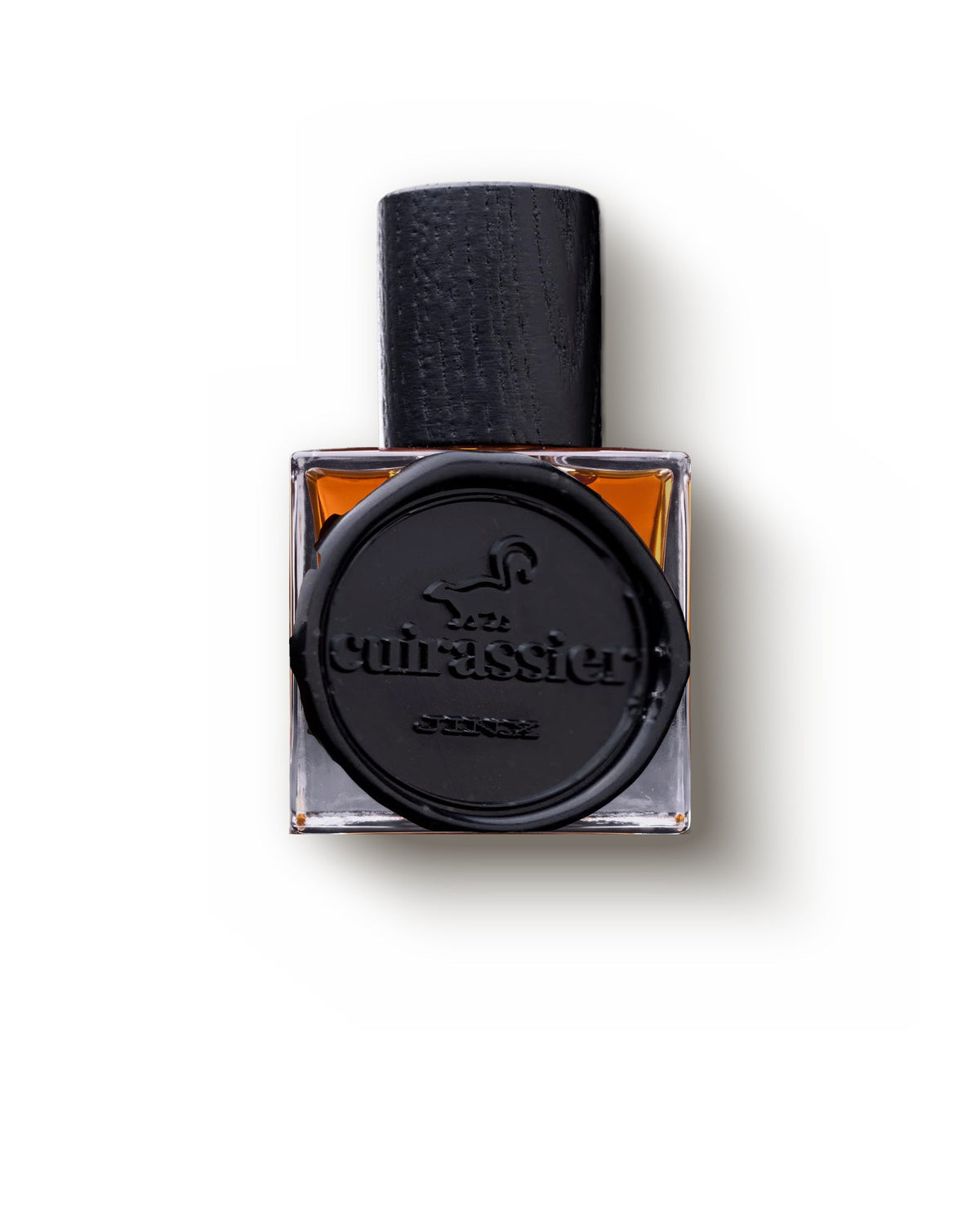
Jinx
Cuirassier
The Story
Cuirassier is a 2025 leather from JINX, made by Arthur Clayton Emrick, a mostly self-taught perfumer who runs the house from a refurbished restaurant in Canandaigua, New York. Bottled at 41% Extrait de Parfum, it sets vintage French cuir against modern Arabian leather. JINX has since moved it to its archive, sold out in every size.


Leather
A jacket with some miles on it
Tanned hide and birch tar, dry, smoky, a bitter rasp and tobacco under it. Sometimes new and lacquered, like a car interior; sometimes worn soft, like suede gloves gone thin. Either way, it smells used.


Woody
Dry grain of cut timber
The smell of cedar shavings, sandalwood, and dry vetiver roots, a sanded, resinous warmth with a faint pencil-box rasp. It feels grounded and composed, the quiet backbone that makes a scent read as serious and lasting.


Animalic
Skin, fur and something not quite tame
A raw, body-warm muskiness that reads of skin, hair and fur, sometimes sweet and powdery, sometimes sharp and faintly feral. At its best you cannot tell where the perfume stops and the wearer starts. At its strongest, it is the reason some people back away.


Smoky
Charred wood and rising embers
The dry, charred scent of burning wood, smoldering incense, and lingering ash, sometimes tarry, sometimes wispy and gray. It feels brooding and atmospheric, conjuring a dying fire and a cool current of air carrying its last breath.


Earthy
Damp soil after the rain
The mineral smell of wet ground, and of beets pulled straight from the dirt with the soil still on them. Cool, raw and faintly bitter, it grounds a fragrance with the dark, humid breath of the forest floor.


Honey
golden sweetness with animal warmth
A thick, waxy sweetness with a faintly animalic, almost leathery undertone beneath the nectar. It hums warm and skin-close, comb-fresh florals on top and something darker and stickier underneath, closer to the hive itself than to anything poured from a jar.


Powdery
Soft hush of dressed skin
A velvety, slightly dry softness of iris root, violet, and fine talc, like face powder or clean linen warmed by skin. It feels intimate, refined, and nostalgic, blurring a fragrance into a gentle, cushioned haze.


Vintage Violet
Powdery purple petals that vanish as you reach
What it is
Almost no violet in perfumery comes from violets. The flower yields so little oil that it is hardly produced any more, so the note is built from ionones, aroma-chemicals first made in a lab in the 1890s.
How it smells
Soft, cool and powdery, with a sugar-dusted candied sweetness and a thin green wetness behind it. It reads tender and nostalgic: Parma violet sweets, face powder, petals crushed in a pocket.
In perfumery
In the heart it does something unusual: it takes the sugar out of sweetness and leaves powder behind. Iris, rose, leather and almond all bend toward it, and violet soliflores wear it like an old makeup box.
Good to know
Ionones saturate the receptors fast, so the scent seems to vanish, then return as your nose recovers: perfumery's textbook case of olfactory fatigue. Violet leaf is another material entirely, green and cucumber-cool.


Honey
Beeswax and dried fruit turning faintly feral
What it is
Bees concentrate flower nectar into a syrup that smells of whatever they foraged. Raw honey resists clean extraction, so the note in a bottle is nearly always built from beeswax absolute and aroma chemicals.
How it smells
Thick and golden, sticky with dried fruit and warm wax, and never quite polite. Under the sweetness runs something animal, closer to skin than to a jar. Push the dose and it turns leathery.
In perfumery
A heart-to-base warmth that rounds tobacco, orange blossom, immortelle and leather, softening their edges while smuggling in body heat. Orientals use it to make sweetness feel lived-in rather than confected.
Good to know
Most of that feral edge is one molecule, phenylacetic acid, which smells of honey and stale sweat at once and edges toward civet. Overdose it and the perfume goes barnyard, so perfumers weigh it in fractions.


Currant
Tart cassis with a wild, animalic snarl
What it is
Perfumery mostly ignores the berry. The material that matters is cassis bud absolute, extracted from the sticky, resinous leaf buds of the shrub, usually propped up with sulphur molecules that carry the fruit's tart snap.
How it smells
Sharp, tart, unmistakably purple, then something feral cuts across it: a green, leafy, faintly sweaty pungency that sits closer to cat than to fruit. Ripe berry with a growl behind it.
In perfumery
A top note with claws. It cuts through sweetness, puts an edge on rose, and gives a fruity-floral something to push against. The classic chypre opening starts here, and it still jolts open modern fruity compositions.
Good to know
The catty edge comes from thiols your nose can catch at parts per trillion, the same family behind tomcat spray and a glass of Sauvignon Blanc. Perfumers dose cassis in drops, not millilitres.


Lily of the Valley
Spring's white bell, rebuilt molecule by molecule
What it is
Tiny white bells on a shade-loving woodland perennial, and one of perfumery's great frustrations: the flower gives up no usable oil. For decades muguet was built from scratch, on hydroxycitronellal and Lyral, rather than taken from the plant.
How it smells
Cool, green and wet: white petals, crushed stem sap, rain. It never goes heady, staying crystalline where jasmine would thicken. The drydown turns soft and clean, faintly soapy, with a last lemony-green glow.
In perfumery
In the heart it works like a window opening: it lifts rose, jasmine and lilac and puts green sparkle into aldehydic bouquets. The great mid-century soliflores were built around this accord, and it still brightens most spring florals.
Good to know
Every part of the plant is poisonous. No still or solvent ever drew scent from those bells, and a first commercial extract appeared only in 2021; by then the Lyral ban had already forced perfumers to rebuild it.


Iris
Cool powdered earth from a patiently aged root
What it is
Perfumery iris comes not from the flower but from the root. The dug rhizomes are dried and left to age three to five years while the aromatic irones form, then ground and steam-distilled into a waxy orris butter.
How it smells
Cool, powdery and rooty: violet, suede and fresh-sawn wood dusted with face powder. Underneath sits a damp mineral earthiness, a faint carrot sweetness, a buttery softness. It feels more texture than perfume, and it stays quiet on skin.
In perfumery
Nothing else gives a blend that cool, powdered restraint. It steadies chypres and florals, takes the shine off rose and violet, and lends sandalwood and ambrette a velvet finish. Iris makes a perfume behave.
Good to know
A tonne of dried, aged rhizome yields about two kilograms of butter. Add the years of waiting before it can even be distilled and you see why real orris turns up in so few bottles.


Rose
Dewy sweetness over a green, peppery bite
What it is
Most perfumery rose is one of two: damascena from Bulgaria and Turkey, centifolia from Grasse. Whole blossoms are picked by hand from before sunrise until about ten thirty, then distilled into otto or solvent-extracted into absolute.
How it smells
Fresh, honeyed, green at the edges, with something dewy still on it. Spice and fruit sit underneath, and in the absolute a jammy darkness. Otto opens crisp and bright; absolute is warmer, smokier, closer to skin.
In perfumery
Rose behaves less like one note than a whole palette. It carries a perfume alone or vanishes into a chypre, turns dark against oud and patchouli, goes powdery beside violet, and holds a floral heart together.
Good to know
The two extractions are not the same bargain. Otto takes three to four thousand kilograms of blossoms to yield one kilogram of oil. Absolute, pulled out with solvent, gets there on roughly a seventh of the flowers.


Patchouli
Damp earth and dark wood after rain
What it is
Nobody guesses mint, but that is the family: a leafy bush whose leaves are dried and left to cure, close to fermenting, before distillation pulls out an oil thick and dark as syrup.
How it smells
Wet soil, forest floor, an old cellar, with a winey sweetness underneath. Young oil can come at you sharp and green, almost camphorous. Aged oil goes the other way, into chocolate and leather, and stays put for hours.
In perfumery
Almost nothing holds a composition down like it. Chypres and orientals are built on that anchor, and a few drops under rose, vetiver or labdanum will hold the whole thing on skin for hours.
Good to know
Nineteenth-century Kashmiri shawls travelled packed in dried patchouli leaves to keep moths off, and Europeans learned to tell a real one by smell alone. The oil improves with age, which almost no essential oil does, mellowing like wine.


Leather Accord
Tanned hide, smoke and animal warmth
What it is
There is no leather essential oil. Perfumers rebuild the smell from birch tar and cade, smoky distilled woods, plus styrax and labdanum resins, isobutyl quinoline and safraleine-type molecules, echoing the tannins and oils once used to cure hides.
How it smells
Smoky, dry and animalic, ranging from supple new suede to tarry old saddle. Birch-tar versions read sooty and phenolic, almost campfire and band-aid; softer suede accords turn powdery, floral and skin-warm.
In perfumery
A base note that lends spine and a carnal edge. It does its best work under rose and violet, alongside tobacco and oud, and a floral heart set on leather turns unmistakably human.
Good to know
The genre was born in Russia, where boots and book bindings were treated with birch tar, and Russian leather still means that smell. The real tanning oils were mostly restricted on safety grounds, so today's leathers are reconstructions.


Vintage Birch Tar
Smoke, leather and campfire distilled from bark
What it is
Birch bark cooked without oxygen until it breaks down into a black, sticky tar. What perfumery uses is that tar redistilled under vacuum, which takes out the carcinogens the crude tar carries.
How it smells
Smoke first, and a lot of it: tar, charred wood, creosote, embers. Under that runs old leather, faintly medicinal, the birch-tanned smell of Russia leather, with a sweet balsamic thread that keeps it from being purely grim.
In perfumery
Nearly every leather accord in perfumery starts here. A base note with real force, it pairs with labdanum and cade to build hide, and a drop under florals turns them smoky. It does not do subtle.
Good to know
Two hundred thousand years ago, Neanderthals were heating birch bark to make glue. It is the oldest manufactured adhesive we know of, and it is still in the perfumer's cabinet, doing a different job.


Castoreum
Smoky beaver hide with an aspirin edge
What it is
Territory marking, essentially. The secretion from a beaver's castor sacs, dried by trappers and worked into a tincture or absolute, though what you smell in almost any bottle today is the synthetic version.
How it smells
Dark, tarry leather with a medicinal edge, like birch smoke off a wet coat. Underneath there is sweetness: dried fruit, hay, a smear of vanilla. Dilute it far enough and the growl turns to warm suede.
In perfumery
It anchors the base and holds everything above it: the hide of a leather scent, the smoke of a Russian-leather style, the long tail of an old oriental. It keeps company with birch tar, labdanum, oakmoss and tobacco.
Good to know
Beavers live on willow and poplar bark, thick with salicin, the compound behind aspirin, and it carries through: a cool, almost medicinal thread under all that leather. It has long been a flavouring material as well.


Cambodian Oud
Dried plum and caramel over soft leather
What it is
Oil distilled from Aquilaria crassna heartwood, which darkens with resin only once a mould infection takes hold. Cambodi is the trade name for the sweet, fruity style that the wild forests of Cambodia first made famous.
How it smells
Dried plum and dark fruit jam up front, sliding into caramel over a soft, leathery warmth with scarcely any animal edge. The dry-down turns bright and faintly tangy, a clean sweet woodiness that clings to cloth.
In perfumery
It works from the heart down into the base, and its sweetness makes it one of the easier ouds to blend. Sandalwood and rose take it readily, and it slips into gourmand builds where a harsher oud would clash.
Good to know
Cambodi caught on in the 1970s as a sweeter alternative to Indian oud. Most oil sold in that style comes from planted crassna, and its character shifts with the tree's age and the distiller's hand. Patch-test the pure oil first.


Mysore Sandalwood
Creamy heartwood, pulled up roots and all
What it is
Harvesting means uprooting: the oil runs richest in the roots, so in Karnataka the whole tree comes out of the ground. Heartwood begins forming at five to ten years, but a heart worth taking is closer to thirty.
How it smells
Cream and warm milk over sawn wood, with a sour-buttery edge that turns almost lactic. Something rosy and balsamic sits underneath. It never sharpens and never smokes, just settles on skin, quiet and close, for hours.
In perfumery
Perfumers use it to hold a blend together: it rounds sharp edges and makes everything above it last longer. Rose, jasmine, violet and oud all soften against it. The great vintage milky-woody orientals are built on it.
Good to know
India cut its own supply almost to collapse. Standing trees and sales now fall under government licence and auction, and genuine Mysore oil has grown scarce, so most sandalwood you meet is Australian plantation wood or synthetic Javanol.


Oakmoss
The damp green soul of the forest floor
What it is
Not a moss at all, but a lichen, scraped off oak and other deciduous bark across temperate Europe, Russia and North Africa. Solvents turn the harvested growth into a dark, viscous concrete, then the absolute perfumers actually use.
How it smells
Wet stone, damp bark and something inky and leathery underneath, dry and faintly bitter. This is not fresh green: it is the cool floor beneath old trees after rain has soaked the ground.
In perfumery
The backbone of the chypre: a base note that gives a fragrance its shadow and its spine, classically under bergamot, beside labdanum and patchouli. Anything described as mossy, vintage or green-masculine is usually leaning on it.
Good to know
Oakmoss carries two allergens, atranol and chloroatranol, potent enough that the EU banned them from cosmetics outright. Perfumers use stripped grades now, but it was the earlier cap on the extract that changed how the classic chypre smells.


Cedar
Dry sharpened pencils and sun-warmed timber
What it is
Most perfumery cedar is not cedar. It is juniper, from the Virginia and Texas trees, steam-distilled from chips and sawmill shavings. True Atlas cedar exists and is used, but it is the smaller source.
How it smells
Freshly sharpened pencils, then the inside of a cedar-lined closet. Atlas leans warm, smoky and balsamic; Virginia reads sharper and cleaner. Either way it settles into soft sawdust warmth and stays there for hours.
In perfumery
A workhorse. It gives woody compositions their backbone and holds lighter materials in place, sitting comfortably beside vetiver, rose, citrus and amber. Its plummy-woody core runs through most modern unisex woods.
Good to know
Egyptian embalmers poured cedar oil into the body rather than burning it, and cedar timber lined the tombs and coffins they meant to outlast them. The true cedars and the junipers share a name through smell, not lineage.


Costus
Warm hair and skin, animalic and unsettling
What it is
A Himalayan thistle whose roots, kuth in India, are dried and aged, then steam-distilled or solvent-extracted into a thick, dark oil that smells almost nothing like a plant.
How it smells
Unwashed hair, scalp, worn wool, with a greasy earthiness under it. Some people find a dry orris-violet facet beneath the funk; others say wet dog or old leather. Dense, slow to fade, and faintly sweet at the end.
In perfumery
In the base it made a chypre or a leather smell like it had already been worn by someone. Perfumers reach now for safe reconstructions such as Costus Oliffac to get the same hair-like signature.
Good to know
Perfumery gave it up in 2006, when the natural oil was ruled too strong a skin sensitiser to use. The plant is protected and critically endangered in any case, overharvested for the very roots that made it interesting.
Fragrance Character
It opens soft and purple, violet over tart currant and a little honey. As the rose and iris thin, birch tar and leather move forward, smoky and smooth rather than raw, in the Cuir de Russie tradition. The drydown turns tarry and animalic, with castoreum sitting under dry oakmoss and cedar.


Longevity
how long it stays on skin
The hourglass reads wear time: how many hours the fragrance keeps speaking before it fades. A bar that barely leaves the start means a few fleeting hours. One that runs the full length carries from morning into evening. Treat it as typical, not promised. Oily skin holds scent far longer than dry.


Sillage
the size of its scent trail
Sillage is French for a ship's wake, and that is exactly what this measures: how much of the scent reaches the room instead of staying on you. Low is a whisper only close friends catch. Enormous fills the room, then keeps filling it after you leave.


Experimental
Built to provoke, not to please
Some perfumes are made to be liked. These are made to be argued about: inky tar, hot rubber, fruit on the turn, metal and fur where you expected flowers. The coin glows for a scent that provokes and dims for one that plays it safe, which is sometimes the point.


Office
Polished, and never louder than the room
Scent is manners in a shared room. At this range it should reach the person across the desk and stop there: tidy citrus, soft musk, pale woods, all of it reading competent and considerate. A glowing coin means nobody has to mention it. A dim one means it travels.


Evening
After dark, when it deepens
Dinner, drinks, the night that runs long. Low light is where ambers, resins and smoky woods stop being polite, and where a plush floral finally blooms. A glowing coin means it is waiting for exactly this hour. A dim one means it did its best work in daylight.


Romantic
Close enough to be felt
A fragrance can hum against skin instead of announcing itself across a table. That is the register here: creamy florals, vanilla, soft musk, a thread of spice, warm enough to make someone lean in. The coin glows when a scent sets that mood and dims when it is more practical than seductive.


Formal
Quiet authority in a dressed-up room
A wedding, a ceremony, a room where everyone has thought about their shoes. What works here is structure, not volume: smooth woods, disciplined florals, soft leather. A glowing coin means it holds its posture all evening. A dim one means it is too casual for the room.


Casual
Easy comfort for unhurried days
Errands, coffee, a slow Saturday with nowhere to be. Nothing here has to impress anyone, so the fit is soft and easy: fresh citrus, light woods, a little warmth off the skin. A glowing coin says yes to all that. A dim one means the fragrance is asking for a bigger night.


Day to Night
where its mood naturally falls
A bar running from sun to moon, reading the hour the fragrance was made for. The more of it that stays gold, the more the scent belongs to daylight and open air. The further the blue reaches back toward the sun, the deeper and warmer it turns: evening, candlelight, low rooms.


Winter
Warmth that carries through cold air
Cold air mutes a fragrance and slows it down, which is why winter belongs to the dense and the warm: resin, smoke, vanilla, leather, ambered spice. The bar reads how well this one pushes back, glowing against the chill instead of thinning out in it.


Spring
Fresh blooms in mild, rising warmth
Mild, humid air lifts a light composition, so the season belongs to dewy florals, green stems, soft powder and citrus you can see through. Alive rather than heavy. The further the green runs along the bar, the more comfortably this one wears in that weather.


Summer
Bright and airy in real heat
Heat does the projecting for you, which is why the wrong perfume turns unbearable by noon. What survives is cool and breathable: sharp citrus, salt air, aromatic herbs, water. Things that refresh instead of cloy. A short bar here means save it for cooler months.


Fall
Spiced warmth for cooling days
As the air cools, the rich materials stop smothering and start reading clearly: dry woods, warm spice, tobacco, amber, fruit gone golden. It is the season perfume turns contemplative. The bar fills according to how naturally this one settles into crisp, cooling days.
Best Worn
Cool autumn and winter evenings and mild spring nights, for a late dinner, a formal event or time alone at home. Best on someone who already loves tar and animalic leather.
Выберите параметры
Атмосфера


Нос
Arthur Clayton Emrick
Основатель и парфюмер
Парфюмер, стоящий за JINX, который собирает ароматы уже почти два десятилетия. По большей части он самоучка, увлечённый химией и экспериментами, и ведёт JINX в переоборудованном ресторане в Канандейгуа, штат Нью-Йорк.
Дом

Парфюмерия с удом в центре и животным характером с севера штата Нью-Йорк, где каждая дистилляция описана по виду, региону и времени варки.
За Jinx стоит Arthur Clayton Emrick, по большей части самоучка, который работает в отреставрированном бывшем ресторане в Канандейгуа, штат Нью-Йорк, и теперь за рабочим столом он уже не один. Большую часть каталога составляет дистиллированное масло уда одного происхождения, зелёное и медицинское, прежде чем оно уходит в животные тона. Составные ароматы плотные, с винтажным уклоном, а синтетика указывается на странице.
- Происхождение
- Канандейгуа, штат Нью-Йорк, США
- Известен благодаря
- Уд одного происхождения и анималистика
Похожие ароматы
Вам также может понравиться