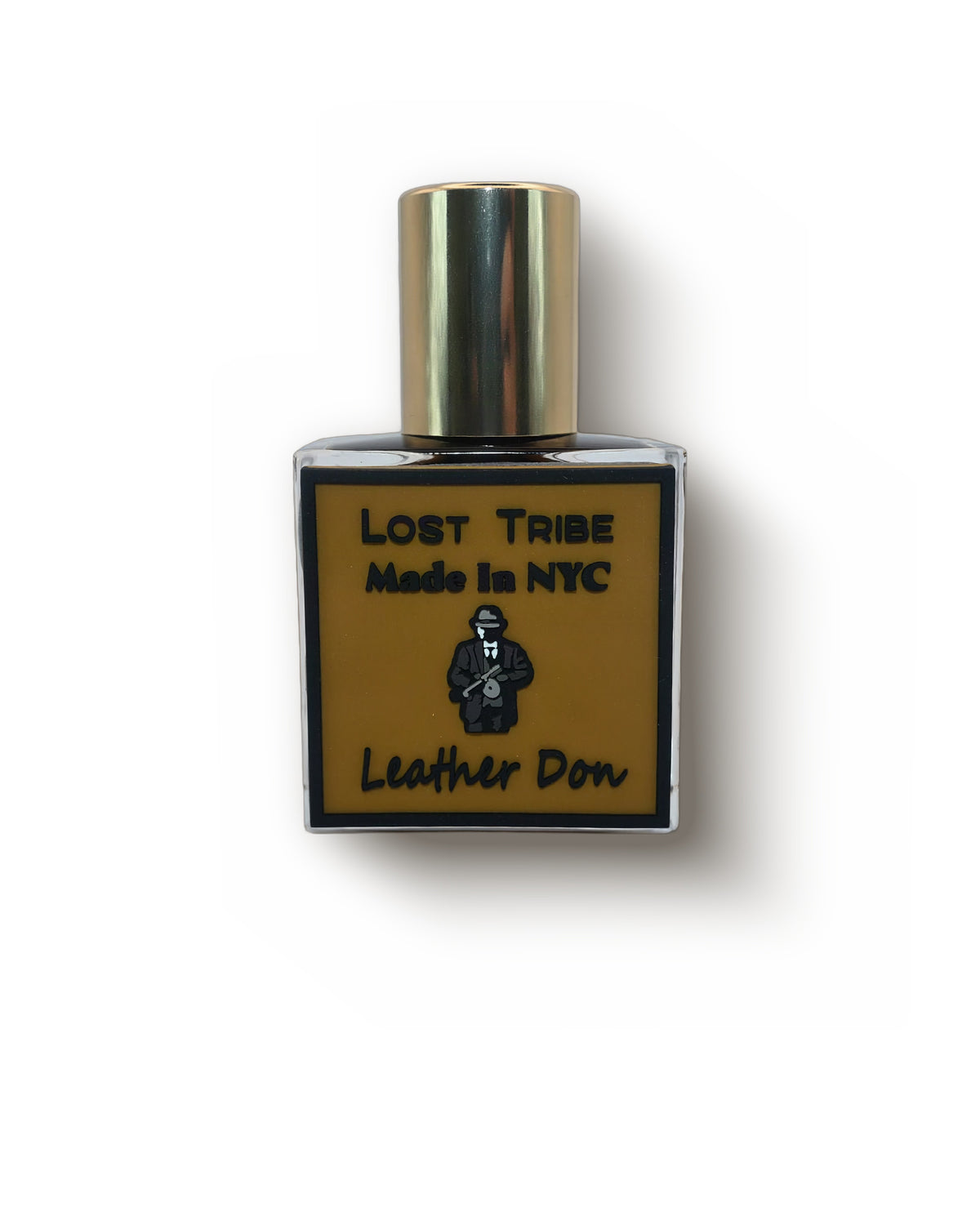
Lost Tribe
Leather Don
The Story
Leather Don was born from a Lost Tribe community contest, where supporters submitted the scents they dreamed of. The winning concept came from John Munro. The result is a leather perfume made for warm weather, built around a custom light leather accord that uses 13 natural ingredients on its own.


Leather
A jacket with some miles on it
Tanned hide and birch tar, dry, smoky, a bitter rasp and tobacco under it. Sometimes new and lacquered, like a car interior; sometimes worn soft, like suede gloves gone thin. Either way, it smells used.


Citrus
First bright zest of morning
The juicy, rind-snapping brightness of lemon, bergamot, and orange peel, tart and effervescent with a clean bitter edge. It opens a scent with instant lift and sparkle, fresh and energizing, evaporating quickly like sunlight on water.


Aromatic
Crushed herbs in cool air
The green, camphorous coolness of lavender, rosemary, sage, and thyme, like herbs bruised between the fingers. It feels clean, invigorating, and a touch austere, the crisp backbone of a classic barbershop freshness.


Woody
Dry grain of cut timber
The smell of cedar shavings, sandalwood, and dry vetiver roots, a sanded, resinous warmth with a faint pencil-box rasp. It feels grounded and composed, the quiet backbone that makes a scent read as serious and lasting.


Oud
What a tree makes when it is wounded
A dense, resinous wood that smells warm and slightly medicinal, with a leathery, animal-tinged smokiness and a sweet, almost barnyard funk underneath. It feels ancient and brooding, wrapping the skin in something thick and quietly powerful.


Animalic
Skin, fur and something not quite tame
A raw, body-warm muskiness that reads of skin, hair and fur, sometimes sweet and powdery, sometimes sharp and faintly feral. At its best you cannot tell where the perfume stops and the wearer starts. At its strongest, it is the reason some people back away.


Mossy
inky green shade under old oaks
The damp, inky smell of oakmoss and treemoss, lichens rather than true mosses, gathered from shaded oak and fir bark, faintly bitter with a cool woody depth. It grounds a fragrance in forest-floor shadow, lending an old, melancholy elegance that feels like breathing in a rain-soaked wood.


Lemon
Cold yellow zest snapping into bright sun
What it is
Squeezed, not distilled: the colored rind is pressed and scraped until the glands give up their oil. Italy and California grow most of what perfumery uses. The tree's white blossom is a different note entirely.
How it smells
Tart, green and fizzing, all cold rind and mouth-watering sourness, with a faint sweet pith underneath and a waxy edge from the peel itself. Enjoy it fast: it is gone within minutes.
In perfumery
It powers the eau de cologne tradition, working with bergamot, neroli and petitgrain to open a fragrance in full sunlight. Because it burns off so fast, perfumers reinforce it with citral.
Good to know
Cold-pressed lemon carries furocoumarins that leave skin liable to burn in sunlight, so perfumers often reach for a stripped grade. It also spoils in the bottle, oxidizing toward turpentine, which is why citrus fragrances are hard to stabilize.


Eucalyptus
Sharp medicinal vapor that clears the head
What it is
Australian trees whose leaves carry so much oil that a hot day makes the whole grove smell of them. Steam-distil the leaves and you get an oil built almost entirely on one molecule: eucalyptol.
How it smells
Cool and penetrating, a sharp medicinal bite that seems to physically open the sinuses. Green, faintly woody facets sit under the ice. It reads clean to the point of clinical, then fades to dry leaf.
In perfumery
Perfumers buy it for one thing: the cooling rush at the top of a fragrance. It lifts lavender, rosemary and mint, sharpens green and marine accords, and gives aromatic fougeres and spa-style scents their bracing edge.
Good to know
The oil that scents the air on a hot day is the same oil that helps a bushfire run through the canopy. It is just as forceful in a formula: one drop can take over a blend.


Bergamot
Sparkling citrus light with a bitter edge
What it is
Nobody eats bergamot. It is sour, seedy and disappointing, and almost the whole world's supply grows on one strip of Calabrian coast, farmed purely for the oil pressed cold from its green rind.
How it smells
Zest and green light in the first second, then something rounder than lemon: a floral, tea-like smoothness sitting on a faintly bitter warmth. It burns off fast. What stays behind is a quiet, slightly spiced hum.
In perfumery
It defines eau de cologne, and sits on top of nearly every fougère alongside lavender and oakmoss. Perfumers want the first bright second it gives, and the oil is also what makes Earl Grey smell like Earl Grey.
Good to know
The thing that makes it sparkle can also burn. Bergamot carries bergapten, which leaves skin hypersensitive to sunlight, so perfumers either keep the dose low or reach for a grade with the molecule stripped out.


Tarragon
Named for a dragon, tastes of liquorice
What it is
A daisy-family herb whose leaves and flowering tops are steam-distilled into an oil loaded with estragole, the molecule behind its anise streak. Central Asia gave it to the world and France made it worth cooking with.
How it smells
Green and herbaceous with a sweet anise lift, fennel and liquorice crossed with fresh-cut grass. A peppery, basil-like coolness runs underneath. Bright and watery close up, then a soft warm-herbal hum, never the sugary heaviness of pure anise.
In perfumery
A top note bringing green freshness and a whiff of the kitchen, set beside lavender, citrus and clary sage in aromatic fougeres. Mid-century citrus colognes opened on it and fresh colognes still do.
Good to know
Estragon traces to a word for little dragon, after the coiled roots or an old belief it cured snakebite. French tarragon sets sterile seed and spreads only from cuttings; the Russian sort grows from seed and barely smells.


Coriander Seed
Warm seed spice with a lavender whisper
What it is
The plant whose leaves taste like soap to some people dries into something else entirely. Coriander seed is the ripe fruit of that same herb, harvested, dried and steam-distilled into a warm, sweet-spiced oil.
How it smells
Bright and dry at first, peppery with a faint citrus lift, then a soft woody body underneath. There is an unexpected lavender edge to it, and a nutty, gingerbread warmth. Spicy without any sharpness.
In perfumery
Top to heart, and mostly a blender: it smooths seams in colognes, chypres, fougeres and orientals, freshening citrus, warming lavender, rounding woods. Plenty of the classic citrus colognes open on it.
Good to know
Most of the oil is a single molecule, linalool, the one that makes lavender smell like lavender. That is where the floral coolness in a seed spice comes from, and why coriander bridges herbs and flowers so easily.


Light Leather Accord
Tanned hide, smoke and animal warmth
What it is
There is no leather essential oil. Perfumers rebuild the smell from birch tar and cade, smoky distilled woods, plus styrax and labdanum resins, isobutyl quinoline and safraleine-type molecules, echoing the tannins and oils once used to cure hides.
How it smells
Smoky, dry and animalic, ranging from supple new suede to tarry old saddle. Birch-tar versions read sooty and phenolic, almost campfire and band-aid; softer suede accords turn powdery, floral and skin-warm.
In perfumery
A base note that lends spine and a carnal edge. It does its best work under rose and violet, alongside tobacco and oud, and a floral heart set on leather turns unmistakably human.
Good to know
The genre was born in Russia, where boots and book bindings were treated with birch tar, and Russian leather still means that smell. The real tanning oils were mostly restricted on safety grounds, so today's leathers are reconstructions.


Koh Kong Oud
Oud that smells like jam, not barnyard
What it is
Cambodia's Koh Kong forests grow agarwood the way other regions cannot: sweet by nature. This is real distilled oil from resin-soaked crassna heartwood, aged for years, never a rebuilt oud accord.
How it smells
Figs, plums, dates and berry jam, with honey trailing behind and a flicker of strawberry and vanilla. Underneath, creamy spice and damp forest soil. Almost none of the fecal funk other ouds wear.
In perfumery
Perfumers reach for Koh Kong when they want depth without shock. It rounds out rose, saffron, amber and resins instead of snarling at them, and a single dab carries strong for hours on skin.
Good to know
The jam is a modern style. Older or raw Koh Kong material reads drier and woodier, so that famous sweetness is as much about the ageing as the forest. Wild slow-aged stock is scarce. Apply by the drop.


Castoreum
Smoky beaver hide with an aspirin edge
What it is
Territory marking, essentially. The secretion from a beaver's castor sacs, dried by trappers and worked into a tincture or absolute, though what you smell in almost any bottle today is the synthetic version.
How it smells
Dark, tarry leather with a medicinal edge, like birch smoke off a wet coat. Underneath there is sweetness: dried fruit, hay, a smear of vanilla. Dilute it far enough and the growl turns to warm suede.
In perfumery
It anchors the base and holds everything above it: the hide of a leather scent, the smoke of a Russian-leather style, the long tail of an old oriental. It keeps company with birch tar, labdanum, oakmoss and tobacco.
Good to know
Beavers live on willow and poplar bark, thick with salicin, the compound behind aspirin, and it carries through: a cool, almost medicinal thread under all that leather. It has long been a flavouring material as well.


Carnation
A clove-peppered bloom with old-fashioned spice
What it is
Almost nobody extracts the real flower; the yield is not worth the trouble. So perfumers build carnation instead, out of the clove molecules eugenol and isoeugenol, propped up with rose and ylang until the bloom appears.
How it smells
Dry, peppery heat first, then a powdery rose sweetness underneath. There is a green snap of stem up top, and as it settles the whole thing turns waxy and honeyed, a flower from a grandmother's dressing table.
In perfumery
A heart note, and the entire point of a carnation soliflore: Caron built Bellodgia on it. Elsewhere it slots between rose and clove, adding spice to a floral without tipping the whole thing into dessert.
Good to know
The clove in it is not a metaphor. Carnation and clove run on the same molecule, eugenol, and once limits on eugenol tightened over skin sensitization, the old spicy carnations became much harder to dose.


Sage
Silver-leaf herb, dry and faintly camphorous
What it is
Two plants answer to sage. Common sage gives the sharp, medicinal oil; clary sage a softer one, plus an ambery absolute. Both are Mediterranean shrubs in the mint family, steam-distilled from silvery leaves and flowering tops.
How it smells
Green and dry, with a cool camphor bite that reads almost minty. Common sage is the sharper, more medicinal one. Clary softens into tea, amber and a faint musky tobacco. Savory rather than sweet, all of it.
In perfumery
The herbal lift under a fougere is usually this. Sage sits high with lavender, citrus and geranium; clary drops lower, an ambery roundness that holds the drydown together and shows up in salty wood-sage accords.
Good to know
Clary sage is why modern amber needs no whale. Its sclareol is what chemists convert into Ambrox, the molecule that replaced most ambergris: a field herb standing in for something washed up at sea.


Hay
Sun-dried meadow grass bottled at golden hour
What it is
Cut meadow grass, clover and sweet vernal, left in the sun. Hay's sweetness is almost entirely one molecule, coumarin, and perfumery takes it either by extracting the dried grasses or by building the molecule outright.
How it smells
Warm, sweet and dry, a sunlit barn loft: cut grass tipping toward almond and vanilla, with a nutty, tobacco-like underside. Green and golden at first, then soft powdery warmth. Mown lawn left to bake all afternoon.
In perfumery
A heart-to-base note handing rustic, sun-warmed character to fougeres, chypres and tobacco blends, and the bridge from green tops to warm bases. Lavender, tobacco, oakmoss and tonka gather round it. The fougere family rests on this accord.
Good to know
Coumarin came out of the tonka bean before anyone learned to build it, one of perfumery's first aroma-chemicals. Grass gives it up only as it dries, which is why hay smells sweeter than a living field.


Lavender
Cool herbal blue from a sunlit hillside
What it is
The flowering tops are cut at peak bloom and go straight to the still, the purple spikes giving up a pale oil. Solvent extraction yields a darker absolute instead. Provence and Bulgaria supply most of it.
How it smells
Sharp and green at first, almost minty, with a cool camphor lift over soft floral sweetness. The dry-down warms into hay, faint vanilla and a powdery calm. True lavender is rounder and sweeter than the lavandin hybrid.
In perfumery
Set it against oakmoss, coumarin and tonka and you have a fougere, the barbershop structure behind countless aromatic masculines. Lavender runs from the top into the heart, cooling bright florals and softening citrus colognes.
Good to know
Those Provence fields the tourists photograph are mostly lavandin, a sterile hybrid that yields far more oil per hectare. True lavender is retreating uphill: a bacterial disease carried by sap-sucking insects has pushed plantings to cooler altitudes.


Carrot Heart
Earthy roots and powdery violets from the field
What it is
Not the root. This is the dried seed of wild carrot, Queen Anne's lace, grown around the Mediterranean and steam-distilled for hours into an oil that runs more than half carotol.
How it smells
Dusty and earthy, like soil shaken off a root, and then the surprise: violets. Trace ionones push a powdery iris sweetness up through the dirt, and it dries soft, close to ambrette.
In perfumery
Perfumers use it in the heart as the affordable stand-in for orris: powdery, rooty, faintly like face powder. It sits with violet, ambrette and oakmoss in chypres and in anything built around iris.
Good to know
The carrot on your chopping board is the same species, bred over centuries for a fat, sweet root. Nobody was breeding for the seed, and the seed is the half that smells of iris and old powder compacts.


Tobacco
Dried leaf curing into honey and hay
What it is
Nothing is burning. The leaf is cured and fermented first, then solvent-extracted into a dark, sticky absolute, and what comes out smells of hay and honey rather than of an ashtray.
How it smells
Warm, dry, sweet: cured hay and pipe tobacco with honey, dried fruit and a trace of cocoa behind it. A green, leathery bite at the start softens into something ambery and balsamic, sometimes with a powdery floral edge.
In perfumery
It sits from the heart down, where vanilla, tonka, honey and leather all cling to it. Give it vanilla and you get the sweet, edible kind; give it leather and spice and you get the dark, dry kind.
Good to know
A living tobacco plant smells sharp and green. Everything sweet in the absolute is made during curing and fermentation. Authentic absolute is costly and restricted in some markets, so many tobacco notes are rebuilt from coumarin and hay.


Hindi Oud
The fermented, leathered, animalic king of agarwood
What it is
Agarwood from Assam, and collectors call it Hindi. What makes an oud Hindi is not the tree but the method: it soaks and ferments for days, then goes into a copper still with the water it rotted in.
How it smells
The opening is not pretty: barnyard, stable floor, frankly fecal. Give it twenty minutes. It resolves into buttery leather, dry hay, black pepper and clove, then a deep smoky base. Aged oils add chai and dried fruit.
In perfumery
Every other oud is measured against this one. The intensity that sends newcomers running is exactly what collectors pay for. Rose is the classic partner, the Arabian mukhallat, though in practice a Hindi oil is usually worn neat.
Good to know
Cambodi is sweet and honeyed, Borneo cool with pine, Thai medicinal. India alone owns the fermented register. Young, a Hindi hits hardest; ageing turns the funk to smooth leather. Loudness proves nothing: a badly cured oil shouts too.


Patchouli
Damp earth and dark wood after rain
What it is
Nobody guesses mint, but that is the family: a leafy bush whose leaves are dried and left to cure, close to fermenting, before distillation pulls out an oil thick and dark as syrup.
How it smells
Wet soil, forest floor, an old cellar, with a winey sweetness underneath. Young oil can come at you sharp and green, almost camphorous. Aged oil goes the other way, into chocolate and leather, and stays put for hours.
In perfumery
Almost nothing holds a composition down like it. Chypres and orientals are built on that anchor, and a few drops under rose, vetiver or labdanum will hold the whole thing on skin for hours.
Good to know
Nineteenth-century Kashmiri shawls travelled packed in dried patchouli leaves to keep moths off, and Europeans learned to tell a real one by smell alone. The oil improves with age, which almost no essential oil does, mellowing like wine.


Costus Root
Warm hair and skin, animalic and unsettling
What it is
A Himalayan thistle whose roots, kuth in India, are dried and aged, then steam-distilled or solvent-extracted into a thick, dark oil that smells almost nothing like a plant.
How it smells
Unwashed hair, scalp, worn wool, with a greasy earthiness under it. Some people find a dry orris-violet facet beneath the funk; others say wet dog or old leather. Dense, slow to fade, and faintly sweet at the end.
In perfumery
In the base it made a chypre or a leather smell like it had already been worn by someone. Perfumers reach now for safe reconstructions such as Costus Oliffac to get the same hair-like signature.
Good to know
Perfumery gave it up in 2006, when the natural oil was ruled too strong a skin sensitiser to use. The plant is protected and critically endangered in any case, overharvested for the very roots that made it interesting.


Cedar Atlas
Dry mountain wood, sweet balsam and warm resin
What it is
A true cedar, and a mountain one: it comes from the high Atlas ranges of Morocco and Algeria. The oil is steam-distilled from chips, offcuts and sawdust, largely what the lumber trade has already finished with.
How it smells
Warm and dry with a sweet balsamic core, lifted by something camphorous and faintly smoky over an earthy base. Sweeter and more resinous than the dry pencil-shaving bite of Virginian cedar. It dries down clean and tenacious.
In perfumery
A workhorse in the base, giving structure, dryness and something for the rest to hold onto. It sits under rose, vetiver, patchouli, oakmoss and labdanum, and it holds up chypre and woody oriental builds from underneath.
Good to know
Atlas cedar is endangered in its own range now, and the forests are shrinking. It is the rare case where the responsible material is the leftover one: sawmill waste, not a standing tree.


Oakmoss
The damp green soul of the forest floor
What it is
Not a moss at all, but a lichen, scraped off oak and other deciduous bark across temperate Europe, Russia and North Africa. Solvents turn the harvested growth into a dark, viscous concrete, then the absolute perfumers actually use.
How it smells
Wet stone, damp bark and something inky and leathery underneath, dry and faintly bitter. This is not fresh green: it is the cool floor beneath old trees after rain has soaked the ground.
In perfumery
The backbone of the chypre: a base note that gives a fragrance its shadow and its spine, classically under bergamot, beside labdanum and patchouli. Anything described as mossy, vintage or green-masculine is usually leaning on it.
Good to know
Oakmoss carries two allergens, atranol and chloroatranol, potent enough that the EU banned them from cosmetics outright. Perfumers use stripped grades now, but it was the earlier cap on the extract that changed how the classic chypre smells.
Fragrance Character
A bright, modern leather that keeps its depth without turning heavy. Lemon and eucalyptus open it cool and fresh over bergamot and tarragon. The light leather accord holds the centre, and rare Koh Kong oud from Cambodia, aged with real castoreum, gives it an animalic edge. Hindi oud, patchouli, cedar atlas and oakmoss close it.


Longevity
how long it stays on skin
The hourglass reads wear time: how many hours the fragrance keeps speaking before it fades. A bar that barely leaves the start means a few fleeting hours. One that runs the full length carries from morning into evening. Treat it as typical, not promised. Oily skin holds scent far longer than dry.


Sillage
the size of its scent trail
Sillage is French for a ship's wake, and that is exactly what this measures: how much of the scent reaches the room instead of staying on you. Low is a whisper only close friends catch. Enormous fills the room, then keeps filling it after you leave.


Experimental
Built to provoke, not to please
Some perfumes are made to be liked. These are made to be argued about: inky tar, hot rubber, fruit on the turn, metal and fur where you expected flowers. The coin glows for a scent that provokes and dims for one that plays it safe, which is sometimes the point.


Office
Polished, and never louder than the room
Scent is manners in a shared room. At this range it should reach the person across the desk and stop there: tidy citrus, soft musk, pale woods, all of it reading competent and considerate. A glowing coin means nobody has to mention it. A dim one means it travels.


Evening
After dark, when it deepens
Dinner, drinks, the night that runs long. Low light is where ambers, resins and smoky woods stop being polite, and where a plush floral finally blooms. A glowing coin means it is waiting for exactly this hour. A dim one means it did its best work in daylight.


Romantic
Close enough to be felt
A fragrance can hum against skin instead of announcing itself across a table. That is the register here: creamy florals, vanilla, soft musk, a thread of spice, warm enough to make someone lean in. The coin glows when a scent sets that mood and dims when it is more practical than seductive.


Formal
Quiet authority in a dressed-up room
A wedding, a ceremony, a room where everyone has thought about their shoes. What works here is structure, not volume: smooth woods, disciplined florals, soft leather. A glowing coin means it holds its posture all evening. A dim one means it is too casual for the room.


Casual
Easy comfort for unhurried days
Errands, coffee, a slow Saturday with nowhere to be. Nothing here has to impress anyone, so the fit is soft and easy: fresh citrus, light woods, a little warmth off the skin. A glowing coin says yes to all that. A dim one means the fragrance is asking for a bigger night.


Day to Night
where its mood naturally falls
A bar running from sun to moon, reading the hour the fragrance was made for. The more of it that stays gold, the more the scent belongs to daylight and open air. The further the blue reaches back toward the sun, the deeper and warmer it turns: evening, candlelight, low rooms.


Winter
Warmth that carries through cold air
Cold air mutes a fragrance and slows it down, which is why winter belongs to the dense and the warm: resin, smoke, vanilla, leather, ambered spice. The bar reads how well this one pushes back, glowing against the chill instead of thinning out in it.


Spring
Fresh blooms in mild, rising warmth
Mild, humid air lifts a light composition, so the season belongs to dewy florals, green stems, soft powder and citrus you can see through. Alive rather than heavy. The further the green runs along the bar, the more comfortably this one wears in that weather.


Summer
Bright and airy in real heat
Heat does the projecting for you, which is why the wrong perfume turns unbearable by noon. What survives is cool and breathable: sharp citrus, salt air, aromatic herbs, water. Things that refresh instead of cloy. A short bar here means save it for cooler months.


Fall
Spiced warmth for cooling days
As the air cools, the rich materials stop smothering and start reading clearly: dry woods, warm spice, tobacco, amber, fruit gone golden. It is the season perfume turns contemplative. The bar fills according to how naturally this one settles into crisp, cooling days.
Best Worn
Made for spring and summer. Wear it daily, to the office or on a casual warm evening, when you want leather with depth and character that never feels heavy.
Scegli le opzioni
L’atmosfera


Il Naso
Mathew Schmuelian
Fondatore e profumiere
Fondatore e profumiere di Lost Tribe, passato dal collezionare naturali artigianali alla macerazione dei propri muschi nel 2022; la sua prima uscita, Lost Tribe Hope You Like It, fu prodotta in circa sedici bottiglie. Ha composto Lost Tribe Sultry Sambac, Lost Tribe Smoky Bear e Lost Tribe Prince of Persia.
Altro da questo nasoNeon PalmsVanilla Waves V2 Extra MuskLost Lotus
La Maison

Tribù piccola, muschio vero, nessun compromesso, versato finché dura la scorta degli originali.
Lost Tribe crea fragranze che sembrano vissute e ad alto volume, quelle che arrivano prima di te e restano dopo che sei uscito. C'è una vena massimalista che attraversa tutta la maison, dalla frutta tropicale ebbra di sole alla vaniglia densa di resina fino all'oud raro costruito su Kinam invecchiato.
- Nota per
- Naturali massimalisti, Kinam invecchiato

Altri profumi Lost Tribe
Potrebbe piacerti anche